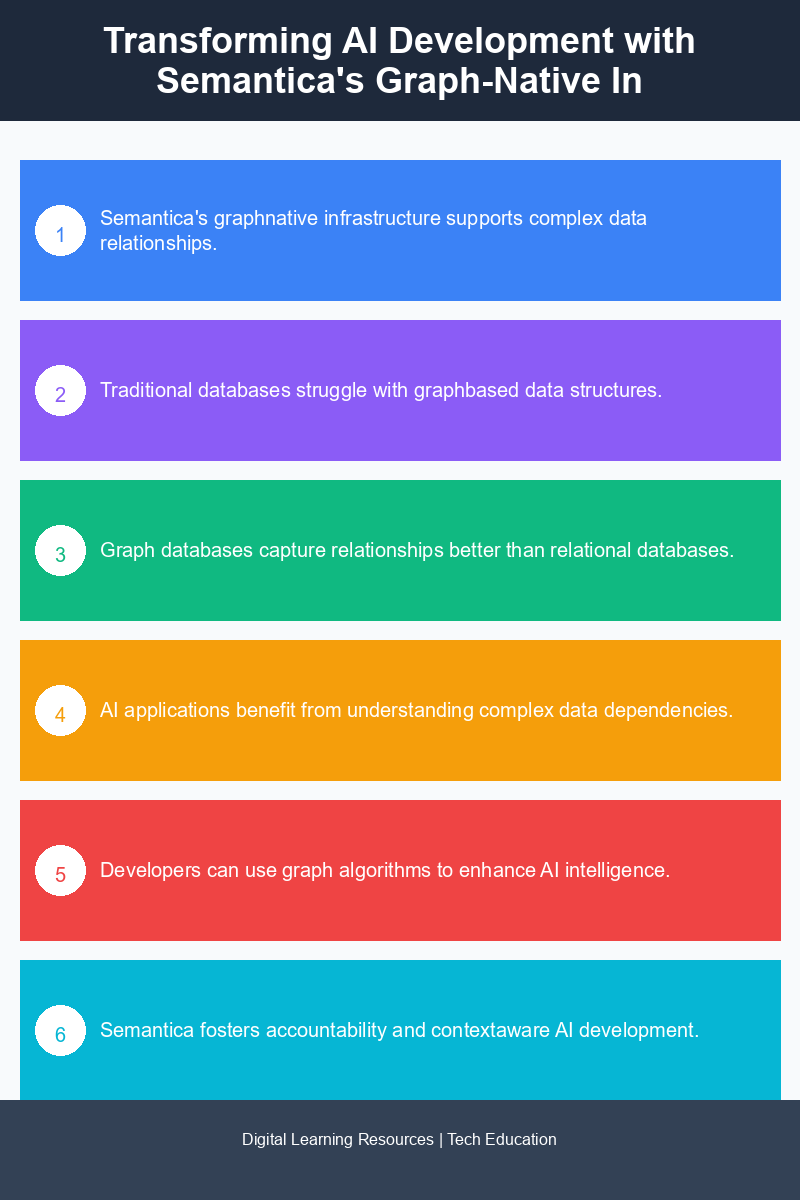
The rapid evolution of artificial intelligence (AI) demands a robust infrastructure capable of supporting complex data relationships. Traditional databases often fall short in accommodating the intricacies of graph-based data structures. Semantica emerges as a solution specifically designed for this challenge, revolutionizing the way developers create and manage AI systems. This post explores Semantica’s core features, its open-source model, and how it fosters accountability and context-aware AI.
Understanding Graph-Native Infrastructure
At the heart of Semantica is its graph-native infrastructure, which allows for a natural representation of data through nodes and edges. Unlike conventional relational databases that organize data in tables, graph databases excel at capturing relationships and interconnections. This capability is crucial for AI applications that require understanding complex dependencies between data points.
For instance, consider a recommendation system that analyzes user preferences. With Semantica, developers can represent users, products, and interactions as a graph. This enables the AI to infer recommendations based on relationships rather than relying solely on predefined rules. By leveraging graph algorithms, such as PageRank or community detection, developers can enhance the intelligence of their AI agents, making them more effective in real-world applications.
📚 Recommended Digital Learning Resources
Take your skills to the next level:
Nclex-RN Exam Prep Flashcards | 800 Cards | All 8 Content Areas | Anki Decks Normal & Cloze | 8 PDF Layouts | RN Licensing Exam
Nclex-RN Exam Prep Flashcards | 800 Cards | All 8 Content Areas | Anki Decks Normal & Cloze | 8 PDF Layouts | RN Licensing Exam
LSAT Flashcard Study System | 800 Cards | 8 Categories | Anki Decks Normal Cloze | 8 PDF Layouts Color Print
LSAT Flashcard Study System | 800 Cards | 8 Categories | Anki Decks Normal Cloze | 8 PDF Layouts Color Print
📊 Key Learning Points Infographic
Visual summary of key concepts
GMAT Flashcard Study System | 700 Cards | 8 Categories | Anki Decks Normal Cloze | 8 PDF Layouts Color Print | Offline Interactive HTML
GMAT Flashcard Study System | 700 Cards | 8 Categories | Anki Decks Normal Cloze | 8 PDF Layouts Color Print | Offline Interactive HTML
MCAT Flashcard Study System | 820 Cards | 9 Categories | Anki Decks Normal Cloze | 8 PDF Layouts Color Print | Instant Download
MCAT Flashcard Study System | 820 Cards | 9 Categories | Anki Decks Normal Cloze | 8 PDF Layouts Color Print | Instant Download
PSAT Flashcard Study System | 600 Cards | 9 Categories | Anki Decks Normal Cloze | 8 Pdf Layouts Color Print | PSAT NMSQT Exam Prep
PSAT Flashcard Study System | 600 Cards | 9 Categories | Anki Decks Normal Cloze | 8 Pdf Layouts Color Print | PSAT NMSQT Exam Prep
The Benefits of Open-Source Development
Semantica is built on an open-source model, granting developers and researchers unrestricted access to its codebase. This approach fosters collaboration and innovation, allowing users to modify and extend the platform according to their specific needs. Open-source software encourages a community-driven development process, where contributors can share improvements and bug fixes, ultimately enhancing the tool’s capabilities.
For developers, using an open-source platform like Semantica means they can avoid vendor lock-in and tailor the infrastructure to their unique use cases. Additionally, the availability of a vibrant community often translates into extensive documentation, tutorials, and support, which can significantly reduce the learning curve associated with adopting new technologies.
Enabling Context-Aware AI
One of Semantica’s standout features is its ability to support context-aware AI systems. Traditional AI models often operate in isolation, lacking an understanding of the broader context in which they function. Semantica addresses this limitation by allowing AI agents to consider contextual information when making decisions or predictions. This capability is particularly valuable in scenarios like natural language processing (NLP) and personalized user experiences.
For example, in a customer service application, a context-aware AI agent built on Semantica can analyze previous interactions, user sentiment, and even external factors like current events. This comprehensive understanding enables the AI to provide more relevant and accurate responses, ultimately enhancing user satisfaction. The ability to adapt based on context not only improves performance but also fosters a more human-like interaction, making AI tools more relatable and effective.
Promoting Accountability in AI Systems
As AI becomes increasingly integrated into critical decision-making processes, the need for accountability in these systems is paramount. Semantica addresses this challenge by enabling developers to create AI models that can be audited and held accountable for their actions. This transparency is essential in applications where ethical considerations and regulatory compliance are crucial.
For instance, in financial services, an AI system built on Semantica can provide clear explanations for its decisions, such as loan approvals or risk assessments. By documenting the relationships and data points that influenced a decision, developers can ensure that the AI operates within ethical guidelines and adheres to industry regulations. This level of accountability not only builds trust among users but also mitigates risks associated with AI deployment.
Incorporating accountability into AI systems is more than just a technical requirement; it is a critical ethical consideration. Semantica’s infrastructure enables developers to create responsible AI solutions that prioritize transparency and user trust.
MyFlashDecks.com
Need Custom Flashcards for Any Exam or Topic?
Get a complete flashcard study system tailored to your exact topic — 800+ cards, an interactive HTML app, 8 PDF layouts, and 2 Anki decks, all delivered to your email within 24 hours.
Conclusion
Semantica represents a significant advancement in AI infrastructure, particularly for developers seeking to leverage graph-based data structures. With its open-source model, context-aware capabilities, and emphasis on accountability, Semantica provides a comprehensive solution for building sophisticated AI systems. As the demand for intelligent, responsible AI continues to grow, platforms like Semantica will play a crucial role in shaping the future of technology development.
Disclaimer: Information gathered from reputed public sources. Verify independently for specific implementations.
Ready to advance your skills? Explore our digital learning resources.
📑 About the author: I also build Digital Bizz Card — hosted digital business cards you can share with a QR code, no app required.