As quantum computing technology advances, the security of traditional cryptographic systems is increasingly at risk. Lattice-based cryptography emerges as a powerful alternative, designed to protect data against quantum attacks. This post delves into the principles of lattice-based cryptography, its significance in post-quantum cryptography, and its practical applications.
The Basics of Lattice-Based Cryptography
Lattice-based cryptography relies on mathematical structures known as lattices, which are grids of points in multi-dimensional space. These lattices serve as the foundation for constructing cryptographic primitives, such as encryption schemes and digital signatures. The security of these systems is predicated on the inherent difficulty of certain problems related to lattices, such as finding the shortest vector in a lattice (SVP) or solving the Learning With Errors (LWE) problem.
The first significant contribution to this field was made by Miklós Ajtai in 1996, who introduced a lattice-based encryption scheme. This marked the beginning of a new era in cryptography, as researchers began to explore the potential of lattice structures for secure communication. Unlike traditional public-key systems such as RSA or Diffie-Hellman, which depend on the difficulty of factoring large numbers or solving discrete logarithm problems, lattice-based cryptography is thought to withstand the capabilities of quantum computers. This resilience is crucial, given that Shor’s algorithm can efficiently break these traditional systems, rendering them obsolete in a post-quantum world.
📚 Recommended Digital Learning Resources
Take your skills to the next level:
Nclex-RN Exam Prep Flashcards | 800 Cards | All 8 Content Areas | Anki Decks Normal & Cloze | 8 PDF Layouts | RN Licensing Exam
Nclex-RN Exam Prep Flashcards | 800 Cards | All 8 Content Areas | Anki Decks Normal & Cloze | 8 PDF Layouts | RN Licensing Exam
LSAT Flashcard Study System | 800 Cards | 8 Categories | Anki Decks Normal Cloze | 8 PDF Layouts Color Print
LSAT Flashcard Study System | 800 Cards | 8 Categories | Anki Decks Normal Cloze | 8 PDF Layouts Color Print
📊 Key Learning Points Infographic
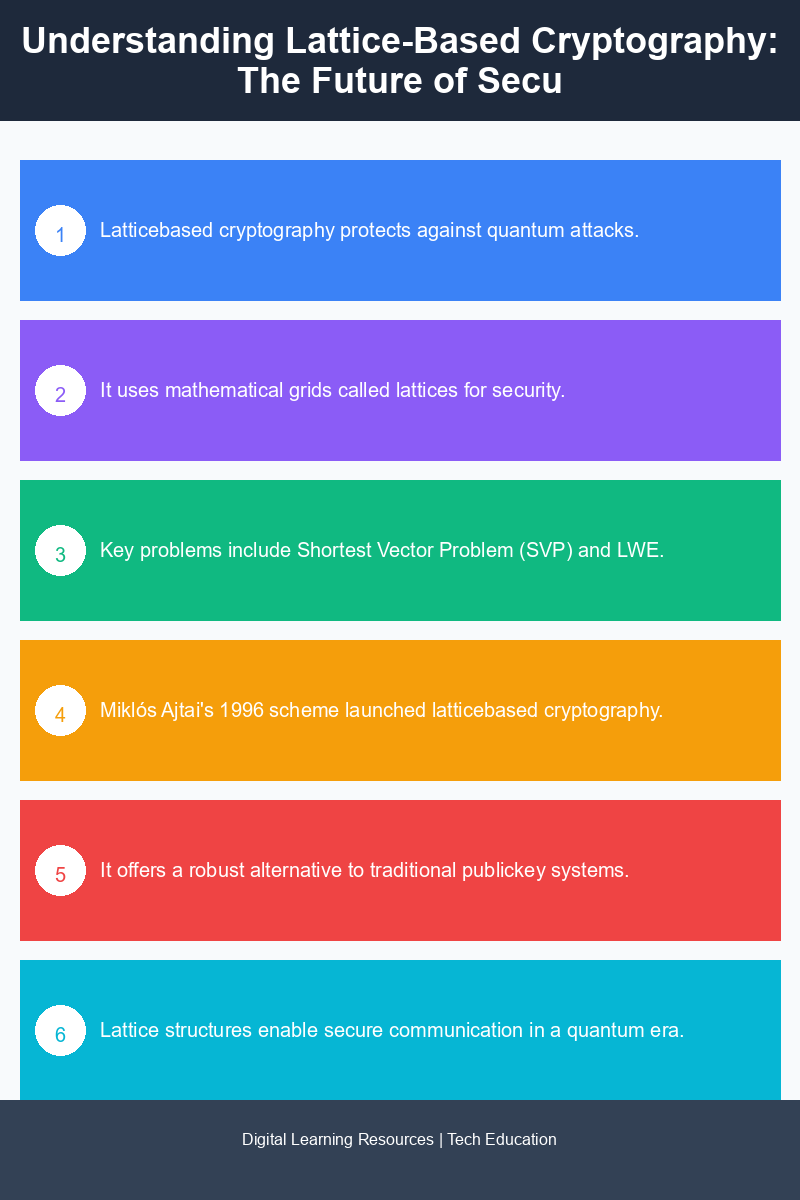
Visual summary of key concepts
GMAT Flashcard Study System | 700 Cards | 8 Categories | Anki Decks Normal Cloze | 8 PDF Layouts Color Print | Offline Interactive HTML
GMAT Flashcard Study System | 700 Cards | 8 Categories | Anki Decks Normal Cloze | 8 PDF Layouts Color Print | Offline Interactive HTML
MCAT Flashcard Study System | 820 Cards | 9 Categories | Anki Decks Normal Cloze | 8 PDF Layouts Color Print | Instant Download
MCAT Flashcard Study System | 820 Cards | 9 Categories | Anki Decks Normal Cloze | 8 PDF Layouts Color Print | Instant Download
PSAT Flashcard Study System | 600 Cards | 9 Categories | Anki Decks Normal Cloze | 8 Pdf Layouts Color Print | PSAT NMSQT Exam Prep
PSAT Flashcard Study System | 600 Cards | 9 Categories | Anki Decks Normal Cloze | 8 Pdf Layouts Color Print | PSAT NMSQT Exam Prep
Why Lattice-Based Cryptography Matters
The urgency for post-quantum solutions cannot be overstated. As quantum computers become more powerful, the vulnerabilities of existing cryptographic standards grow. Lattice-based cryptography is a cornerstone of the emerging post-quantum cryptography standards, as endorsed by organizations like the National Institute of Standards and Technology (NIST). NIST has been actively evaluating lattice-based schemes for inclusion in its post-quantum cryptographic standardization process, signaling a shift towards more secure alternatives.
Cynthia Dwork’s work in this domain has been particularly influential. She demonstrated that the average-case problem of finding short integer solutions (SIS) is at least as hard as the worst-case lattice problem. This finding is significant because it means that if an adversary can solve the average-case problem, they can also solve the worst-case problem, reinforcing the security assumptions of lattice-based systems. Dwork also developed a cryptographic hash function based on the computational hardness of the SIS problem, further establishing the practical applications of lattice theory in cryptography.
Real-World Applications of Lattice-Based Cryptography
Lattice-based cryptography is not just theoretical; it has real-world applications that can be integrated into existing systems. For instance, the NewHope algorithm, which is based on lattice techniques, is already being utilized in Google’s post-quantum key exchange experiments. This algorithm allows secure key agreement between parties, even in the presence of quantum adversaries.
Another notable implementation is NTRUEncrypt, a lattice-based public-key encryption scheme that has been in use for years. It offers an efficient alternative to RSA and elliptic-curve systems, providing faster encryption and decryption times along with robust security. Its adaptability makes it suitable for a variety of environments, including resource-constrained devices.
Moreover, developers can leverage various libraries that incorporate lattice-based cryptographic schemes. Libraries such as NTRU and the Lizard Library provide tools for implementing these advanced cryptographic techniques, making it easier for software engineers to adopt post-quantum solutions in their applications.
Challenges and Considerations
Despite its advantages, the transition to lattice-based cryptography is not without challenges. One primary concern is the increased complexity and larger key sizes associated with lattice-based systems compared to traditional schemes. For example, while a 2048-bit RSA key might provide adequate security, a comparable lattice-based key could be significantly larger, which may not be feasible in all applications.
Additionally, developers must be cautious about the implementation of lattice-based schemes. Cryptographic protocols require rigorous testing to ensure they are free from vulnerabilities that could be exploited by attackers. As such, understanding the underlying mathematics and security proofs is essential for those looking to deploy these systems effectively.
MyFlashDecks.com
Need Custom Flashcards for Any Exam or Topic?
Get a complete flashcard study system tailored to your exact topic — 800+ cards, an interactive HTML app, 8 PDF layouts, and 2 Anki decks, all delivered to your email within 24 hours.
In summary, lattice-based cryptography offers a promising solution to the impending challenges posed by quantum computing. Its robust security foundations and real-world applicability make it a critical area of focus for developers and researchers alike. As the field evolves, continued exploration and implementation of lattice-based systems will play a pivotal role in securing our digital communications against future threats.
Disclaimer: Information gathered from reputed public sources. Verify independently for specific implementations.
Ready to advance your skills? Explore our digital learning resources.
📑 About the author: I also build Digital Bizz Card — hosted digital business cards you can share with a QR code, no app required.