AI Concepts Explained
Understanding Vector Databases: What They Are and How They Work
Discover how vector databases store and search vectors for applications like image recognition and NLP, using embeddings and ANN search for efficient data retrieval.
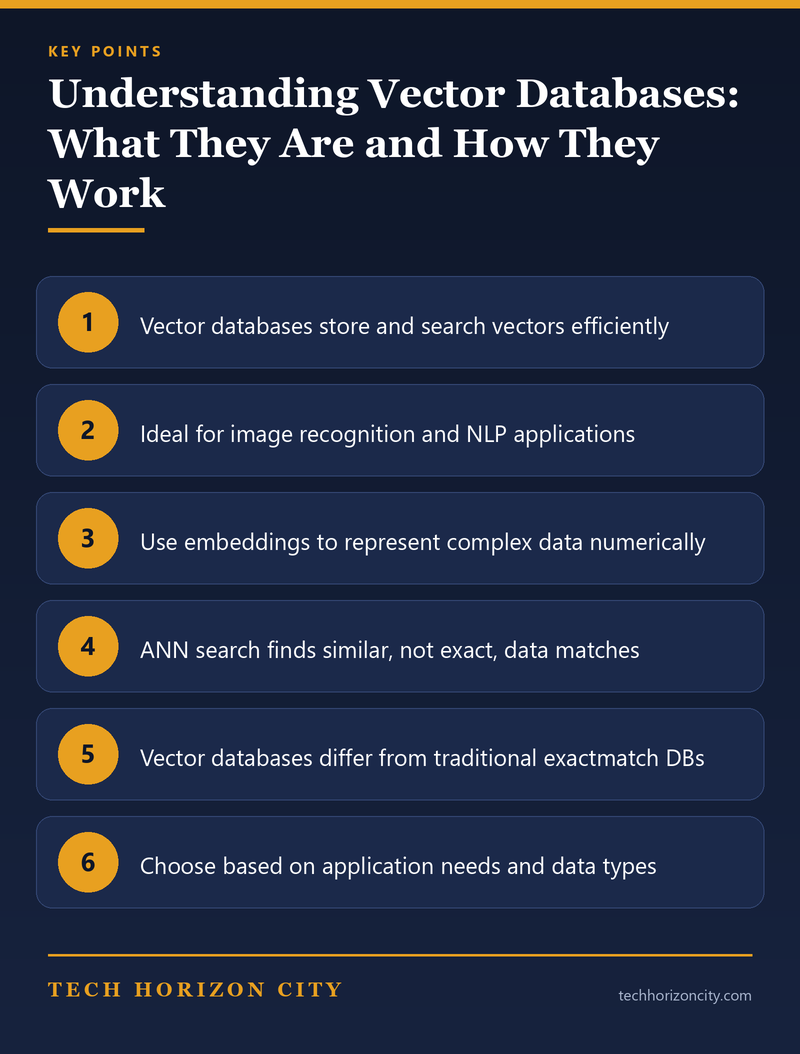
In short A vector database is a specialized system designed to store and search vectors—mathematical representations of complex data.
Unlike traditional databases that focus on exact matches, vector databases excel at finding similar data through approximate nearest neighbor (ANN) searches. This makes them ideal for applications such as image recognition, audio processing, and natural language understanding. Let’s delve deeper into how vector databases work, the differences between vector and traditional databases, and how to choose the right one for your needs.
How Embeddings and Similarity Search Work
At the core of vector databases lies the concept of embeddings. Embeddings are numerical codes that represent data in a way that computers can easily process. For instance, in natural language processing, words or phrases are converted into vectors that capture their semantic meaning. When you have a vector database, it acts like a smart librarian, efficiently finding the most similar items in a dataset, even if they are not exact matches.
Similarity search, often implemented as ANN search, is the process of finding vectors that are “close” to a given query vector. This is crucial for applications where you need to find similar items, like suggesting related products in an e-commerce platform or identifying similar images in a photo repository. ANN algorithms speed up this process by approximating the nearest neighbors rather than calculating exact distances, which would be computationally expensive.
Vector Database vs. Traditional Database
While traditional databases like SQL rely on structured data and exact matches, vector databases handle unstructured data and focus on similarity-based retrieval. Traditional databases are optimized for querying data using keys and indexes, making them highly efficient for operations like data retrieval and transactional processing. However, they fall short when it comes to tasks that require understanding the context or similarity between complex data points.
In contrast, vector databases are designed to handle the nuances of high-dimensional data. They allow for rapid comparison of vector embeddings, which is essential for AI-driven applications. For example, in an image recognition task, traditional databases would struggle to identify the similarity between different images, whereas a vector database can quickly find visually similar images by comparing their vector representations.
How to Choose a Vector Database
Choosing the right vector database depends on several factors, including your specific application needs, scalability requirements, and available resources. Here are some considerations to guide your decision:
- Application Needs: Determine whether your application requires similarity search capabilities. If your focus is on AI tasks like image recognition or recommendation systems, a vector database is likely beneficial.
- Scalability: Consider the volume of data you plan to handle. Some vector databases are optimized for large-scale data processing, while others might be better suited for smaller datasets.
- Integration: Evaluate how well the vector database integrates with your existing tech stack. Compatibility with your current systems can significantly ease implementation.
- Cost: Vector databases can vary in cost based on features and scalability. Review pricing models and choose a solution that aligns with your budget while meeting your performance requirements.
Overall, the choice of a vector database should align with your project’s goals and technical constraints. It’s often beneficial to experiment with a few different systems, leveraging trial versions or open-source options, to find the best fit.
In summary, vector databases offer a powerful approach to handling complex data and enabling AI-driven applications. By understanding embeddings, similarity search, and the differences from traditional databases, you can make informed decisions about integrating vector databases into your technology stack.
Frequently Asked Questions
What is a vector database and how does it work?
A vector database is a specialized database designed to store and manage high-dimensional vectors, often used in machine learning applications. It works by indexing these vectors to enable efficient similarity searches using algorithms like Approximate Nearest Neighbors (ANN).
How do embeddings relate to vector databases?
Embeddings are numerical representations of data, such as words or images, that can be stored as vectors in a vector database. These embeddings allow for efficient similarity searches and comparisons within the database.
Why use a vector database for similarity search?
Vector databases are optimized for similarity search by using advanced indexing techniques that allow for fast retrieval of similar items, making them ideal for applications like recommendation systems and image recognition.
Can ANN algorithms improve the performance of vector databases?
Yes, Approximate Nearest Neighbors (ANN) algorithms improve the performance of vector databases by providing faster and more scalable similarity search capabilities compared to exact search methods.
Is a vector database suitable for real-time applications?
Yes, a vector database is suitable for real-time applications because it can quickly process and retrieve similar data points, making it ideal for dynamic environments like online recommendations and personalized content delivery.
Ready to advance your skills? Explore our digital learning resources.
Keep reading
Details such as prices, limits and version behaviour change often. Check the provider’s own documentation before relying on them.
📑 About the author: I also build Digital Bizz Card — hosted digital business cards you can share with a QR code, no app required.