World models are transforming how artificial intelligence systems interact with their environments. By creating internal representations of the world, these models enable agents to predict changes based on their actions, significantly reducing reliance on real-world trial and error. This capability is crucial for advancing AI applications in various fields, including robotics, autonomous driving, and complex simulations.
What Are World Models?
A world model in artificial intelligence is a sophisticated machine learning system that builds an internal representation of an environment. This internal model allows AI agents to simulate and understand how their actions will affect the environment over time. Unlike traditional AI systems that merely classify data or generate outputs based on existing inputs, world models empower agents to plan, reason, and act based on their predictions about future states. This predictive capability is essential for tasks that require foresight and strategic decision-making.
The Evolution of World Models
The concept of world models was first introduced by Jürgen Schmidhuber in 1990, laying the groundwork for future advancements in AI. Fast forward to 2022, and Yann LeCun, a leading figure in AI research, advanced the idea in a position paper titled “A Path Towards Autonomous Machine Intelligence.” In this paper, LeCun proposed a novel framework called the *joint embedding predictive architecture (JEPA)*, which serves as a foundational structure for developing world models.
📚 Recommended Digital Learning Resources
Take your skills to the next level:
Nclex-RN Exam Prep Flashcards | 800 Cards | All 8 Content Areas | Anki Decks Normal & Cloze | 8 PDF Layouts | RN Licensing Exam
Nclex-RN Exam Prep Flashcards | 800 Cards | All 8 Content Areas | Anki Decks Normal & Cloze | 8 PDF Layouts | RN Licensing Exam
LSAT Flashcard Study System | 800 Cards | 8 Categories | Anki Decks Normal Cloze | 8 PDF Layouts Color Print
LSAT Flashcard Study System | 800 Cards | 8 Categories | Anki Decks Normal Cloze | 8 PDF Layouts Color Print
📊 Key Learning Points Infographic
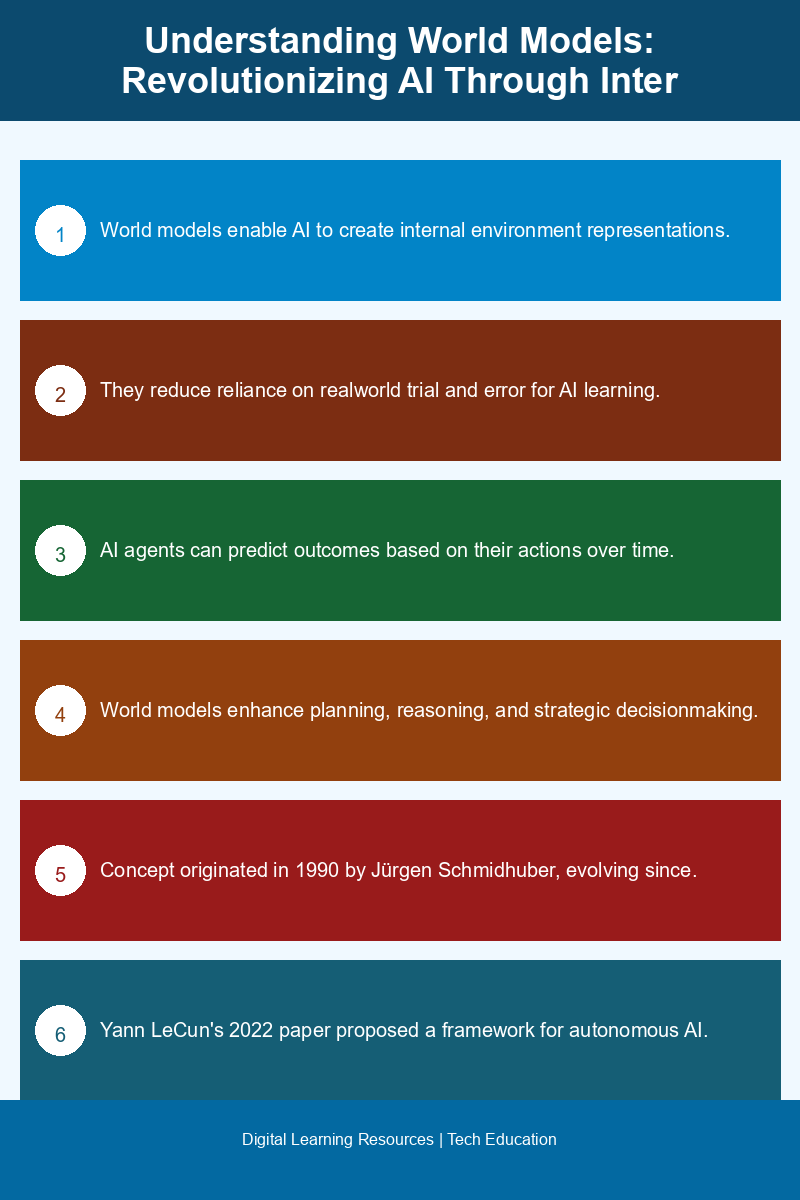
Visual summary of key concepts
GMAT Flashcard Study System | 700 Cards | 8 Categories | Anki Decks Normal Cloze | 8 PDF Layouts Color Print | Offline Interactive HTML
GMAT Flashcard Study System | 700 Cards | 8 Categories | Anki Decks Normal Cloze | 8 PDF Layouts Color Print | Offline Interactive HTML
MCAT Flashcard Study System | 820 Cards | 9 Categories | Anki Decks Normal Cloze | 8 PDF Layouts Color Print | Instant Download
MCAT Flashcard Study System | 820 Cards | 9 Categories | Anki Decks Normal Cloze | 8 PDF Layouts Color Print | Instant Download
PSAT Flashcard Study System | 600 Cards | 9 Categories | Anki Decks Normal Cloze | 8 Pdf Layouts Color Print | PSAT NMSQT Exam Prep
PSAT Flashcard Study System | 600 Cards | 9 Categories | Anki Decks Normal Cloze | 8 Pdf Layouts Color Print | PSAT NMSQT Exam Prep
JEPA allows for better integration of different types of data, enabling machines to create more accurate representations of their environments. The research culminated in the introduction of V-JEPA 2, a system that achieved state-of-the-art performance in video understanding and physical reasoning. This was a significant milestone, showcasing the practical capabilities of world models in real-world applications.
Practical Applications of World Models
One of the most notable applications of world models is in the field of autonomous driving. In February 2026, Waymo integrated a specialized world model named Genie 3 into its simulation processes. Known as the Waymo World Model, this system utilizes advanced predictive capabilities to enhance the safety and efficiency of autonomous vehicles. By simulating various driving scenarios and predicting potential outcomes, the Waymo World Model allows for more robust decision-making in real-time driving conditions.
Another area where world models show immense potential is in robotics. Robots equipped with world models can navigate complex environments more effectively by anticipating changes and adapting their behaviors accordingly. For example, a robot tasked with assembling components in a factory can use its world model to predict the consequences of its movements, thereby optimizing its operations without the need for constant human oversight.
The Future of World Models
As researchers continue to refine and develop world models, the implications for AI technology are profound. In 2026, Yann LeCun founded Advanced Machine Intelligence Labs to focus on further advancements in this area. The work being done in these labs aims to push the boundaries of what AI can achieve, particularly in creating more autonomous and intelligent systems capable of understanding and interacting with their environments in nuanced ways.
The development of world models not only enhances the capabilities of AI systems but also opens new avenues for research and application. As these models become more sophisticated, they will likely become integral to a wide range of technologies—from autonomous vehicles to intelligent robotics and beyond.
MyFlashDecks.com
Need Custom Flashcards for Any Exam or Topic?
Get a complete flashcard study system tailored to your exact topic — 800+ cards, an interactive HTML app, 8 PDF layouts, and 2 Anki decks, all delivered to your email within 24 hours.
In summary, world models are a critical advancement in artificial intelligence, allowing machines to create internal representations of their environments and predict changes over time. This capability significantly enhances the planning and reasoning abilities of AI agents, making them more effective in real-world applications. With ongoing research and development, the potential of world models is poised to reshape the landscape of AI technology.
Disclaimer: Information gathered from reputed public sources. Verify independently for specific implementations.
Ready to advance your skills? Explore our digital learning resources.
📑 About the author: I also build Digital Bizz Card — hosted digital business cards you can share with a QR code, no app required.