Organizations today face a significant challenge: how to manage and deliver high-quality data quickly across diverse platforms. As businesses increasingly rely on data for critical decision-making, the demand for efficient data management practices has surged. Enter DataOps, a collaborative approach to data management that aims to streamline processes, enhance data quality, and ensure that teams are aligned. This article explores the core principles of DataOps, its operational framework, and its impact on data-driven decision-making.
The Core Principles of DataOps
DataOps can be likened to DevOps in software development, as it orchestrates the management and analytics of data with a focus on speed and quality. At its heart, DataOps is about breaking down silos that traditionally separate data teams, allowing for a more integrated workflow. It emphasizes collaboration among cross-functional teams, including data engineers, data scientists, and business analysts.
One of the primary goals of DataOps is to enable faster delivery of data products while maintaining high standards of data quality. By implementing automated workflows, DataOps reduces the manual effort involved in data management, which can often lead to errors and inconsistencies. These automated processes improve data availability across platforms such as data lakes, data warehouses, and analytics platforms, making it easier for teams to access and utilize data effectively.
📚 Recommended Digital Learning Resources
Take your skills to the next level:
Nclex-RN Exam Prep Flashcards | 800 Cards | All 8 Content Areas | Anki Decks Normal & Cloze | 8 PDF Layouts | RN Licensing Exam
Nclex-RN Exam Prep Flashcards | 800 Cards | All 8 Content Areas | Anki Decks Normal & Cloze | 8 PDF Layouts | RN Licensing Exam
LSAT Flashcard Study System | 800 Cards | 8 Categories | Anki Decks Normal Cloze | 8 PDF Layouts Color Print
LSAT Flashcard Study System | 800 Cards | 8 Categories | Anki Decks Normal Cloze | 8 PDF Layouts Color Print
📊 Key Learning Points Infographic
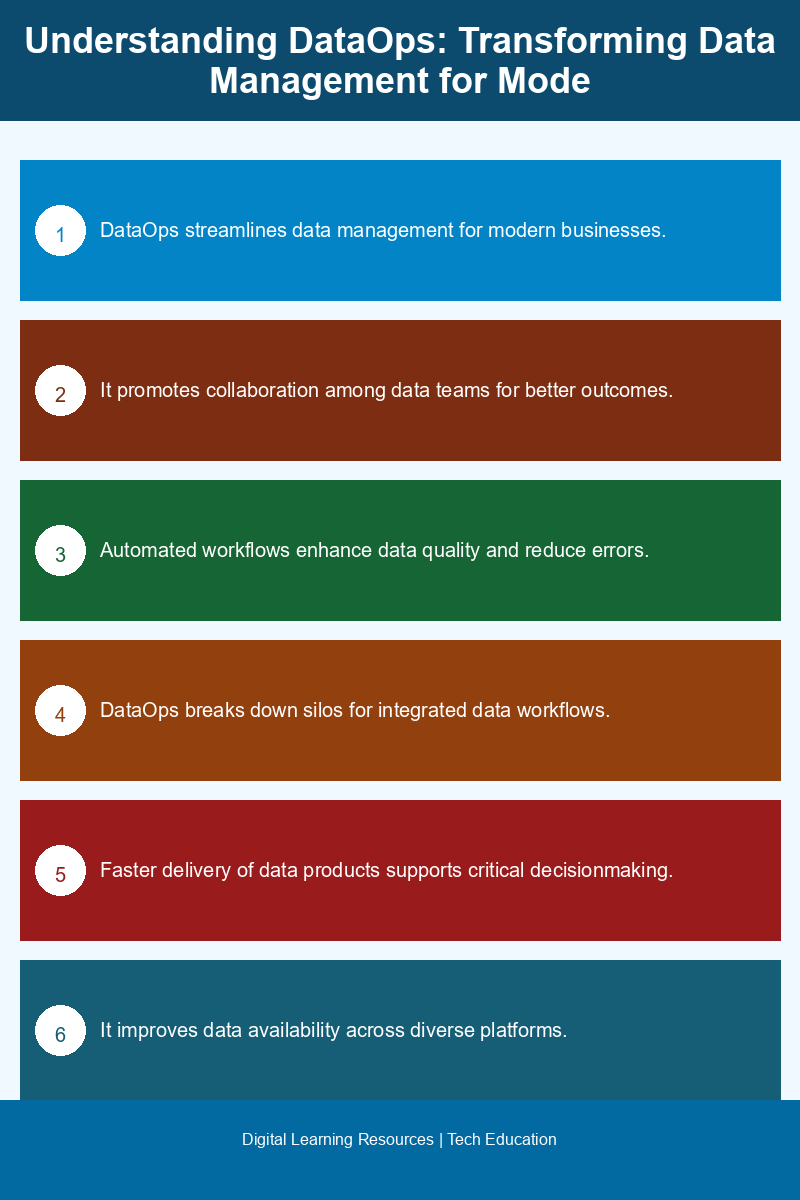
Visual summary of key concepts
GMAT Flashcard Study System | 700 Cards | 8 Categories | Anki Decks Normal Cloze | 8 PDF Layouts Color Print | Offline Interactive HTML
GMAT Flashcard Study System | 700 Cards | 8 Categories | Anki Decks Normal Cloze | 8 PDF Layouts Color Print | Offline Interactive HTML
MCAT Flashcard Study System | 820 Cards | 9 Categories | Anki Decks Normal Cloze | 8 PDF Layouts Color Print | Instant Download
MCAT Flashcard Study System | 820 Cards | 9 Categories | Anki Decks Normal Cloze | 8 PDF Layouts Color Print | Instant Download
PSAT Flashcard Study System | 600 Cards | 9 Categories | Anki Decks Normal Cloze | 8 Pdf Layouts Color Print | PSAT NMSQT Exam Prep
PSAT Flashcard Study System | 600 Cards | 9 Categories | Anki Decks Normal Cloze | 8 Pdf Layouts Color Print | PSAT NMSQT Exam Prep
Automated Workflows and Continuous Monitoring
A defining feature of DataOps is its reliance on automated workflows. These workflows facilitate the collection, processing, and delivery of data in a seamless manner. For example, tools like Apache NiFi or Talend can be utilized to automate data ingestion from various sources into a central repository. This automation not only speeds up the data delivery process but also ensures that data is consistently updated and of high quality.
Continuous testing and monitoring are critical components of the DataOps framework. By integrating testing into the data pipeline, organizations can identify and address issues in real-time, ensuring that downstream applications—such as business intelligence (BI), artificial intelligence (AI), and machine learning (ML) systems—receive reliable data. This proactive approach minimizes the risk of data errors that could lead to misguided business decisions.
Unified Workflows for Diverse Use Cases
DataOps replaces isolated data stacks with unified, end-to-end workflows that cater to a variety of use cases. For instance, consider a retail company that uses data to optimize its inventory management and enhance customer experiences. With DataOps, the company can integrate data from sales, supply chain, and customer feedback into a single workflow. This unified approach enables the organization to derive insights quickly, adapt to changing market conditions, and make more informed decisions.
Moreover, DataOps supports the growing need for agile analytics, allowing businesses to respond to real-time data. For instance, during a flash sale, a company can utilize DataOps to analyze sales data as it comes in, adjusting inventory levels and marketing strategies on the fly. This capacity for rapid adaptation is essential in today’s fast-paced business environment.
The Benefits of Implementing DataOps
The rise of DataOps is driven by its tangible benefits. Organizations that adopt DataOps practices can expect faster decision-making processes due to the swift availability of high-quality data. A study found that companies implementing DataOps reported a 30% improvement in data delivery times. Additionally, the quality of data is markedly enhanced, as continuous monitoring and testing ensure that errors are caught early in the data lifecycle.
Furthermore, resilient analytics pipelines created through DataOps can adapt to real-time business needs. This adaptability is crucial for organizations looking to stay competitive in an ever-evolving landscape. The ability to quickly derive insights from data not only fosters innovation but also provides a strategic advantage over competitors who may still rely on traditional, slower data management practices.
MyFlashDecks.com
Need Custom Flashcards for Any Exam or Topic?
Get a complete flashcard study system tailored to your exact topic — 800+ cards, an interactive HTML app, 8 PDF layouts, and 2 Anki decks, all delivered to your email within 24 hours.
In summary, DataOps is transforming how organizations manage and utilize data. By fostering collaboration, automating workflows, and emphasizing continuous monitoring, DataOps ensures that high-quality data is accessible across all business areas. As organizations increasingly leverage data for strategic decision-making, adopting DataOps practices will be essential for driving efficiency and innovation.
Disclaimer: Information gathered from reputed public sources. Verify independently for specific implementations.
Ready to advance your skills? Explore our digital learning resources.
📑 About the author: I also build Digital Bizz Card — hosted digital business cards you can share with a QR code, no app required.