As artificial intelligence (AI) technology continues to advance at a rapid pace, the implications of its deployment have raised significant concerns about safety, ethics, and accountability. Organizations are increasingly recognizing the need for comprehensive AI governance frameworks to manage these challenges effectively. AI governance encompasses a set of processes, standards, and guardrails designed to ensure that AI systems operate safely and ethically, aligning with societal values and regulatory requirements.
The Framework of AI Governance
AI governance frameworks provide essential guidelines for the research, development, and application of AI technologies. These frameworks are not merely theoretical constructs; they are practical tools that help organizations navigate the complexities of AI implementation. By establishing clear processes and protocols, AI governance ensures that AI systems are developed with a focus on safety, fairness, and respect for human rights.
For example, the European Union’s AI Act proposes a risk-based approach to AI regulation, categorizing AI applications into different risk levels, from minimal to unacceptable. This framework mandates varying levels of compliance and oversight, ensuring that high-risk AI applications, such as facial recognition technologies, undergo rigorous evaluation and monitoring.
📚 Recommended Digital Learning Resources
Take your skills to the next level:
Nclex-RN Exam Prep Flashcards | 800 Cards | All 8 Content Areas | Anki Decks Normal & Cloze | 8 PDF Layouts | RN Licensing Exam
Nclex-RN Exam Prep Flashcards | 800 Cards | All 8 Content Areas | Anki Decks Normal & Cloze | 8 PDF Layouts | RN Licensing Exam
LSAT Flashcard Study System | 800 Cards | 8 Categories | Anki Decks Normal Cloze | 8 PDF Layouts Color Print
LSAT Flashcard Study System | 800 Cards | 8 Categories | Anki Decks Normal Cloze | 8 PDF Layouts Color Print
📊 Key Learning Points Infographic
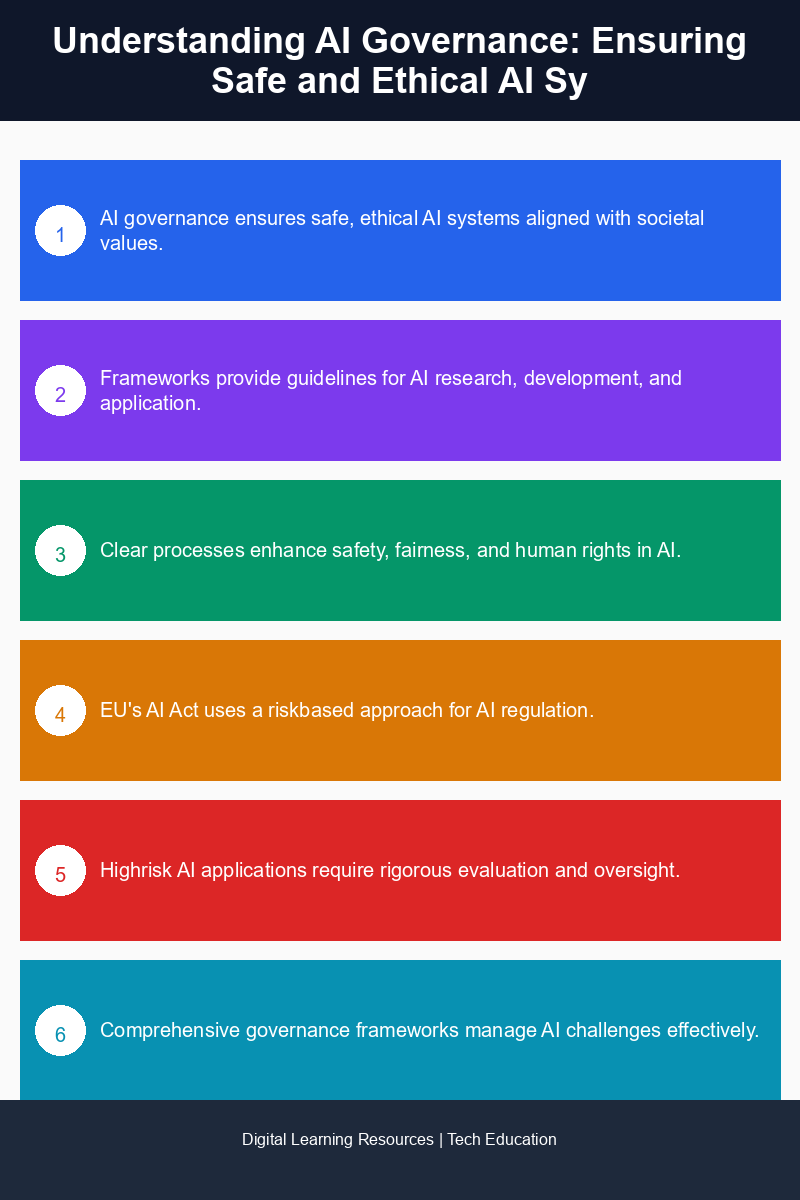
Visual summary of key concepts
GMAT Flashcard Study System | 700 Cards | 8 Categories | Anki Decks Normal Cloze | 8 PDF Layouts Color Print | Offline Interactive HTML
GMAT Flashcard Study System | 700 Cards | 8 Categories | Anki Decks Normal Cloze | 8 PDF Layouts Color Print | Offline Interactive HTML
MCAT Flashcard Study System | 820 Cards | 9 Categories | Anki Decks Normal Cloze | 8 PDF Layouts Color Print | Instant Download
MCAT Flashcard Study System | 820 Cards | 9 Categories | Anki Decks Normal Cloze | 8 PDF Layouts Color Print | Instant Download
PSAT Flashcard Study System | 600 Cards | 9 Categories | Anki Decks Normal Cloze | 8 Pdf Layouts Color Print | PSAT NMSQT Exam Prep
PSAT Flashcard Study System | 600 Cards | 9 Categories | Anki Decks Normal Cloze | 8 Pdf Layouts Color Print | PSAT NMSQT Exam Prep
Maintaining Compliance and Securing Data
Another critical aspect of AI governance is regulatory compliance. Organizations must ensure that their AI systems adhere to existing laws and regulations, including data protection and privacy laws. With the increasing scrutiny on data usage, AI governance frameworks help organizations implement necessary safeguards to secure sensitive data related to AI technologies. This includes adherence to regulations such as the General Data Protection Regulation (GDPR) in Europe, which sets strict guidelines on data handling and user consent.
To comply with such regulations, organizations often implement data governance tools that track and manage data flows within AI systems. For instance, tools like Informatica or Collibra can assist in data lineage tracking, ensuring transparency and accountability in data management practices.
Best Practices and Safeguards in AI Governance
Effective AI governance involves a variety of practices, protocols, and systems designed to mitigate risks associated with AI technologies. This includes the establishment of internal policies and guidelines that dictate how AI models should be created, trained, and deployed. AI professionals are actively developing methods for responsible AI usage, ensuring that risks are identified and addressed proactively.
For instance, organizations may adopt the principles outlined in the IEEE’s Ethically Aligned Design guidelines, which advocate for the incorporation of ethical considerations into AI systems. This includes conducting impact assessments to evaluate potential unintended consequences of AI deployment. Moreover, continuous monitoring and auditing of AI systems are crucial for identifying and mitigating vulnerabilities as they arise.
Aligning AI with Ethical Values
A robust AI governance policy goes beyond compliance; it strives to align AI systems with moral and ethical social values. This alignment is essential to foster public trust in AI technologies. Organizations are increasingly recognizing that AI must not just be effective in its tasks but also responsible in its impact on society.
Guidelines for applying AI models emphasize the importance of layered safety measures and human regulatory oversight. This approach ensures that AI systems operate within ethical boundaries while providing mechanisms for accountability. By embedding ethical considerations into the development process, organizations can create AI technologies that reflect societal values and promote fairness.
MyFlashDecks.com
Need Custom Flashcards for Any Exam or Topic?
Get a complete flashcard study system tailored to your exact topic — 800+ cards, an interactive HTML app, 8 PDF layouts, and 2 Anki decks, all delivered to your email within 24 hours.
Ultimately, effective AI governance not only reduces vulnerabilities and mitigates risks across diverse AI applications but also enhances the overall quality of AI systems. As AI continues to evolve, the commitment to ethical governance will play a pivotal role in shaping its future and ensuring its benefits are realized responsibly.
Disclaimer: Information gathered from reputed public sources. Verify independently for specific implementations.
Ready to advance your skills? Explore our digital learning resources.
📑 About the author: I also build Digital Bizz Card — hosted digital business cards you can share with a QR code, no app required.