Machine learning practitioners often face the challenge of efficiently handling complex problem spaces. A powerful approach to tackle this issue is the Mixture of Experts (MoE) technique, which allows for the specialization of networks within a model. This blog post explores how MoE works, its practical applications, and its relevance in today’s AI landscape.
How Mixture of Experts Works
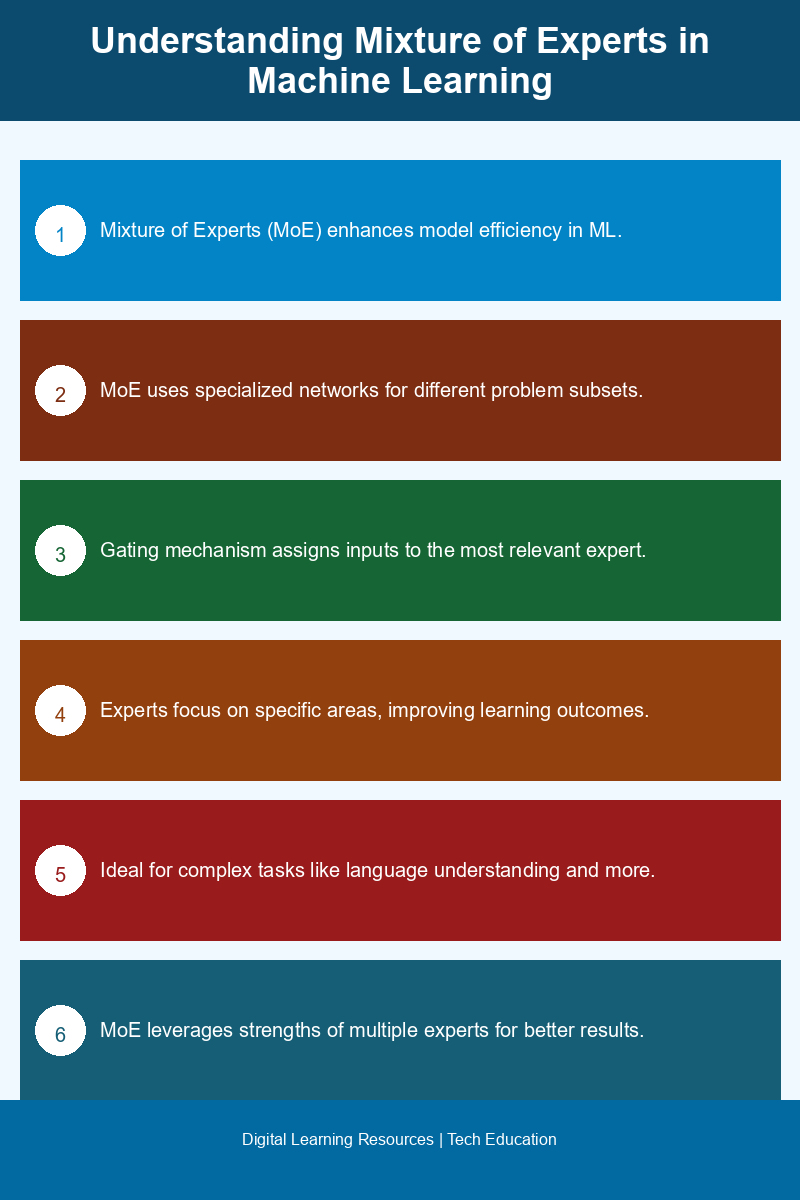
The Mixture of Experts architecture consists of multiple expert networks, each trained to focus on a specific subset of the problem space. This division of labor allows the model to learn more effectively by leveraging the strengths of various experts. The core idea is to assign inputs to the most suitable expert based on their characteristics, ensuring that each expert is only responsible for a particular region of the input space.
At the heart of this architecture is a gating mechanism. The gating network analyzes the input and produces a set of weights that determine how much influence each expert has on the output. For instance, in a language model, one expert might specialize in understanding technical jargon, while another excels at casual conversation. The gating network will then assign a higher weight to the relevant expert based on the input context.
📚 Recommended Digital Learning Resources
Take your skills to the next level:
Nclex-RN Exam Prep Flashcards | 800 Cards | All 8 Content Areas | Anki Decks Normal & Cloze | 8 PDF Layouts | RN Licensing Exam
Nclex-RN Exam Prep Flashcards | 800 Cards | All 8 Content Areas | Anki Decks Normal & Cloze | 8 PDF Layouts | RN Licensing Exam
LSAT Flashcard Study System | 800 Cards | 8 Categories | Anki Decks Normal Cloze | 8 PDF Layouts Color Print
LSAT Flashcard Study System | 800 Cards | 8 Categories | Anki Decks Normal Cloze | 8 PDF Layouts Color Print
📊 Key Learning Points Infographic
Visual summary of key concepts
GMAT Flashcard Study System | 700 Cards | 8 Categories | Anki Decks Normal Cloze | 8 PDF Layouts Color Print | Offline Interactive HTML
GMAT Flashcard Study System | 700 Cards | 8 Categories | Anki Decks Normal Cloze | 8 PDF Layouts Color Print | Offline Interactive HTML
MCAT Flashcard Study System | 820 Cards | 9 Categories | Anki Decks Normal Cloze | 8 PDF Layouts Color Print | Instant Download
MCAT Flashcard Study System | 820 Cards | 9 Categories | Anki Decks Normal Cloze | 8 PDF Layouts Color Print | Instant Download
PSAT Flashcard Study System | 600 Cards | 9 Categories | Anki Decks Normal Cloze | 8 Pdf Layouts Color Print | PSAT NMSQT Exam Prep
PSAT Flashcard Study System | 600 Cards | 9 Categories | Anki Decks Normal Cloze | 8 Pdf Layouts Color Print | PSAT NMSQT Exam Prep
Practical Applications of Mixture of Experts
Mixture of Experts has found its place in various applications across the field of machine learning. One notable example is in natural language processing (NLP). Large language models, such as Google’s Switch Transformer, utilize the MoE architecture to improve performance while reducing computational costs. By activating only a subset of experts for each input, these models can maintain high accuracy without the need for excessive resources.
Another area where MoE shines is in recommendation systems. By segmenting users into different groups, each expert can tailor its recommendations to its specific demographic. For example, a streaming service might have one expert focusing on action films and another on romantic comedies. When a user interacts with the service, the gating mechanism identifies which expert’s recommendations are most relevant, leading to a more personalized experience.
The Advantages of Using Mixture of Experts
The Mixture of Experts technique offers several advantages that make it particularly appealing for developers and researchers:
- Efficiency: By activating only a subset of experts at a time, MoE reduces the computational burden and memory usage, making it feasible to train larger models.
- Specialization: Each expert’s focus on a specific region of the problem space enhances the model’s overall performance, as it leverages the unique strengths of each expert.
- Scalability: New experts can be added to the system without needing to retrain the entire model, allowing for continuous improvement and adaptation to new data.
These advantages are particularly valuable in production environments, where performance and efficiency are critical. For developers, implementing MoE can lead to more robust models that perform well across diverse tasks.
Challenges and Considerations
Despite its benefits, using the Mixture of Experts approach does come with challenges. The complexity of the gating mechanism can lead to difficulties in model interpretability. Understanding why a specific expert was chosen for an input can be less straightforward compared to simpler models.
Additionally, training MoE models can be more resource-intensive due to the need for managing multiple experts. Developers must ensure that their infrastructure can handle the increased complexity. It may also require careful tuning of hyperparameters to balance the contributions of each expert effectively.
Lastly, over-specialization can become a concern. If experts become too narrowly focused, they may not generalize well to unseen data. Regularization techniques, such as dropout and weight decay, can help mitigate this risk by promoting a balance between specialization and generalization.
MyFlashDecks.com
Need Custom Flashcards for Any Exam or Topic?
Get a complete flashcard study system tailored to your exact topic — 800+ cards, an interactive HTML app, 8 PDF layouts, and 2 Anki decks, all delivered to your email within 24 hours.
In summary, the Mixture of Experts technique represents a sophisticated method for tackling complex machine learning problems by leveraging specialized networks. Its practical applications, particularly in NLP and recommendation systems, demonstrate its versatility and efficiency. However, developers must navigate the challenges of complexity and over-specialization to fully harness its potential.
Disclaimer: Information gathered from reputed public sources. Verify independently for specific implementations.
Ready to advance your skills? Explore our digital learning resources.
📑 About the author: I also build Digital Bizz Card — hosted digital business cards you can share with a QR code, no app required.