Large Language Models (LLMs) have revolutionized how machines interact with human language, enabling them to generate coherent text, translate languages, and engage in meaningful conversations. As these models permeate various industries, it’s essential to understand not just their applications but also the mathematical principles that underpin their functionality. This breakdown will clarify how LLMs operate, focusing on key concepts like tokens, attention mechanisms, and optimization.
What Are Large Language Models?
LLMs are advanced AI systems designed to understand and generate human language. Notable examples include OpenAI’s GPT (Generative Pre-trained Transformer), Google’s BERT (Bidirectional Encoder Representations from Transformers), Anthropic’s Claude, and Mistral. These models leverage vast amounts of text data to learn language patterns, allowing them to perform tasks such as text completion, question-answering, and translation with remarkable accuracy.
The power of LLMs lies in their architecture, which is primarily based on deep learning techniques. By analyzing the relationships between words and phrases, these models can generate text that often closely resembles human writing. However, behind this impressive output lies a complex web of mathematical principles that enable these models to function effectively.
📚 Recommended Digital Learning Resources
Take your skills to the next level:
Nclex-RN Exam Prep Flashcards | 800 Cards | All 8 Content Areas | Anki Decks Normal & Cloze | 8 PDF Layouts | RN Licensing Exam
Nclex-RN Exam Prep Flashcards | 800 Cards | All 8 Content Areas | Anki Decks Normal & Cloze | 8 PDF Layouts | RN Licensing Exam
LSAT Flashcard Study System | 800 Cards | 8 Categories | Anki Decks Normal Cloze | 8 PDF Layouts Color Print
LSAT Flashcard Study System | 800 Cards | 8 Categories | Anki Decks Normal Cloze | 8 PDF Layouts Color Print
📊 Key Learning Points Infographic
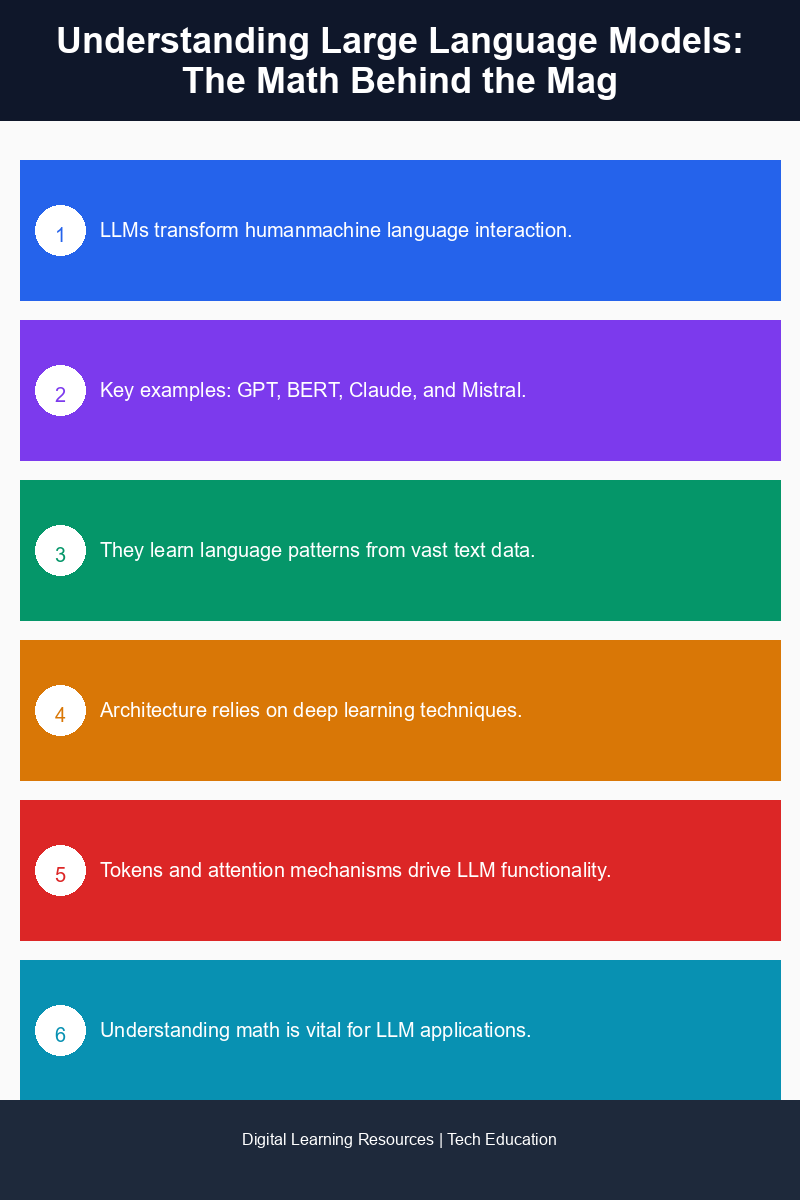
Visual summary of key concepts
GMAT Flashcard Study System | 700 Cards | 8 Categories | Anki Decks Normal Cloze | 8 PDF Layouts Color Print | Offline Interactive HTML
GMAT Flashcard Study System | 700 Cards | 8 Categories | Anki Decks Normal Cloze | 8 PDF Layouts Color Print | Offline Interactive HTML
MCAT Flashcard Study System | 820 Cards | 9 Categories | Anki Decks Normal Cloze | 8 PDF Layouts Color Print | Instant Download
MCAT Flashcard Study System | 820 Cards | 9 Categories | Anki Decks Normal Cloze | 8 PDF Layouts Color Print | Instant Download
PSAT Flashcard Study System | 600 Cards | 9 Categories | Anki Decks Normal Cloze | 8 Pdf Layouts Color Print | PSAT NMSQT Exam Prep
PSAT Flashcard Study System | 600 Cards | 9 Categories | Anki Decks Normal Cloze | 8 Pdf Layouts Color Print | PSAT NMSQT Exam Prep
Key Mathematical Principles in LLMs
Understanding the inner workings of LLMs requires familiarity with several critical mathematical concepts:
- Tokens: In the context of LLMs, tokens are the basic units of text that the model processes. A token can represent a word, a part of a word, or even punctuation. For instance, the sentence “I love AI!” would be tokenized into several components, allowing the model to analyze and generate responses based on these smaller units.
- Embeddings: Once the text is tokenized, each token is converted into a numerical representation known as an embedding. These embeddings capture semantic meaning, allowing the model to understand the context and relationships between words. For example, the words “king” and “queen” would have embeddings that reflect their related meanings.
- Attention Mechanisms: Attention mechanisms allow LLMs to focus on specific parts of the input text when generating outputs. This is crucial for understanding context, as it enables the model to weigh the importance of different tokens relative to one another. The self-attention mechanism used in transformer architectures like GPT and BERT is a prime example of this concept.
- Feedforward Networks: After processing the input through attention layers, the resulting embeddings are passed through feedforward networks. These networks consist of layers that apply transformations to the data, refining the model’s understanding of the input before producing an output.
- Layer Normalization: To stabilize and speed up the training process, LLMs often employ layer normalization. This technique normalizes the outputs of each layer, ensuring that the model learns effectively without being hindered by variations in input data.
- Optimization: Finally, optimization techniques are employed to adjust the model’s parameters based on the loss function, which measures how well the model’s predictions match the actual outcomes. Algorithms like Adam or stochastic gradient descent are commonly used to minimize this loss, resulting in a more accurate model over time.
Applications of LLMs Across Industries
The versatility of LLMs is evident in their applications across various fields:
MyFlashDecks.com
Need Custom Flashcards for Any Exam or Topic?
Get a complete flashcard study system tailored to your exact topic — 800+ cards, an interactive HTML app, 8 PDF layouts, and 2 Anki decks, all delivered to your email within 24 hours.
- Business: Companies leverage LLMs to enhance customer service through chatbots that provide instant responses to queries, thereby improving user experience and operational efficiency.
- Healthcare: In the medical field, LLMs assist in generating patient reports, interpreting clinical notes, and even providing preliminary diagnoses based on patient data, facilitating better healthcare delivery.
- Creative Content Generation: Writers and marketers utilize LLMs to brainstorm ideas, generate drafts, and create engaging content, streamlining the creative process and reducing time spent on initial drafts.
As LLMs continue to evolve, their capabilities are expected to expand, opening new avenues for innovation in numerous sectors. Understanding the mathematical foundations that drive these models not only demystifies their operation but also empowers developers and learners to harness their potential effectively.
Disclaimer: Information gathered from reputed public sources. Verify independently for specific implementations.
Ready to advance your skills? Explore our digital learning resources.
📑 About the author: I also build Digital Bizz Card — hosted digital business cards you can share with a QR code, no app required.