As artificial intelligence becomes increasingly integrated into various applications, optimizing AI agents for performance, reliability, and adaptability is critical. Developers often face the challenge of ensuring that these agents respond accurately and consistently while maintaining relevance to user queries. Here, we explore several robust methods for optimizing AI agents, focusing on structured evaluation frameworks, data-driven optimization, automated feedback loops, A/B testing workflows, real-time performance monitoring, automated staged rollouts, and comprehensive automation pipelines. These techniques assume a working agent is already in place — if you’re starting from scratch, see our guide to building custom AI agents for the underlying architecture first.
Structured Evaluation Frameworks
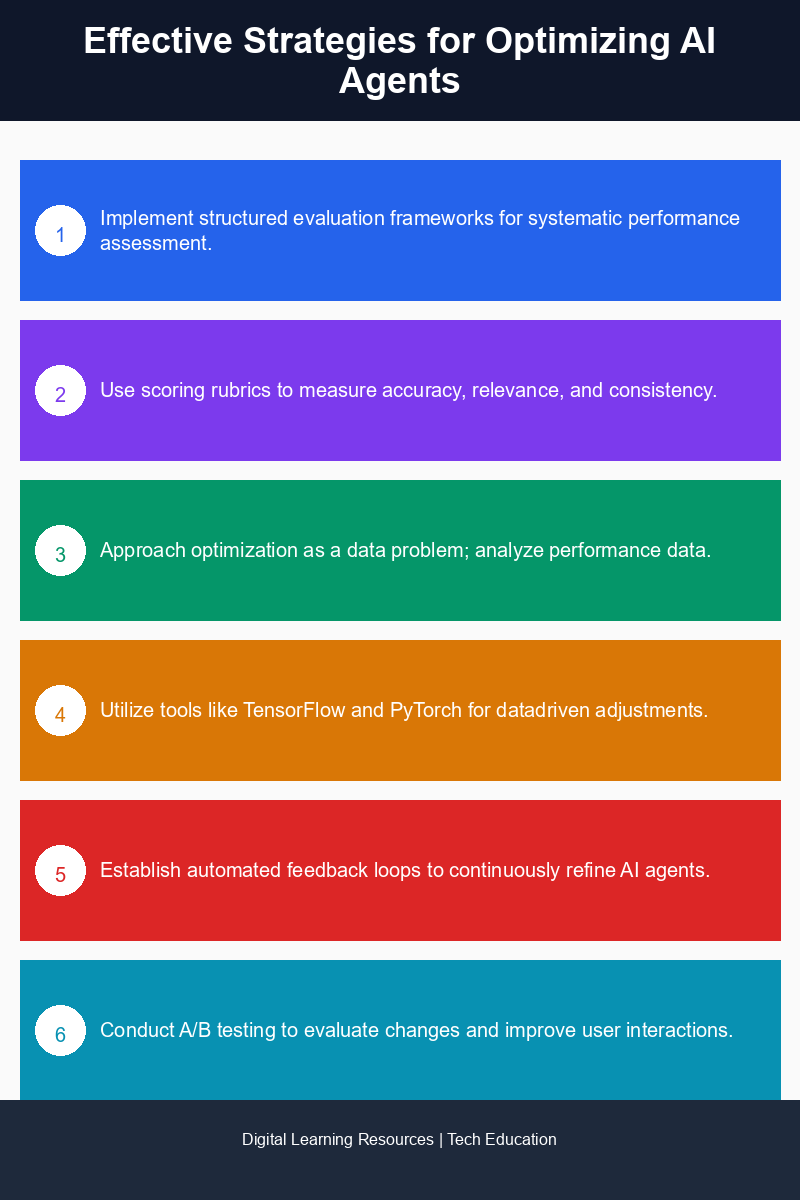
One of the foundational steps in optimizing AI agents is implementing structured evaluation frameworks. These frameworks utilize scoring rubrics to assess agent behavior. Key metrics include function call accuracy, response relevance, and output consistency. By defining clear criteria for evaluation, developers can systematically measure performance and identify areas for improvement. For instance, an agent that frequently misinterprets user queries can be fine-tuned by analyzing the scoring data to enhance its natural language processing capabilities.
Data-Driven Optimization
Optimizing AI agents should be approached as a data problem rather than relying on intuition or guesswork. This entails collecting and analyzing performance data to inform adjustments. Using tools like TensorFlow or PyTorch, developers can train models on historical interaction data, allowing them to identify patterns and anomalies. By employing machine learning techniques, such as reinforcement learning, agents can learn from their mistakes and improve over time. For example, if an agent consistently misinterprets certain phrases, it can be retrained with additional examples to enhance understanding.
📚 Recommended Digital Learning Resources
Take your skills to the next level:
Nclex-RN Exam Prep Flashcards | 800 Cards | All 8 Content Areas | Anki Decks Normal & Cloze | 8 PDF Layouts | RN Licensing Exam
Nclex-RN Exam Prep Flashcards | 800 Cards | All 8 Content Areas | Anki Decks Normal & Cloze | 8 PDF Layouts | RN Licensing Exam
LSAT Flashcard Study System | 800 Cards | 8 Categories | Anki Decks Normal Cloze | 8 PDF Layouts Color Print
LSAT Flashcard Study System | 800 Cards | 8 Categories | Anki Decks Normal Cloze | 8 PDF Layouts Color Print
📊 Key Learning Points Infographic
Visual summary of key concepts
GMAT Flashcard Study System | 700 Cards | 8 Categories | Anki Decks Normal Cloze | 8 PDF Layouts Color Print | Offline Interactive HTML
GMAT Flashcard Study System | 700 Cards | 8 Categories | Anki Decks Normal Cloze | 8 PDF Layouts Color Print | Offline Interactive HTML
MCAT Flashcard Study System | 820 Cards | 9 Categories | Anki Decks Normal Cloze | 8 PDF Layouts Color Print | Instant Download
MCAT Flashcard Study System | 820 Cards | 9 Categories | Anki Decks Normal Cloze | 8 PDF Layouts Color Print | Instant Download
PSAT Flashcard Study System | 600 Cards | 9 Categories | Anki Decks Normal Cloze | 8 Pdf Layouts Color Print | PSAT NMSQT Exam Prep
PSAT Flashcard Study System | 600 Cards | 9 Categories | Anki Decks Normal Cloze | 8 Pdf Layouts Color Print | PSAT NMSQT Exam Prep
Automated Feedback Loops and A/B Testing Workflows
Establishing automated feedback loops is essential for continuous improvement of AI agents. These systems automatically test agent parameters and adjust them based on performance metrics. Developers can create A/B testing workflows to experiment with different configurations, ensuring that only the best-performing versions are deployed. For instance, if an agent’s response time is a critical factor, two configurations can be tested simultaneously to determine which one delivers faster responses without sacrificing accuracy. This iterative process allows for rapid optimization based on real user interactions.
Real-Time Performance Monitoring and Automated Staged Rollouts
Continuous performance monitoring is vital for maintaining the effectiveness of AI agents. By implementing real-time monitoring systems, developers can detect output drift—where the agent’s performance deviates from expected behavior—and initiate retraining or parameter adjustments automatically. For example, if an agent begins to provide irrelevant answers due to changes in user behavior, the monitoring system can trigger a retraining process using the most recent data.
Furthermore, employing automated staged rollouts allows developers to test new functionalities in isolated environments before full deployment. This method reduces the risk of introducing errors into production. If performance declines during the rollout, automated rollback capabilities can revert changes swiftly, preserving user experience and trust.
Comprehensive Automation Pipeline
To tie all these strategies together, developing a comprehensive automation pipeline is crucial. This pipeline manages testing, deployment, and performance issues automatically. Tools like Jenkins or GitLab CI/CD can be integrated into the workflow to facilitate continuous integration and delivery. By automating the entire optimization process, developers can focus on strategic improvements rather than getting bogged down in manual testing and deployment tasks.
MyFlashDecks.com
Need Custom Flashcards for Any Exam or Topic?
Get a complete flashcard study system tailored to your exact topic —
800+ cards, an interactive HTML app, 8 PDF layouts, and 2 Anki decks,
all delivered to your email within 24 hours.
HTML App
8 PDF Layouts
2 Anki Decks
Any Exam
From $4.99
In summary, optimizing AI agents involves a multifaceted approach that integrates structured evaluation, data-driven methodologies, automated feedback mechanisms, and comprehensive automation pipelines. Implementing these strategies not only enhances the performance of AI agents but also ensures they remain relevant and reliable in an ever-evolving technological landscape.
Disclaimer: Information gathered from reputed public sources.
Verify independently for specific implementations.
Ready to advance your skills?
Explore our digital learning resources.
📑 About the author: I also build Digital Bizz Card — hosted digital business cards you can share with a QR code, no app required.