The Shortest Vector Problem (SVP) is a fundamental challenge in computational mathematics and cryptography, particularly relevant to lattice-based cryptography. A recent paper titled Solving the Shortest Vector Problem in \(2^{0.6039n}\) Time via Mid-point Hessian presents a significant development in this area, offering a novel algorithm that reduces the time complexity of solving SVP. This advancement not only has implications for cryptography but also enhances our understanding of data structures and algorithms. This blog post will dissect the paper’s contributions and their potential impact on the field.
Understanding the Shortest Vector Problem (SVP)
The Shortest Vector Problem involves finding the shortest non-zero vector in a lattice, which can be represented as a set of points in n-dimensional space. The challenge of SVP lies in its computational complexity; it is known to be NP-hard in the general case. This problem is particularly critical in cryptographic applications where the security of lattice-based schemes depends on the difficulty of solving SVP. The implications of more efficient algorithms are profound, as they could potentially undermine the security of existing cryptographic protocols.
Key Contributions of the Paper
The authors of the paper have introduced a new algorithm that achieves a time complexity of \(2^{0.6039n}\), which marks a notable improvement over previous approaches. Central to this advancement is the use of a technique called the Mid-point Hessian. By leveraging this technique, the authors offer a method that not only reduces the time complexity but also enhances the practical feasibility of solving SVP in larger dimensions.
📚 Recommended Digital Learning Resources
Take your skills to the next level:
Nclex-RN Exam Prep Flashcards | 800 Cards | All 8 Content Areas | Anki Decks Normal & Cloze | 8 PDF Layouts | RN Licensing Exam
Nclex-RN Exam Prep Flashcards | 800 Cards | All 8 Content Areas | Anki Decks Normal & Cloze | 8 PDF Layouts | RN Licensing Exam
LSAT Flashcard Study System | 800 Cards | 8 Categories | Anki Decks Normal Cloze | 8 PDF Layouts Color Print
LSAT Flashcard Study System | 800 Cards | 8 Categories | Anki Decks Normal Cloze | 8 PDF Layouts Color Print
📊 Key Learning Points Infographic
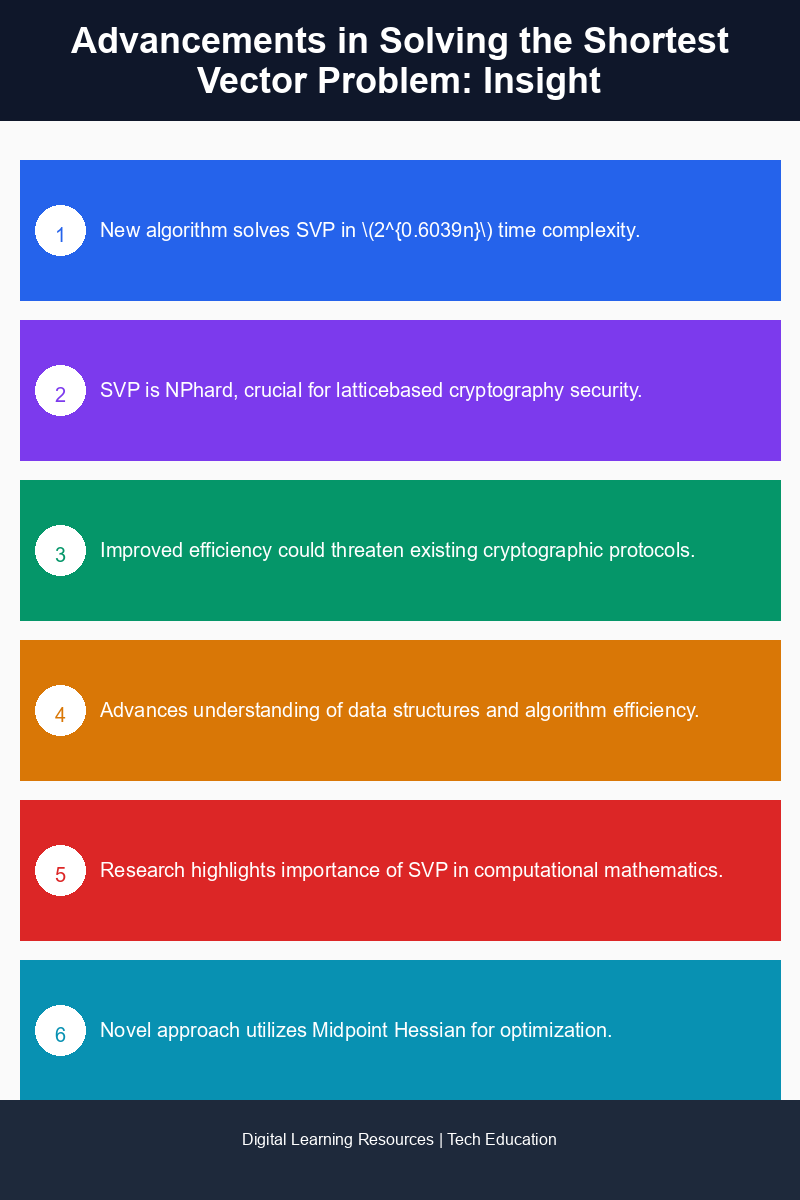
Visual summary of key concepts
GMAT Flashcard Study System | 700 Cards | 8 Categories | Anki Decks Normal Cloze | 8 PDF Layouts Color Print | Offline Interactive HTML
GMAT Flashcard Study System | 700 Cards | 8 Categories | Anki Decks Normal Cloze | 8 PDF Layouts Color Print | Offline Interactive HTML
MCAT Flashcard Study System | 820 Cards | 9 Categories | Anki Decks Normal Cloze | 8 PDF Layouts Color Print | Instant Download
MCAT Flashcard Study System | 820 Cards | 9 Categories | Anki Decks Normal Cloze | 8 PDF Layouts Color Print | Instant Download
PSAT Flashcard Study System | 600 Cards | 9 Categories | Anki Decks Normal Cloze | 8 Pdf Layouts Color Print | PSAT NMSQT Exam Prep
PSAT Flashcard Study System | 600 Cards | 9 Categories | Anki Decks Normal Cloze | 8 Pdf Layouts Color Print | PSAT NMSQT Exam Prep
The Mid-point Hessian approach allows for a more refined analysis of lattice structures, which can lead to more efficient searching methods for the shortest vectors. This is particularly relevant for developers and researchers working on cryptographic systems that rely on the hardness of SVP. The authors detail the algorithm’s implementation, providing insights into its effectiveness through various experimental results, which demonstrate its superiority over traditional methods.
Implications for Cryptography and Security
The advancements presented in this paper have significant implications for the field of cryptography. As lattice-based cryptographic schemes gain traction due to their potential resistance to quantum attacks, understanding the efficiency of algorithms solving SVP becomes paramount. A more efficient solution could potentially expose vulnerabilities in current cryptographic systems, necessitating rapid advancements in security protocols to safeguard against emerging threats.
Furthermore, the paper emphasizes the importance of community engagement and collaboration in research. The authors have made their findings accessible through arXiv, allowing other researchers to build upon their work. This aligns with the goals of platforms like arXivLabs, which promote the development of new features and tools to enhance the sharing of scientific knowledge. Researchers are encouraged to utilize bibliographic tools and explore code and data associated with the paper, fostering a collaborative approach to advancing the field.
Exploration and Future Directions
The paper opens up various avenues for future research. The introduction of the Mid-point Hessian technique could inspire further innovations in algorithm design, potentially leading to even more efficient solutions for SVP and related problems. Researchers may also explore the application of this algorithm in other areas of computational mathematics, extending its relevance beyond cryptography.
As the landscape of cybersecurity evolves, continuous exploration of SVP solutions will be crucial. The insights gained from this research could prompt the development of next-generation cryptographic systems that are both secure and efficient. For developers and learners in the field, engaging with these advancements through structured practice and collaboration will be essential in staying ahead of potential challenges posed by new vulnerabilities.
MyFlashDecks.com
Need Custom Flashcards for Any Exam or Topic?
Get a complete flashcard study system tailored to your exact topic — 800+ cards, an interactive HTML app, 8 PDF layouts, and 2 Anki decks, all delivered to your email within 24 hours.
The work presented in arXiv:2608.02478v2 [cs.DS] is a critical step forward in addressing one of the most challenging problems in computer science and cryptography. By understanding and applying the findings of this paper, researchers and developers can contribute to a safer digital future.
Disclaimer: Information gathered from reputed public sources. Verify independently for specific implementations.
Ready to advance your skills? Explore our digital learning resources.
📑 About the author: I also build Digital Bizz Card — hosted digital business cards you can share with a QR code, no app required.