As global temperatures continue to rise, the demand for energy-efficient cooling technologies has never been more critical. Passive radiative cooling (PRC) offers a compelling solution by allowing surfaces to emit thermal radiation directly into space, effectively reducing temperatures without the need for energy input. This process utilizes the atmospheric transparency window between 8 to 13 micrometers, where infrared radiation can escape with minimal interference. Understanding the advancements in high emissivity materials and their practical applications can provide developers and researchers with the insights needed to leverage this technology effectively.
Understanding Passive Radiative Cooling
Passive radiative cooling is defined as the ability of a surface to lose heat by emitting infrared radiation into the atmosphere without any external energy source. This mechanism is particularly effective at night or in clear sky conditions, where surface temperatures can drop significantly. The key to enhancing this cooling effect lies in the use of high emissivity materials, which are engineered to maximize heat radiation in the infrared spectrum while simultaneously reflecting incoming solar radiation. This dual functionality allows for surfaces to achieve temperatures that can be below ambient levels, offering substantial energy savings in applications such as air-conditioning and refrigeration.
Innovative Materials and Their Optical Properties
Recent advancements in macromolecular and materials chemistry have led to the development of novel materials that enhance passive radiative cooling. Among these are nanophotonic structures and polymer films designed with hierarchical porosity. These materials are specifically tailored to exploit the optical properties necessary for effective cooling. For instance, nanostructured surfaces can be engineered to have high emissivity in the infrared range, often exceeding 90%, while maintaining low solar absorptance. This allows them to effectively radiate heat while reflecting sunlight, which is essential for maintaining lower temperatures.
📚 Recommended Digital Learning Resources
Take your skills to the next level:
Nclex-RN Exam Prep Flashcards | 800 Cards | All 8 Content Areas | Anki Decks Normal & Cloze | 8 PDF Layouts | RN Licensing Exam
Nclex-RN Exam Prep Flashcards | 800 Cards | All 8 Content Areas | Anki Decks Normal & Cloze | 8 PDF Layouts | RN Licensing Exam
LSAT Flashcard Study System | 800 Cards | 8 Categories | Anki Decks Normal Cloze | 8 PDF Layouts Color Print
LSAT Flashcard Study System | 800 Cards | 8 Categories | Anki Decks Normal Cloze | 8 PDF Layouts Color Print
📊 Key Learning Points Infographic
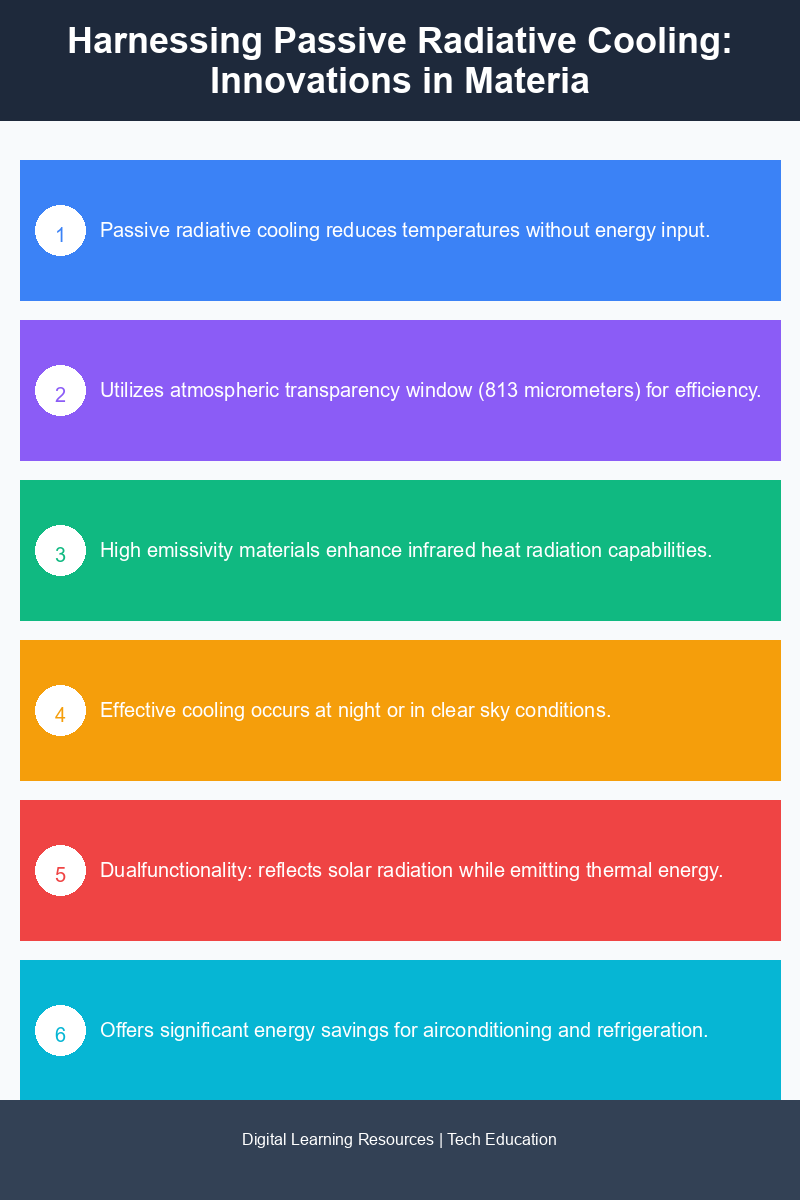
Visual summary of key concepts
GMAT Flashcard Study System | 700 Cards | 8 Categories | Anki Decks Normal Cloze | 8 PDF Layouts Color Print | Offline Interactive HTML
GMAT Flashcard Study System | 700 Cards | 8 Categories | Anki Decks Normal Cloze | 8 PDF Layouts Color Print | Offline Interactive HTML
MCAT Flashcard Study System | 820 Cards | 9 Categories | Anki Decks Normal Cloze | 8 PDF Layouts Color Print | Instant Download
MCAT Flashcard Study System | 820 Cards | 9 Categories | Anki Decks Normal Cloze | 8 PDF Layouts Color Print | Instant Download
PSAT Flashcard Study System | 600 Cards | 9 Categories | Anki Decks Normal Cloze | 8 Pdf Layouts Color Print | PSAT NMSQT Exam Prep
PSAT Flashcard Study System | 600 Cards | 9 Categories | Anki Decks Normal Cloze | 8 Pdf Layouts Color Print | PSAT NMSQT Exam Prep
One promising example is the use of polymer films that incorporate micro- and nano-scale features. These films can be applied to building surfaces, roofing materials, or even textiles, enhancing their cooling properties. Researchers have demonstrated that such films can reduce surface temperatures significantly, with some studies indicating temperature drops of up to 10°C below ambient conditions. This not only contributes to energy savings but also addresses urban heat island effects, where metropolitan areas experience higher temperatures than their rural surroundings due to human activities and infrastructure.
Practical Applications and Impact on Energy Efficiency
The practical implications of passive radiative cooling technologies are vast. In urban environments, integrating high emissivity materials into building designs can lead to substantial energy savings in air-conditioning systems, reducing reliance on electricity during peak demand periods. For example, a study found that buildings utilizing passive cooling materials could reduce their cooling energy consumption by as much as 30%. This reduction not only lowers utility costs but also decreases greenhouse gas emissions associated with energy production.
Moreover, passive radiative cooling can enhance the efficiency of photovoltaic systems. By keeping solar panels cooler, these materials can improve energy conversion rates, leading to higher overall electricity generation. This synergy between passive cooling technologies and renewable energy sources is vital for creating sustainable energy solutions. Additionally, the development of wearable thermal-management textiles utilizing these materials opens up new avenues in consumer products, providing comfort without the need for electronic cooling devices.
The Growing Interest and Research Trends
The field of passive radiative cooling is gaining traction, with an increasing publication trend noted in scientific literature. Researchers are continually exploring new materials, applications, and theoretical frameworks to enhance the efficiency of passive cooling systems. This growing interest underscores the technology’s potential to address pressing climate challenges and improve energy efficiency across various sectors.
For developers and researchers in the tech and materials science fields, staying abreast of these advancements is essential. Engaging with current literature, attending conferences, and participating in collaborative projects can foster innovation and lead to the development of next-generation cooling technologies that are both effective and sustainable.
MyFlashDecks.com
Need Custom Flashcards for Any Exam or Topic?
Get a complete flashcard study system tailored to your exact topic — 800+ cards, an interactive HTML app, 8 PDF layouts, and 2 Anki decks, all delivered to your email within 24 hours.
In summary, passive radiative cooling represents a promising intersection of materials science and energy efficiency. By harnessing the unique optical properties of high emissivity materials, it is possible to create solutions that not only combat rising temperatures but also support sustainable practices across multiple industries.
Disclaimer: Information gathered from reputed public sources. Verify independently for specific implementations.
Ready to advance your skills? Explore our digital learning resources.
📑 About the author: I also build Digital Bizz Card — hosted digital business cards you can share with a QR code, no app required.