Programming & Dev Tutorials
Transforming AI Agents: How Function Calling in LLMs Revolutionizes Tool Use
Discover how function calling in large language models transforms AI agents into powerful tools, enabling them to perform complex tasks and access real-time data.
Contents
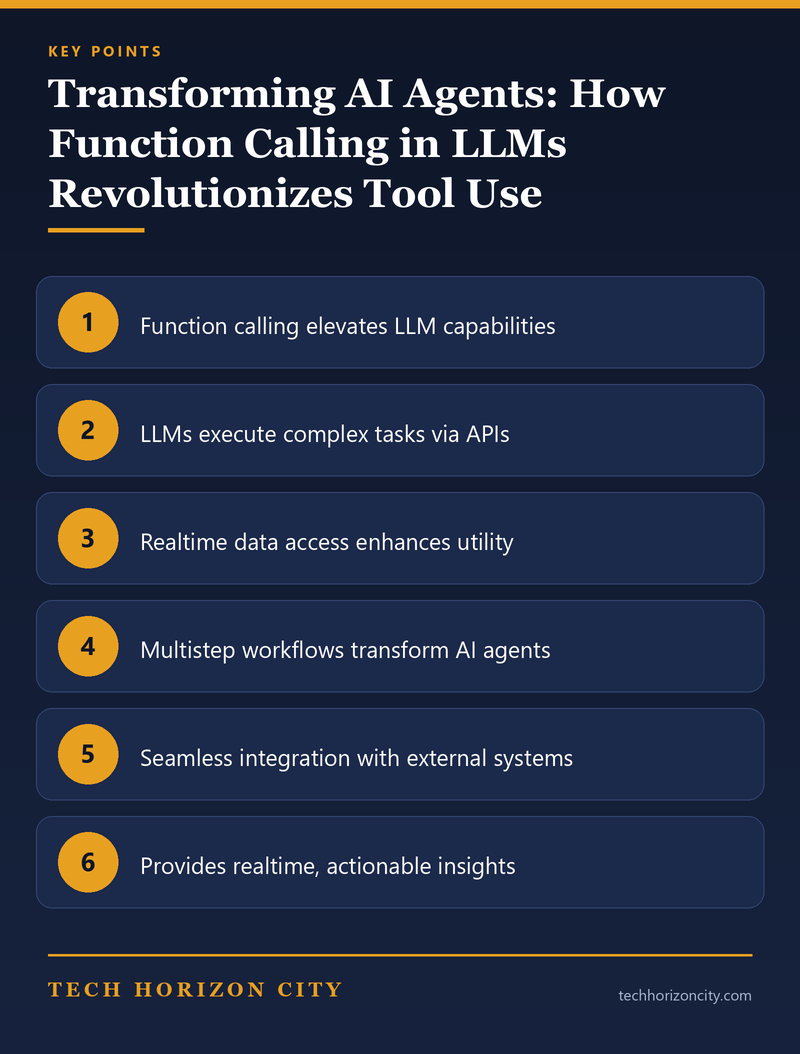
How a Tool Call Works Step by StepA Simple Python ExampleCommon MistakesBeyond Chatbots: The Rise of Useful AutomationFrequently Asked QuestionsFunction calling in large language models (LLMs) elevates them from simple conversational tools to sophisticated software agents capable of executing complex tasks. This innovation allows LLMs to interact with external systems, access live data, and perform multi-step workflows, effectively transforming their capabilities and utility in real-world applications.
How a Tool Call Works Step by Step
Understanding how function calling operates in LLMs requires a breakdown of the process into clear, actionable steps. When a user inputs a request, the LLM processes the text to identify if an external action is necessary. If so, the LLM generates a function call that matches the user’s intent. This function call is then dispatched to the relevant API or external tool.
Once the request reaches the external system, it executes the required operation—be it fetching data, updating records, or triggering a workflow. The system then returns the result to the LLM, which integrates this data into a coherent response. This entire process is seamless, providing users with real-time, actionable insights.
📚 Recommended Digital Learning Resources
Take your skills to the next level:
A Simple Python Example
To illustrate function calling, consider a simple Python example where an LLM retrieves weather data. The LLM receives a user query: “What is the weather in New York?” Upon identifying the need for external data, it executes a function call to a weather API:
import requests def get_weather(city): api_key = “your_api_key” url = f”http://api.weatherapi.com/v1/current.json?key={api_key}&q={city}” response = requests.get(url) return response.json() weather_data = get_weather(“New York”) print(f”Current temperature in New York: {weather_data[‘current’][‘temp_c’]}°C”)In this example, the LLM identifies the city and uses the get_weather function to retrieve current weather data, which is then returned to the user. This interaction exemplifies how LLMs can dynamically access and utilize external data.
Common Mistakes
While function calling significantly enhances LLM capabilities, common mistakes can hinder its effectiveness. One frequent error is improper API authentication. Developers must ensure that API keys and tokens are correctly configured and securely managed to prevent unauthorized access.
Another mistake involves handling unexpected API responses. External systems may return errors or unexpected data formats, which can disrupt the LLM’s processing. Implementing robust error handling and data validation strategies is crucial to maintain smooth operations.
Lastly, improper parsing of user inputs can lead to incorrect function calls. Developers should implement natural language processing techniques to accurately interpret user intent and map it to the correct external functions.
Beyond Chatbots: The Rise of Useful Automation
Function calling blurs the line between traditional chatbots and advanced automation solutions. By enabling LLMs to interact with external tools and APIs, these models move beyond simple text generation to become powerful agents capable of executing meaningful actions. They can access live CRM data, check inventory levels, and manage workflows across various platforms, offering significant benefits to businesses and users alike.
This evolution not only enhances user experience by providing real-time, actionable insights but also streamlines business operations. Industries ranging from customer service to supply chain management can leverage these advanced capabilities to optimize efficiency and improve decision-making processes.
In conclusion, function calling in LLMs represents a significant leap forward in AI technology, transforming these models into versatile agents capable of complex interactions with external systems. By understanding the intricacies of this process and avoiding common pitfalls, developers can harness the full potential of LLMs to drive innovation and automation across various domains.
Frequently Asked Questions
How does function calling work in LLMs?
Function calling in LLMs involves invoking specific functions or APIs to enhance the model’s capabilities, allowing it to perform tasks like data retrieval, calculations, or interacting with external systems.
What are the benefits of AI agents using tools?
AI agents using tools can significantly expand their functionality, enabling them to perform more complex tasks, access real-time information, and provide more accurate and context-aware responses.
Can you give a Python API example for function calling in LLMs?
A Python API example for function calling in LLMs might involve using a library like OpenAI’s API, where you define a function in Python and use the LLM to call this function to perform specific tasks or computations.
Why are LLM capabilities enhanced by tool use?
LLM capabilities are enhanced by tool use because tools can provide access to specialized knowledge, allow for real-time data processing, and enable interaction with external systems, thus broadening the range of tasks the LLM can perform.
Is function calling in LLMs essential for advanced AI applications?
Function calling in LLMs is essential for advanced AI applications as it allows the integration of external functionalities, enabling the AI to perform tasks beyond its inherent language processing capabilities.
Ready to advance your skills? Explore our digital learning resources.
Keep reading
Details such as prices, limits and version behaviour change often. Check the provider’s own documentation before relying on them.