The challenge of updating a Retrieval-Augmented Generation (RAG) knowledge base without a complete rebuild is critical for maintaining system efficiency and data relevance. By employing incremental update patterns, leveraging a metadata registry, and utilizing delta indexing, organizations can significantly enhance their knowledge management processes. This article will explore these methodologies in detail, demonstrating how they can be implemented for effective knowledge base updates.
Understanding Incremental Update Patterns
Incremental update patterns revolutionize the way knowledge bases are maintained, allowing for quick adjustments without the need for extensive downtime or resource consumption. Rather than performing full rebuilds, which can take hours or even longer, incremental updates focus on processing only new or modified documents. This approach can drastically reduce ingestion latency from several hours to as little as single-digit minutes, ensuring that the most current data is always at your fingertips.
For instance, if your knowledge base relies on a full nightly rebuild, consider adjusting to a system that only ingests changes. This way, you can add new documents or update existing ones almost in real-time. Such efficiency not only enhances user experience but also improves overall system performance.
Utilizing a Metadata Registry
A metadata registry plays a pivotal role in effective incremental updates. By tracking indexed items with essential data points—such as document IDs, content hashes, and timestamps—this registry allows the system to identify which documents need to be processed during an update. This tracking ensures that even minor changes are accounted for, eliminating the possibility of outdated information lingering in the knowledge base.
For example, when a document is modified, the system can reference its content hash to determine if a re-index is necessary. If the hash has changed, the metadata registry flags it for inclusion in the next update cycle. This method ensures that only relevant documents undergo processing, further enhancing the speed and efficiency of updates.
Implementing Delta Indexing and Automation
Delta indexing is a technique that focuses solely on new or altered documents, making it a cornerstone of efficient knowledge base management. By processing these changes incrementally, organizations can greatly reduce latency and ensure that data remains current without the overhead of full indexing.
📊 Key Learning Points Infographic
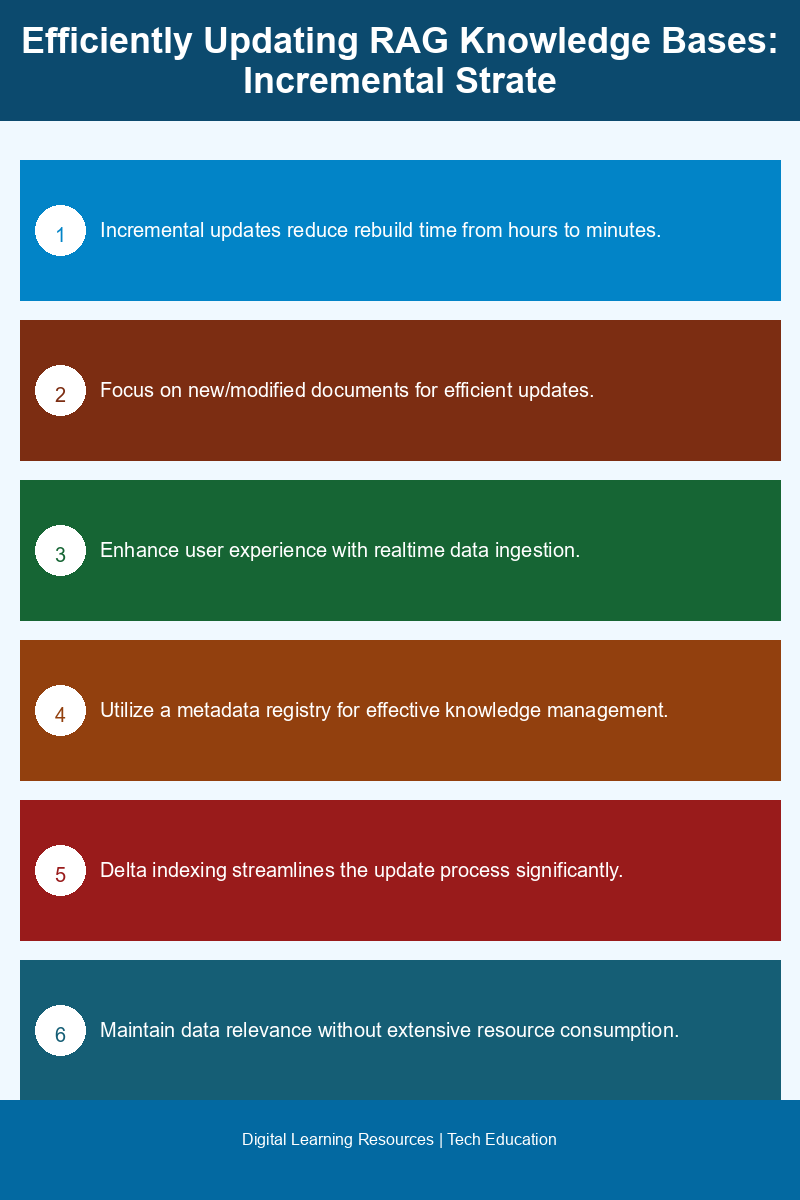
Visual summary of key concepts
To implement delta indexing effectively, organizations should consider using file system monitoring or CMS webhooks. These tools can automatically trigger the ingestion of updates whenever a document is added or modified. For example, a webhook can notify the knowledge base system immediately after a blog post is published, prompting an update that includes the new content without delay.
This real-time processing capability means that updates can be completed in minutes, ensuring users are interacting with the most up-to-date information. Such speed is vital in environments where data accuracy is paramount, such as customer support or live data analytics.
Ensuring Consistency with Atomic Updates and Staging Patterns
While speed is essential, maintaining the integrity of the knowledge base during updates is equally important. This is where atomic updates and staging patterns come into play. Atomic updates ensure that changes are either fully applied or not applied at all, preventing inconsistencies during the ingestion process.
For critical documents, implementing a staging pattern allows old vectors to remain active while new ones are being generated. This approach avoids retrieval gaps that could occur if a user attempts to access a document during an update. By using a temporary staging flag in the metadata, the system can manage the transition smoothly, ensuring continuous access to information.
Once new vectors are successfully inserted, organizations can perform a batch deletion of old vectors in a single operation. This method not only simplifies the cleanup process but also guarantees that the knowledge base is always covered comprehensively by the newest data.
Leveraging Vector Database Support
Most modern vector databases offer robust support for metadata filtering, which can significantly enhance the update processes. By utilizing these features, organizations can streamline their incremental update strategies even further. For example, when new documents are ingested, the vector database can automatically filter and index them based on the associated metadata, ensuring that retrieval is both efficient and precise.
Additionally, using a vector database with built-in support for real-time updates can simplify the architecture of the knowledge base system. The combination of delta indexing and metadata filtering allows for a seamless update experience, with minimal impact on system performance.
Conclusion
Updating a RAG knowledge base need not be a cumbersome task fraught with latency issues. By adopting incremental update patterns, utilizing a metadata registry, and implementing delta indexing alongside automation tools, organizations can achieve rapid updates while maintaining data integrity. Prioritizing these strategies from the outset of system design ensures that updates become a streamlined part of the knowledge management process, enhancing both efficiency and user satisfaction.
Frequently Asked Questions
How can I update my RAG knowledge base without rebuilding everything?
You can implement incremental update patterns that allow you to modify specific sections of your knowledge base while keeping the overall structure intact. This approach minimizes downtime and streamlines the update process.
What are incremental update patterns for knowledge base updates?
Incremental update patterns refer to strategies that allow you to make targeted updates to your knowledge base, such as adding new information or correcting existing data, without needing a complete overhaul. This method enhances efficiency and reduces resource expenditure.
Why is metadata tracking important for a knowledge base?
Metadata tracking is crucial because it helps maintain the context and relevance of the information in your knowledge base. It allows for easier updates, better organization, and improved retrieval of information when needed.
Can I automate the process of updating my RAG knowledge base?
Yes, you can automate updates by using scripts or tools that monitor changes in your data sources and integrate them into your knowledge base. This automation can significantly reduce manual workload and ensure timely updates.
Is it necessary to rebuild my knowledge base for every update?
No, it is not necessary to rebuild your knowledge base for every update. Utilizing incremental update methods allows you to make changes efficiently without a complete rebuild, saving time and resources.
Disclaimer: Information gathered from reputed public sources. Verify independently for specific implementations.
Ready to advance your skills? Explore our digital learning resources.
Related reading:
📑 About the author: I also build Digital Bizz Card — hosted digital business cards you can share with a QR code, no app required.