Programming & Dev Tutorials
Evaluating AI Agents: Key Metrics and Common Pitfalls
Learn how to evaluate AI agents effectively by focusing on task performance, decision-making quality, user interaction, safety, trustworthiness, and bias mitigation.
In short Evaluating AI agents is a crucial step in ensuring they perform effectively in tasks, make sound decisions, and interact seamlessly with users. This process not only verifies that AI agents function according to their design but also ensures compliance with ethical AI principles.
Contents
What to Measure in AI Agent EvaluationBuilding a Small Test SetCommon Failure Modes in AI AgentsConclusionFrequently Asked QuestionsBy assessing AI agents accurately, developers can ensure these systems are safe, trustworthy, and ready for deployment in real-world scenarios.
What to Measure in AI Agent Evaluation
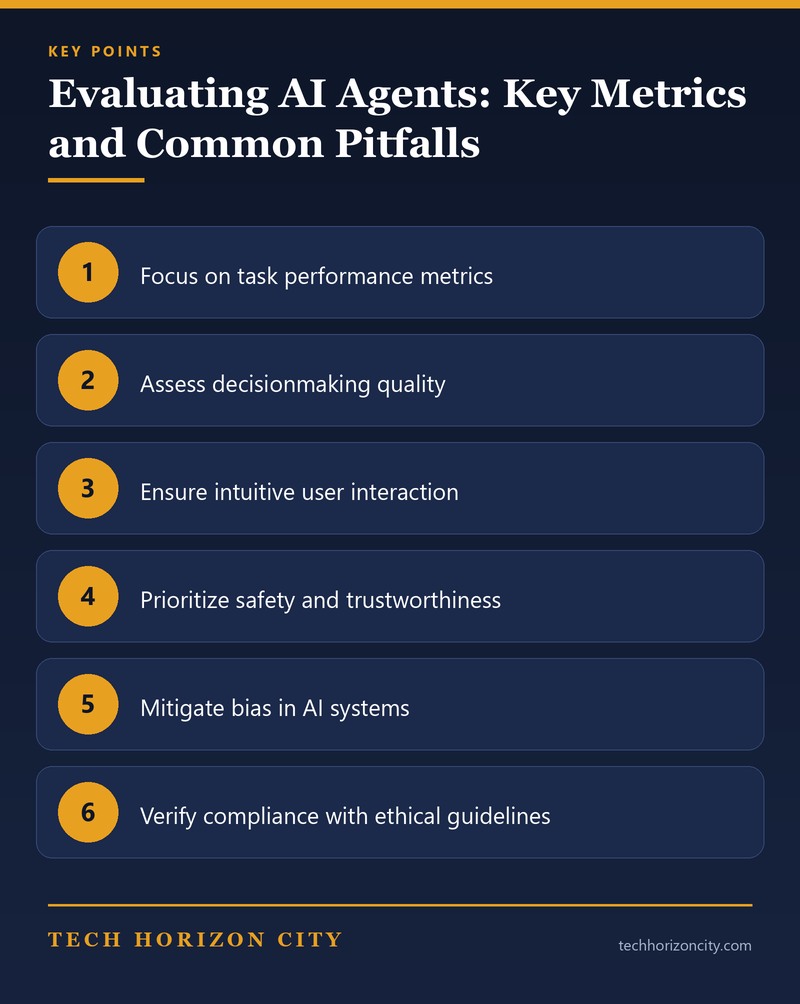
When evaluating AI agents, it’s essential to focus on several key metrics to gain a comprehensive understanding of their performance. The primary aspects include:
- Task Performance: This involves measuring the accuracy and efficiency with which the AI agent completes its assigned tasks. Metrics like task completion rate, error rate, and time taken to complete tasks are common indicators.
- Decision-Making Quality: Evaluating the quality of decisions made by AI agents is critical. This includes assessing how well the agent adheres to predefined decision-making protocols and ethical guidelines.
- User Interaction: AI agents must interact with users in a way that is intuitive and understandable. Evaluation should include metrics for interaction quality, such as user satisfaction scores and response times.
- Safety and Trustworthiness: Safety involves ensuring the agent does not engage in harmful behavior, while trustworthiness means the agent’s actions are predictable and verifiable. These aspects are crucial for maintaining user trust and policy compliance.
- Bias Mitigation: It’s vital to assess the agent for any biased behaviors or decisions, ensuring fairness and avoiding discriminatory outcomes.
Building a Small Test Set
Creating a representative test set is a foundational step in evaluating AI agents. A well-designed test set should include diverse inputs that reflect real-world scenarios and conditions. To build an effective test set, consider the following steps:
- Data Collection: Gather data from a variety of sources to ensure a wide range of inputs. This might include different user demographics, task types, and environmental conditions.
- Annotation: Annotated data serves as the ground truth for testing AI models. Ensure that the dataset is accurately labeled to provide a reliable benchmark for evaluation.
- Scenario Simulation: Include scenarios that simulate real-time conditions the AI agent might face. This helps test the agent’s adaptability and robustness in dynamic environments.
By building a comprehensive test set, developers can better understand how an AI agent will perform in actual use cases, leading to more reliable deployment outcomes.
Common Failure Modes in AI Agents
Despite careful evaluation, AI agents can exhibit various failure modes that compromise their effectiveness. Understanding these common pitfalls can help developers anticipate and mitigate potential issues:
- Overfitting: This occurs when an AI agent performs exceptionally well on test data but fails to generalize to new, unseen data. It often results from training on a dataset that is too narrow or not representative enough.
- Bias and Discrimination: If the training data is biased, the AI agent can inherit these biases, leading to unfair or discriminatory behavior. Regularly auditing datasets for bias is crucial to prevent this.
- Safety Violations: AI agents can sometimes make decisions that violate safety protocols, posing risks to users or systems. Rigorous testing for safety compliance is necessary to avoid such issues.
- Manipulation and Misuse: AI agents can be susceptible to manipulation or misuse, either by users or malicious actors. Ensuring robust security measures and monitoring can help safeguard against these threats.
Recognizing these failure modes allows developers to implement preemptive strategies to enhance the reliability and safety of AI agents.
Conclusion
Evaluating AI agents is a multifaceted process that requires careful consideration of task performance, decision-making, user interaction, and safety. By focusing on key metrics, building robust test sets, and understanding common failure modes, developers can ensure that AI agents are ready for real-world deployment. Such thorough evaluation is essential for maintaining user trust, ensuring policy compliance, and preventing harmful behavior, ultimately paving the way for more effective and ethical AI systems.
Frequently Asked Questions
How do you evaluate AI agent performance effectively?
To evaluate AI agent performance effectively, use a combination of quantitative metrics like accuracy, precision, recall, and F1 score, alongside qualitative assessments such as user feedback and task-specific benchmarks.
What are the key AI performance metrics to consider?
Key AI performance metrics include accuracy, precision, recall, F1 score, and AUC-ROC, which help gauge the effectiveness and efficiency of an AI agent in performing its designated tasks.
Why is AI bias mitigation important in AI agent evaluation?
AI bias mitigation is crucial because it ensures fairness and prevents discriminatory outcomes, which is vital for maintaining ethical AI principles and building trust in AI systems.
Can ethical AI principles improve AI agent evaluation?
Yes, incorporating ethical AI principles into AI agent evaluation helps ensure that the AI system operates fairly, transparently, and responsibly, aligning with societal values and legal standards.
Is there a standard process for AI agent evaluation?
While there is no one-size-fits-all standard, a robust AI agent evaluation process typically involves defining clear objectives, selecting appropriate performance metrics, and conducting thorough testing for bias and ethical compliance.
Ready to advance your skills? Explore our digital learning resources.
Keep reading
Details such as prices, limits and version behaviour change often. Check the provider’s own documentation before relying on them.
Looking for paid, flexible work in AI? The Handshake AI Program offers remote, part-time AI projects, and no AI experience is required. It is open to applicants based in the U.S. with valid U.S. work authorization.
Referral link: if you sign up through it, I may receive a referral reward.