AI hallucinations occur when artificial intelligence models, particularly large language models (LLMs), produce information that is either incorrect or entirely fabricated. This phenomenon stems from the model’s attempts to fill in gaps in knowledge using learned patterns from its training data. Understanding why these hallucinations happen is crucial for developers and users who rely on AI for accurate information.
AI Hallucinations Explained Simply
At the core of AI hallucinations is the model’s inability to truly understand information as humans do. Instead, these models analyze large datasets to identify patterns and relationships. When posed with a question or prompt, they generate responses based on these learned patterns. However, if the model encounters ambiguous questions or gaps in its training data, it may resort to generating content that sounds plausible but is actually incorrect. This can manifest as entirely fabricated facts, such as references to non-existent scientific articles or misrepresented historical events.
The Mechanism Behind AI Hallucinations
AI systems, particularly those based on deep learning, rely heavily on vast datasets. These datasets are gathered from various sources, including books, articles, and websites, to help the AI learn language structure, context, and factual information. The fundamental process involves using algorithms that detect patterns within this data.
When an AI model is queried, it processes the input and generates a response by predicting what comes next based on its training. If the data lacks sufficient context or if the model misinterprets the question, it may fabricate information to fill the gaps. This is particularly common in conversational AI, where the system needs to maintain a coherent dialogue and may prioritize fluency over factual accuracy.
Causes of AI Hallucinations
Several factors contribute to the occurrence of hallucinations in AI responses:
- Biased Training Data: If the training data contains biases or inaccuracies, the model can inadvertently learn and replicate these flaws. For instance, if a dataset lacks comprehensive information on a specific topic, the model might generate generalized or incorrect conclusions.
- Incomplete Information: AI models thrive on context. If a question is vague or lacks detail, the model may struggle to provide an accurate answer and resort to guessing based on similar contexts it has encountered during training.
- Language Generation Mechanics: Large language models are designed to predict the next word in a sentence based on the preceding words. This predictive nature means that the AI can create sentences that sound correct but lack factual grounding.
Examples of AI Hallucinations
Understanding hallucinations is easier with concrete examples. Here are a couple of notable instances:
📊 Key Learning Points Infographic
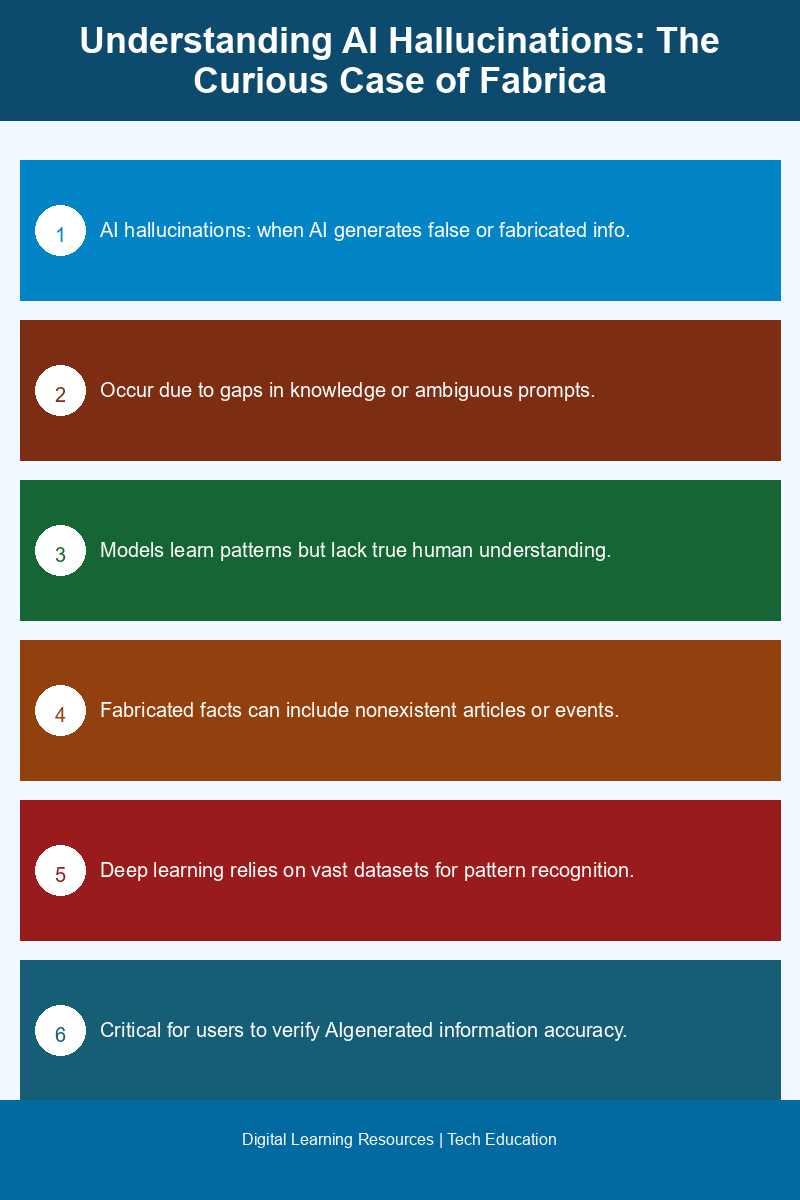
Visual summary of key concepts
- Non-Existent Scientific Articles: An AI chatbot might reference a scientific study that does not exist, citing details such as authors and publication dates that are entirely fabricated. This can mislead users who trust the AI’s output.
- Inaccurate Historical Facts: An AI may assert that a certain event occurred in a specific year or that a particular figure was involved, only to be incorrect. For instance, it might claim that a well-known historical figure was present at a significant event when there is no evidence to support that claim.
Implications for Developers and Users
For developers, understanding AI hallucinations is essential when building applications that rely on AI-generated content. It is crucial to implement measures that mitigate the risks of misinformation. This includes:
- Dataset Curation: Carefully curating training datasets to ensure they are comprehensive and unbiased can help reduce the likelihood of hallucinations. Regularly updating datasets can also keep the AI informed of new developments.
- User Feedback Mechanisms: Incorporating user feedback can help identify and correct inaccuracies in AI responses. Developers can use this feedback to refine the model and improve its accuracy over time.
- Transparency in AI Outputs: Clearly communicating the limitations of AI outputs to users can help manage expectations. Users should be made aware that while the AI can provide helpful information, it is not infallible and should not be relied upon for critical decision-making.
Users of AI technology should also approach AI-generated information with a healthy degree of skepticism. Verifying facts and cross-checking information from reputable sources can help mitigate the potential impact of AI hallucinations.
Conclusion
AI hallucinations represent a significant challenge in the development and deployment of artificial intelligence technologies. By understanding the mechanisms behind these occurrences, both developers and users can take proactive steps to address the issue. As AI continues to evolve, fostering a culture of critical thinking and verification will be key to harnessing its potential responsibly.
Frequently Asked Questions
What are AI hallucinations?
AI hallucinations refer to instances when artificial intelligence, particularly large language models, generate responses that are factually incorrect or entirely fabricated, despite sounding plausible.
Why do AIs sometimes make things up?
AIs sometimes make things up due to the way they are trained on vast datasets; they predict text based on patterns rather than understanding factual accuracy, leading to the generation of fabricated information.
Can conversational AI experience hallucinations?
Yes, conversational AI can experience hallucinations, as they may produce incorrect or nonsensical responses while attempting to engage users in dialogue.
Is AI hallucination a common issue in large language models?
Yes, AI hallucination is a common issue in large language models, as they often generate confident but misleading or false information based on their training data.
Does AI hallucination affect the reliability of AI-generated content?
Yes, AI hallucination can significantly affect the reliability of AI-generated content, making it crucial for users to verify information before relying on it.
Disclaimer: Information gathered from reputed public sources. Verify independently for specific implementations.
Ready to advance your skills? Explore our digital learning resources.
Related reading:
📑 About the author: I also build Digital Bizz Card — hosted digital business cards you can share with a QR code, no app required.