Hybrid search in Retrieval-Augmented Generation (RAG) significantly improves the quality of AI-generated responses by combining keyword search and vector search methodologies. This dual approach enables systems to retrieve not only exact matches for user queries but also semantically relevant information, thereby enhancing the effectiveness of information retrieval and overall user satisfaction.
What is Hybrid Search in RAG?
Hybrid search in RAG integrates two distinct methods of information retrieval: traditional keyword search, often referred to as sparse search, and vector search, which is grounded in semantic understanding. In this framework, user queries are processed using both techniques simultaneously, leading to a more comprehensive retrieval process.
Keyword search operates on the principle of matching exact terms within a database. For example, if a user searches for “memory leaks,” the system retrieves documents that contain this specific phrase. While this method is straightforward, it suffers from significant limitations; it can overlook relevant information that does not explicitly match the search terms.
On the other hand, vector search utilizes machine learning algorithms to represent words and phrases as vectors in a high-dimensional space. This allows it to capture the semantic meanings behind words. Thus, a query for “memory leaks” might also surface documents discussing “performance optimization,” even if the exact phrase isn’t mentioned. By combining both methods, hybrid search ensures that users receive a richer set of results, encompassing both exact matches and broader contextual understanding.
Implementing Hybrid Search with Meilisearch
Meilisearch is an open-source search engine designed for fast and relevant search experiences. It provides an ideal platform for implementing hybrid search in RAG due to its support for both keyword and vector search capabilities. Here’s how you can set up a hybrid search pipeline using Meilisearch:
- Step 1: Indexing Data – Begin by indexing your data in Meilisearch. This involves creating a searchable dataset that contains both keyword-rich documents and their corresponding embeddings, which can be generated using models like Sentence Transformers or BERT.
- Step 2: Configuring Search Settings – Configure Meilisearch to handle keyword searches using BM25 ranking, a popular algorithm that optimizes the retrieval of documents based on term frequency and document length. Simultaneously, enable vector search capabilities by integrating embeddings into your dataset.
- Step 3: Query Processing – When a user submits a query, Meilisearch first performs a keyword search to retrieve relevant documents that contain the explicit search terms. It then executes a vector search to find semantically related content. This dual search operation can be performed in parallel, ensuring that the most relevant results are surfaced quickly.
- Step 4: Merging and Re-Ranking – Once both searches are complete, the results are merged and re-ranked based on relevance. This step is crucial as it allows you to prioritize documents that are most aligned with user intent, combining both exact matches and semantically relevant entries.
- Step 5: Passing Results to LLM – Finally, the top-ranked documents are sent to a large language model (LLM) for answer generation. The LLM utilizes the retrieved information to formulate comprehensive and contextually accurate responses, thereby enhancing the user experience.
Benefits of Hybrid Search in RAG
The adoption of hybrid search in RAG systems, especially through tools like Meilisearch, offers several advantages:
📊 Key Learning Points Infographic
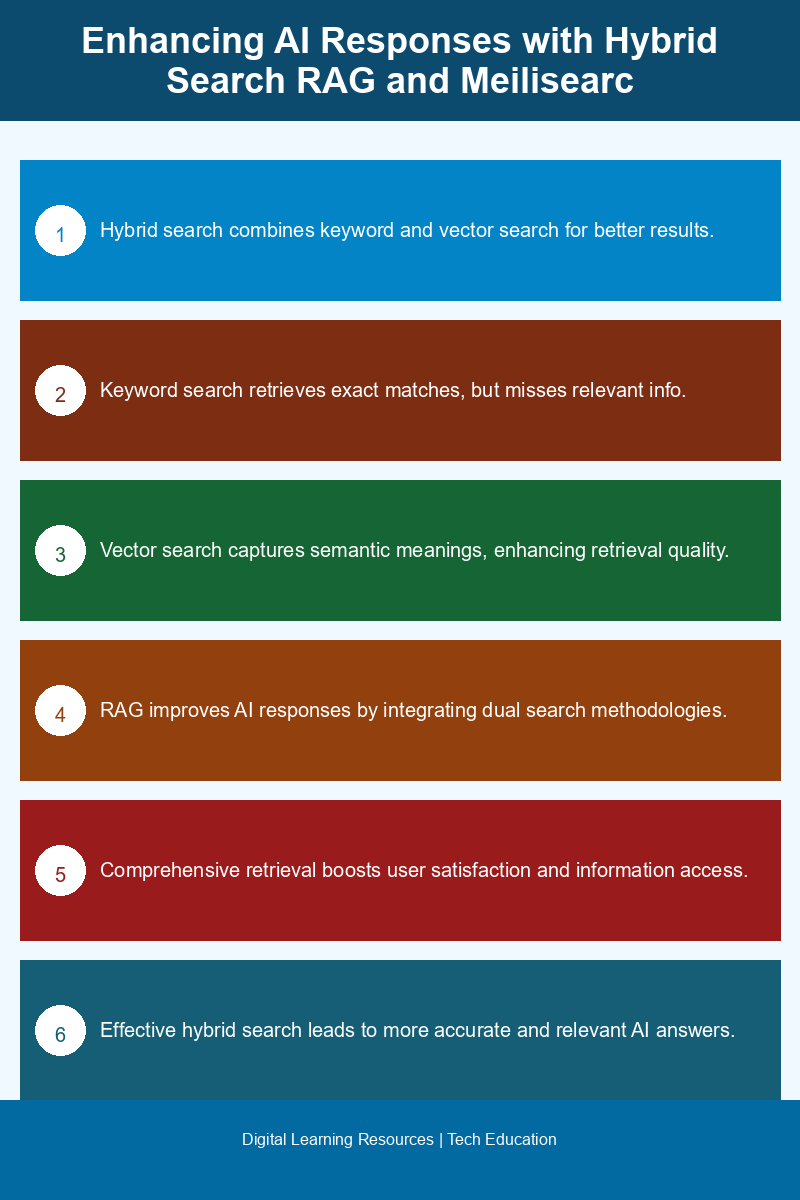
Visual summary of key concepts
- Comprehensive Retrieval: By leveraging both keyword and vector search, hybrid search captures a wider range of relevant information. Users benefit from receiving not just documents that contain their specific search terms, but also those that are contextually related, which might contain guides, code snippets, or explanations that can aid in problem-solving.
- Improved Precision and Accuracy: The re-ranking process enhances the precision of the results. Users are more likely to find exactly what they need within the top results, reducing the time spent sifting through irrelevant information.
- Enhanced User Experience: The combination of exact and semantically related content leads to a more satisfying user experience, as users receive answers that are more aligned with their queries. This is particularly beneficial in customer support scenarios, where understanding user intent is crucial.
Real-World Application: Customer Support RAG Pipeline
A practical example of hybrid search in action can be seen in customer support systems. In such scenarios, users often seek answers to complex questions that may not be directly addressed in available documentation. A well-implemented hybrid search RAG pipeline can significantly enhance response quality.
In a customer support context, suppose a user queries “how to resolve memory leaks in my application.” A pure keyword search might only retrieve articles that have the exact phrase “memory leaks,” which could be limited. However, a hybrid search approach using Meilisearch would fetch not only the articles with that specific term but also those discussing related topics such as “application performance” or “garbage collection techniques.” This broader retrieval allows the support agent or automated response system to provide a more comprehensive answer that addresses the user’s underlying concerns.
By merging results from both search methods and re-ranking them based on relevance, the system can present the most pertinent information to the LLM, which can then craft a well-rounded response. This capability significantly boosts customer satisfaction and reduces resolution times.
Conclusion
Hybrid search in RAG, especially when implemented through tools like Meilisearch, represents a powerful advancement in AI-driven information retrieval. By combining keyword and vector search methodologies, systems can deliver more relevant and accurate responses to user queries. This not only enhances the effectiveness of AI applications but also enriches the overall user experience, making it an essential technique for developers and tech educators to understand and employ in their workflows.
Frequently Asked Questions
What is hybrid search RAG in Meilisearch?
Hybrid search RAG (Retrieval-Augmented Generation) in Meilisearch combines traditional keyword search with semantic search capabilities, allowing AI to generate more accurate and contextually relevant responses based on both structured data and unstructured content.
How does Meilisearch improve AI-generated responses?
Meilisearch enhances AI-generated responses by leveraging its fast indexing and retrieval capabilities, enabling the AI to access relevant information quickly and provide answers that are not only precise but also contextually aware.
Why is semantic search important for AI answers?
Semantic search is crucial for AI answers because it allows the AI to understand the intent behind queries and the contextual meaning of words, leading to more relevant and accurate responses that align with user expectations.
Can I use Meilisearch for hybrid search RAG?
Yes, Meilisearch is specifically designed to support hybrid search RAG, allowing developers to implement both keyword-based and semantic search features seamlessly in their applications.
When should I consider implementing hybrid search RAG?
You should consider implementing hybrid search RAG when your application requires high-quality, contextually relevant AI-generated responses, especially in scenarios where users seek nuanced information or insights from a mix of structured and unstructured data.
Disclaimer: Information gathered from reputed public sources. Verify independently for specific implementations.
Ready to advance your skills? Explore our digital learning resources.
Related reading:
📑 About the author: I also build Digital Bizz Card — hosted digital business cards you can share with a QR code, no app required.