The efficiency of the Retrieval-Augmented Generation (RAG) pipeline is heavily influenced by how source content is chunked. Improper chunking can result in irrelevant or incomplete answers, undermining the potential of this powerful AI tool. Understanding the nuances of chunking is essential for developers and data scientists who want to optimize their RAG systems for better retrieval and generation outcomes.
The Importance of Chunking in RAG
Chunking refers to the process of dividing documents into manageable, retrievable pieces. This step is crucial in a RAG setup where the system retrieves information from a vast corpus to generate coherent answers. An effective chunking strategy directly impacts the vector search results and the clarity of the answers provided by the AI.
When chunks are too small, they often lack the necessary context, leading to fragmented information that can confuse the model. Conversely, if chunks are too large, the relevance of the information can diminish, as they may encompass multiple topics. This can result in a loss of discriminative power during similarity searches, causing the model to retrieve irrelevant content. Therefore, finding the right balance in chunk size is essential for maintaining both relevance and context.
Challenges with Chunk Size
Determining the optimal size for chunks is a complex challenge. Industry frameworks and vendor guidelines highlight chunking as a critical design decision. For instance, if you are working with technical documentation, smaller chunks may be appropriate to ensure that specific queries yield precise answers. However, in cases where broader context is necessary, larger chunks might be beneficial. For concrete starting points by content type, see our breakdown of recommended chunk sizes for effective document processing.
Large chunks can inadvertently combine disparate topics, which dilutes the effectiveness of the retrieval process. For example, if a chunk contains information about both “AI development” and “cloud computing,” queries focused solely on AI might return irrelevant details about cloud technologies. This dilution complicates the retrieval process, ultimately leading to suboptimal performance of embeddings and large language models (LLMs).
Tailoring Chunking Strategies to Data Type and Usage
There is no one-size-fits-all approach to chunking. The effectiveness of a chunking strategy can vary widely based on the data type, the nature of user queries, and the specific trade-offs between latency and accuracy. For example, a real-time application might prioritize speed and therefore opt for larger chunks to minimize retrieval time, accepting some loss of precision. In contrast, applications demanding high accuracy—such as medical or legal document retrieval—might benefit from smaller, context-rich chunks.
📊 Key Learning Points Infographic
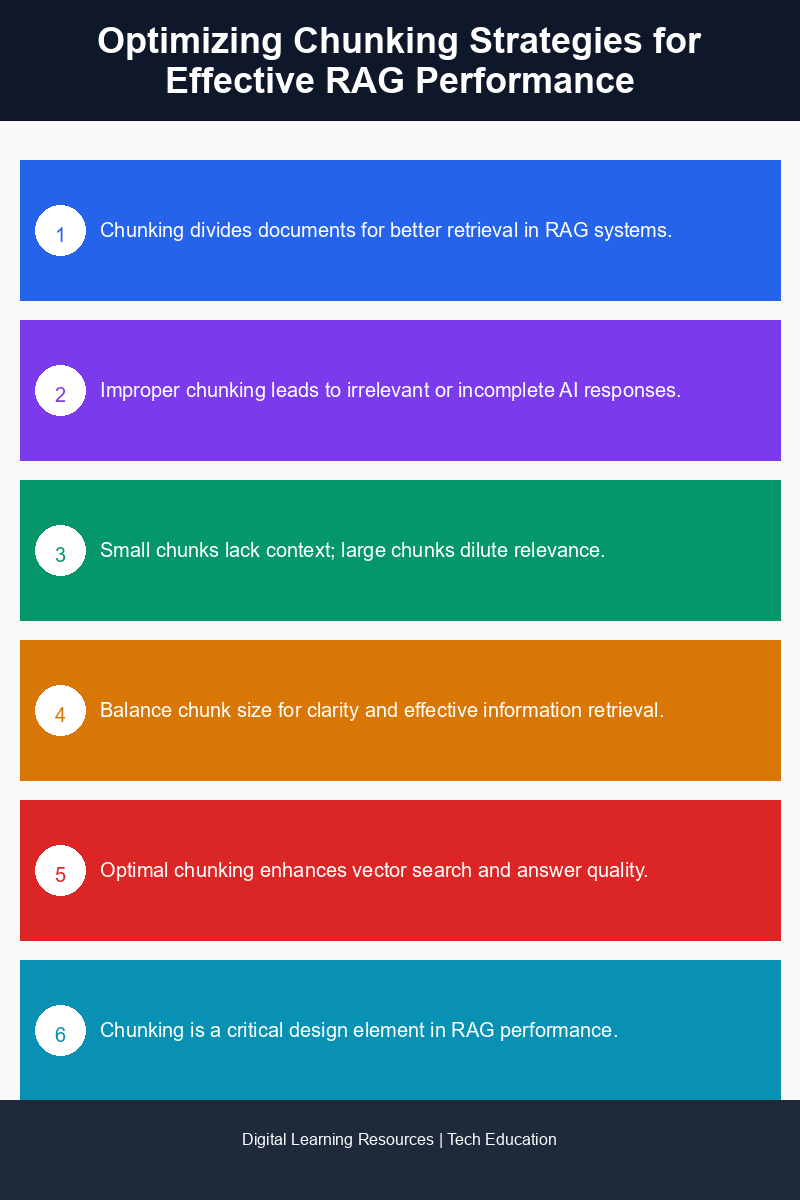
Visual summary of key concepts
Developers can utilize various techniques to optimize chunking based on specific use cases. For instance, implementing a hierarchical chunking strategy can allow for broader context in initial retrievals, followed by a secondary, finer-grained search of smaller chunks for detailed answers. Tools like Elasticsearch or Apache Solr can aid in the effective indexing of these chunks, improving retrieval accuracy.
Best Practices for Implementing Effective Chunking
To ensure that your RAG pipeline functions optimally, consider the following best practices for chunking:
- Analyze Content Types: Identify the nature of the documents you are working with. Technical manuals, articles, and FAQs each require different chunking strategies due to their distinct formats and purposes.
- Iterate on Chunk Size: Start with a balanced approach and adjust based on performance metrics. Monitor the relevance and completeness of answers returned by the RAG system and refine chunk sizes accordingly.
- Use Semantic Analysis: Incorporate natural language processing (NLP) techniques to understand the underlying themes within documents. This can help in creating more coherent and contextually appropriate chunks.
- Leverage Feedback Loops: Implement a system to gather user feedback on the relevance of the responses. Use this data to continually improve chunking strategies and enhance overall system performance.
Incorporating these practices will not only improve the quality of the answers generated by your RAG pipeline but also enhance user satisfaction and trust in the system.
Chunking is a fundamental aspect of the RAG architecture that can significantly influence the overall effectiveness of the model. By paying careful attention to how documents are chunked and making informed adjustments, developers can optimize their systems for better retrieval and generation outcomes. This leads to a richer user experience and more accurate information delivery, ultimately driving the success of AI-driven applications.
Disclaimer: Information gathered from reputed public sources.
Verify independently for specific implementations.
Ready to advance your skills?
Explore our digital learning resources.
📑 About the author: I also build Digital Bizz Card — hosted digital business cards you can share with a QR code, no app required.