When working with AI models, particularly in the context of retrieval-augmented generation (RAG) or question-and-answer systems, understanding the optimal chunk size for processing documents is crucial. The chunk size directly affects the model’s ability to retrieve relevant information and generate coherent responses. Misjudging this parameter can lead to inefficient processing and poor performance. This article breaks down the recommended chunk sizes for various types of content, highlighting the importance of overlaps and providing practical guidelines for developers and data scientists.
General RAG and Question/Answer Systems
For general RAG and Q&A systems, the recommended chunk size ranges from 512 to 1,024 tokens. This range strikes a balance between providing sufficient context for the model while ensuring it can efficiently process the text. A chunk size of 512 tokens provides enough information for the model to understand the context, while 1,024 tokens allow for more extensive detail without overwhelming the model.
In terms of overlap, a 10% to 20% overlap between chunks is advisable. This overlap helps to maintain continuity and context across chunks, which is essential for coherent responses. For instance, if you are chunking a document of 2,000 tokens, your chunks could be organized as follows:
- Chunk 1: Tokens 1-512
- Chunk 2: Tokens 412-924 (20% overlap)
- Chunk 3: Tokens 824-1,336
- Chunk 4: Tokens 1,236-1,748
By employing this strategy, you ensure that the model has access to overlapping information, which is vital for accurate retrieval and contextual understanding.
Short Content and FAQs
In the case of short content or frequently asked questions (FAQs), the recommended chunk size decreases to 128 to 256 tokens. Shorter chunks are more manageable and allow the model to quickly digest and retrieve information. For this type of content, no overlap is necessary, as each question or answer is typically self-contained. For example, if you have a set of FAQs:
- Question 1: What’s the weather like today?
- Answer 1: The weather is sunny with a high of 75°F.
- Question 2: What is the capital of France?
- Answer 2: The capital of France is Paris.
Each question and answer can be treated as an independent chunk, allowing for rapid retrieval by the model without the need for overlap.
📊 Key Learning Points Infographic
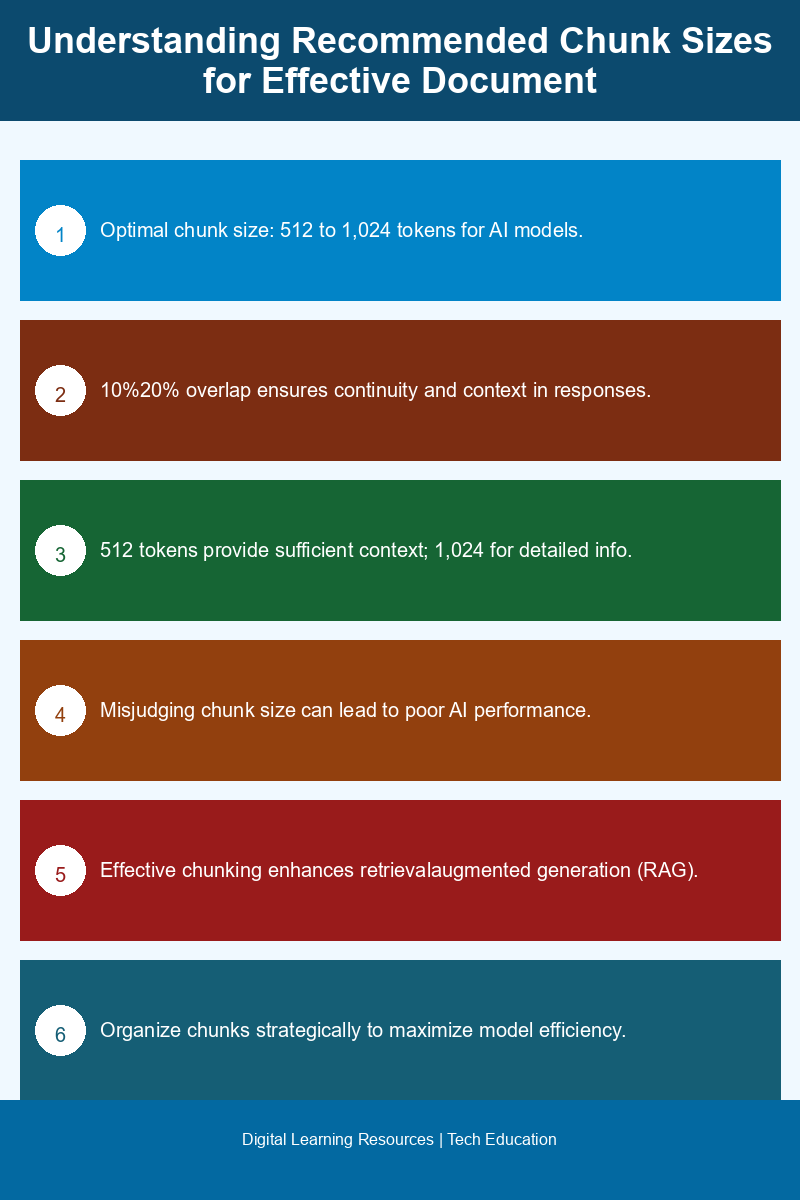
Visual summary of key concepts
Technical Documents and Research Papers
When dealing with technical documents, research papers, or legal materials, larger chunk sizes are required. The recommended size ranges from 1,024 to 2,048 tokens. These documents often contain dense information that requires more context for proper understanding. A 10% to 15% overlap is also suggested to ensure that key concepts are not lost between chunks.
Consider a technical document with 5,000 tokens. The segmentation could look like this:
- Chunk 1: Tokens 1-1,024
- Chunk 2: Tokens 924-1,948 (10% overlap)
- Chunk 3: Tokens 1,848-2,872
- Chunk 4: Tokens 2,772-3,796
- Chunk 5: Tokens 3,708-4,732
This method ensures continuity and allows the model to maintain a strong grasp of complex information, making it particularly valuable for developers and researchers who rely on detailed documentation.
Conversational Memory and Code
In applications involving conversational memory, such as chatbots or virtual assistants, the recommended chunk size is typically between 256 to 512 tokens per turn. This size provides enough context for the model to understand the flow of conversation while remaining concise. No overlap is necessary, as each conversation turn is designed to be a distinct interaction.
For code, the chunk size can be more variable but generally falls between 200 to 600 tokens, depending on the function or class being processed. Each piece of code should be treated independently, with no overlap. This approach helps maintain the integrity and readability of the code, making it easier for the model to understand and generate relevant outputs.
Adapting Chunk Sizes to Specific Needs
The chunk sizes mentioned above serve as starting points. It is essential to adjust these sizes based on the specific requirements of your project or application. Factors such as the type of content, the complexity of the language used, and the intended use of the processed information all play a role in determining the optimal chunk size. Your choice of framework matters here too — LangChain and LlamaIndex handle chunked indexing differently, which can shift what chunk size actually performs best in practice.
For instance, if you are working with a highly technical document that includes jargon or complex terminology, you might want to consider larger chunk sizes to ensure that the model captures the necessary context. Conversely, for straightforward or conversational content, smaller chunks may suffice.
Ultimately, the goal is to strike a balance between context and efficiency to maximize the performance of your AI models.
In conclusion, understanding the recommended chunk sizes for various types of content is essential for effective document processing and AI model training. By employing the appropriate sizes and overlaps, developers can enhance the retrieval capabilities of their models, ensuring they generate accurate and contextually relevant responses.
Disclaimer: Information gathered from reputed public sources.
Verify independently for specific implementations.
Ready to advance your skills?
Explore our digital learning resources.
📑 About the author: I also build Digital Bizz Card — hosted digital business cards you can share with a QR code, no app required.