Generative AI chatbots have become a vital resource for cancer patients and their families, providing instant information and support. However, a significant challenge persists: the occurrence of hallucinations, where these chatbots deliver incorrect or misleading information. A recent study has explored strategies to mitigate this issue, particularly focusing on the Retrieval-Augmented Generation (RAG) framework. This article delves into the findings of this study, examining how RAG can enhance the reliability of AI responses in the context of cancer information.
Understanding Hallucinations in Generative AI
Hallucination in generative AI refers to the phenomenon where models generate incorrect, nonsensical, or fabricated information. This is particularly concerning in sensitive areas like healthcare, where misinformation can lead to detrimental consequences for patients. For instance, a chatbot providing erroneous treatment options or misinterpreting symptoms can severely affect patient outcomes.
The study highlights the critical need for accurate information retrieval methods in generative AI systems. As these technologies evolve, the integration of reliable data sources becomes essential to minimize inaccuracies and improve user trust. The challenge lies in balancing the rapid response capabilities of generative AI with the accuracy of the information provided.
📚 Recommended Digital Learning Resources
Take your skills to the next level:
The Role of Retrieval-Augmented Generation (RAG)
Retrieval-Augmented Generation (RAG) is an innovative approach that combines the strengths of large language models (LLMs) with external knowledge sources. By integrating factual data into the generative process, RAG significantly reduces the likelihood of hallucinations. This methodology enables chatbots to supplement their generated responses with relevant medical information, ensuring users receive accurate and contextually appropriate answers.
The study demonstrates that RAG not only enhances the accuracy of responses but also improves the chatbot’s ability to handle topics with limited scientific evidence. For example, when a patient inquires about a rare cancer treatment, RAG can pull from verified medical databases to provide the most relevant information, rather than relying solely on the potentially flawed knowledge embedded in the LLM.
📊 Key Learning Points Infographic
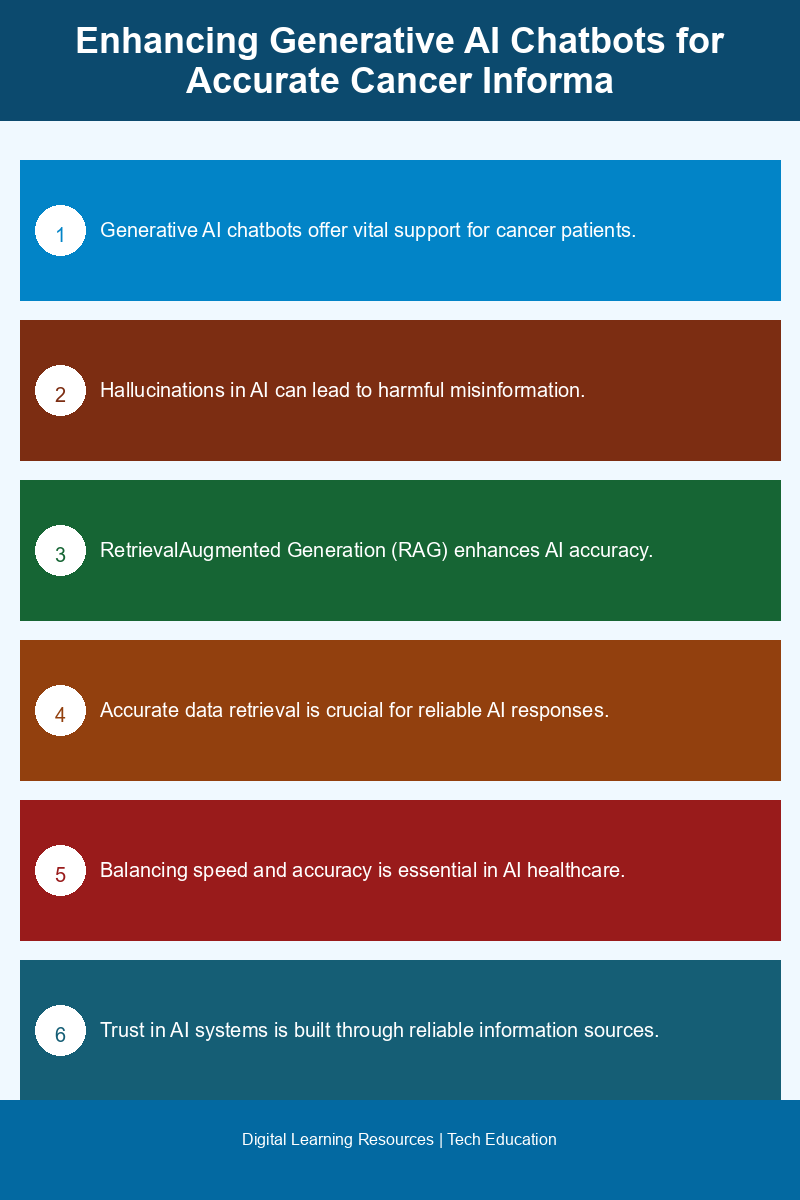
Visual summary of key concepts
Methods to Mitigate Hallucinations: RAG, Fine-Tuning, and Prompt Engineering
The research outlines several effective methods for reducing hallucinations in chatbots, with RAG emerging as a particularly favorable option. Fine-tuning LLMs is a common technique where models are adjusted using specific datasets to improve accuracy in targeted applications. However, this process can be resource-intensive, requiring considerable time and expertise.
Prompt engineering involves crafting specific input queries to guide the model’s responses. While valuable, this method can be complex and varies significantly based on the context. In contrast, RAG offers a more straightforward and cost-effective solution. Its shorter development time and simplicity make it easier to implement across various applications.
Furthermore, the study notes that RAG’s adaptability extends beyond healthcare, allowing developers to apply this framework to numerous fields requiring accurate information retrieval. This versatility positions RAG as a leading approach in the ongoing effort to enhance generative AI reliability.
Development of Generative AI Chatbots for Cancer Information
The study’s researchers developed six different types of generative AI chatbots by combining two versions of LLMs, aiming to assess their effectiveness in delivering cancer-related information. Each chatbot was evaluated on its ability to provide accurate responses, demonstrating the tangible benefits of employing RAG in real-world scenarios.
One notable outcome of the development process was the ability of these chatbots to engage with users in a more informed manner. For instance, when a patient asked about the side effects of a specific chemotherapy drug, the chatbot could reference external medical literature to provide comprehensive and accurate information, reducing the risk of misinformation.
The findings from this study are promising, indicating that as generative AI technologies advance, the potential for improved patient support systems grows. By incorporating reliable information sources, developers can create chatbots that not only respond quickly but also enhance the overall quality of care for cancer patients and their families.
Practical Implications for Developers and Learners
For software developers and AI practitioners, the implications of this study are profound. The use of RAG provides a roadmap for building more reliable chatbots, particularly in sensitive fields such as healthcare. By focusing on integrating external knowledge sources, developers can enhance the efficacy of their generative AI applications.
Moreover, this approach encourages a shift in how AI systems are designed and evaluated. Instead of relying solely on LLMs, incorporating retrieval mechanisms can lead to more robust and trustworthy AI solutions. This change is particularly important as the demand for accurate information continues to grow in various sectors.
Learning to implement RAG in generative AI workflows can be an invaluable skill for developers. By understanding the intricacies of information retrieval and integration, practitioners can build applications that not only meet user needs but also uphold ethical standards in information dissemination.
In conclusion, the study on reducing hallucinations in generative AI chatbots through RAG offers a significant step forward in enhancing the reliability of AI in providing cancer information. As technologies evolve, the integration of accurate data sources will be critical in ensuring that generative AI serves as a trustworthy resource for patients and healthcare providers alike.
Disclaimer: Information gathered from reputed public sources. Verify independently for specific implementations.
Ready to advance your skills? Explore our digital learning resources.
📑 About the author: I also build Digital Bizz Card — hosted digital business cards you can share with a QR code, no app required.