Understanding the cost implications of deploying a Retrieval-Augmented Generation (RAG) pipeline is essential for businesses looking to leverage AI in their operations. This guide provides a real, sourced breakdown of vector database, embedding, and inference costs, helping enterprise architects and budget planners make informed decisions on their AI investments.
Understanding RAG Pipeline Costs
Running a RAG pipeline has three real, separately-priced cost centers: vector database hosting, embedding API calls, and LLM inference (the actual chat responses). Engineering/build time is a fourth, much more variable cost that depends on your team’s rates rather than any published price list. Pricing note: figures below reflect public vendor pricing pages as of September 2026 — providers change pricing regularly, so always check the current rate on the provider’s own site before budgeting.
Vector Database Hosting Costs
Managed vector database pricing varies widely by provider and scale. At roughly 10 million vectors, published pricing looks like this:
- Qdrant Cloud: starts at $25/month, the cheapest managed entry point; around $65/month at 10M vectors
- Pinecone: free for the first 100K vectors, then serverless pricing starts around $70/month at low scale, $500–$2,500/month at mid scale, and $10,000+/month for large production workloads; storage is billed separately around $0.33/GB/month
- Weaviate Cloud: starts at $45/month (Flex tier) or $280/month (Plus tier with an SLA)
- Chroma: designed for prototyping, not production — most teams graduate to Qdrant or Postgres with pgvector once they need to ship
Self-hosting is the other option: Qdrant and Weaviate are both free, open-source software, so your only cost is infrastructure — typically $300–$800/month for a production-grade cluster, or as little as $30–$50/month on a small VPS for lighter workloads. Self-hosting trades a lower bill for the engineering time to run and maintain the database yourself.
Embedding API Costs
Turning your documents into vectors requires an embedding model. OpenAI’s current published pricing:
- text-embedding-3-small: $0.02 per 1 million tokens — the cheapest option and a reasonable default for most RAG use cases
- text-embedding-3-large: $0.13 per 1 million tokens — higher-dimensional embeddings for when retrieval quality matters more than cost
Both are billed only on input tokens (no output cost), and OpenAI’s Batch API cuts either price roughly in half for non-realtime indexing jobs — a good fit for the initial bulk-indexing of a knowledge base.
Putting It Together: Realistic Monthly Ranges
Rough, all-in monthly estimates by scale — vector DB hosting plus embedding costs (LLM inference for generating actual answers is a separate, usually larger line item that scales with your chosen chat model and query volume, not covered by vector-DB or embedding pricing):
- Small/startup (a few thousand documents, low query volume): $25–$70/month for vector hosting, embedding costs typically a few dollars since indexing is infrequent
- Mid-size production (100K+ documents, steady query volume): $200–$2,500/month for vector hosting, embedding costs scaling with how often the knowledge base is re-indexed
- Enterprise scale (10M+ vectors, high query volume): vector hosting alone can run $5,000–$10,000+/month before counting LLM inference
Build/engineering time is the hardest cost to pin a number on honestly — unlike vendor pricing, there’s no public price list for developer time, and it depends entirely on your team’s rates, whether you’re building in-house or hiring out, and how much of the pipeline (chunking, retrieval evaluation, reranking, agentic tool use) you actually need. Treat any specific build-cost figure you see elsewhere with real skepticism unless it comes with a clear scope attached.
Choosing a Tier for Your Use Case
Rather than fixed price tiers, think in terms of what capabilities you actually need, since that’s what drives both hosting and engineering cost:
Basic Retrieval
Simple chunking plus retrieve-and-generate, no reranking or evaluation loop. The cheapest managed vector DB tiers (Qdrant Cloud’s $25/month entry point, or Pinecone’s free tier) comfortably cover this for low query volumes.
Advanced RAG
Adds reranking, hybrid (keyword + vector) search, and some form of retrieval-quality evaluation. This is where mid-tier managed pricing ($200–$2,500/month depending on provider and scale) becomes relevant, and where the extra engineering time to build and tune reranking actually shows up in your build cost.
Agentic RAG
Multi-step reasoning, tool use, and self-correction on top of retrieval. This tier is dominated by LLM inference cost (more model calls per query, not vector DB pricing) and meaningfully more engineering time to get right — budget for both before committing to this tier.
How to Estimate Your Own Costs
Rather than relying on a generic calculator, the most reliable estimate comes from three real numbers specific to your own use case: your expected document/vector count (drives vector DB tier), your expected query volume (drives both vector DB reads and LLM inference calls), and your chosen LLM for generation (the biggest lever on ongoing cost, since inference pricing varies far more between models than vector DB pricing does between providers). Plug those into the vendor pricing pages linked above directly — that will always be more accurate than a third-party estimate, since providers update their own pricing pages first.
📊 Key Learning Points Infographic
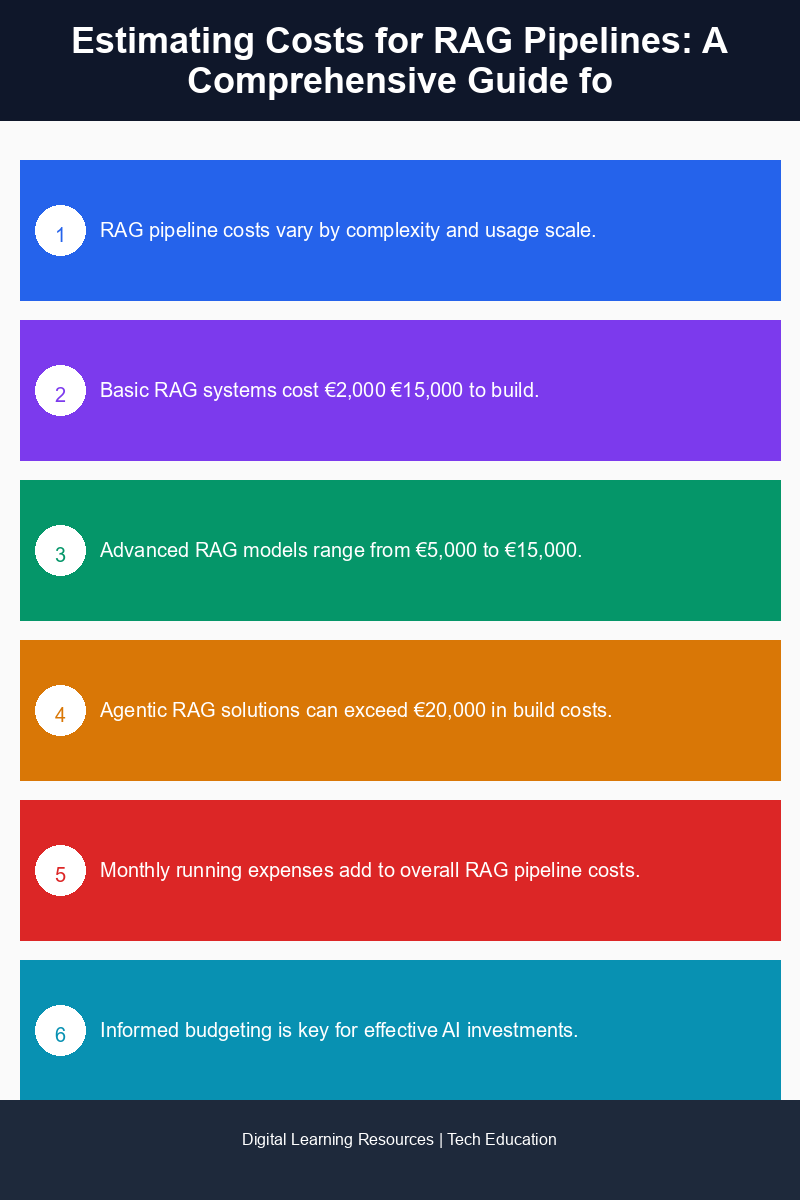
Visual summary of key concepts
Frequently Asked Questions
How can I estimate RAG pipeline costs for my enterprise?
The most reliable way is to plug your own numbers — expected vector count, query volume, and chosen LLM — directly into vendor pricing pages (Pinecone, Qdrant, Weaviate) rather than relying on generic estimates, since those change independently of any third-party guide.
What is the purpose of an AI investment in an enterprise solution?
The purpose of an AI investment in an enterprise solution is to enhance operational efficiency, improve decision-making processes, and drive innovation by leveraging advanced technologies for data analysis and automation.
Why is budget planning important for enterprise architecture?
Budget planning is crucial for enterprise architecture as it ensures that resources are allocated effectively, helps in forecasting future expenses, and aligns technological investments with business goals to maximize ROI.
Is vector database pricing the same across providers?
No — entry-level managed pricing alone ranges from Qdrant Cloud’s 5/month up to Pinecone’s free-then-0/month serverless tier, and self-hosting shifts the cost to infrastructure instead of a subscription. Compare providers directly against your own expected scale rather than assuming one number applies broadly.
When should I start planning my budget for AI investments?
You should start planning your budget for AI investments as early as possible, ideally during the initial stages of project development, to ensure adequate funding and resource allocation throughout the implementation process.
Disclaimer: Vector database and embedding API pricing sourced from provider pricing pages as of September 2026 and is subject to change — verify current rates directly with each provider before budgeting.
Ready to advance your skills? Explore our digital learning resources.
Related reading:
📑 About the author: I also build Digital Bizz Card — hosted digital business cards you can share with a QR code, no app required.