Retrieval-Augmented Generation (RAG) systems often face serious accuracy issues that hinder their effectiveness. These problems primarily emerge due to failures in the data pipeline, leading to incorrect, outdated, or irrelevant responses. To tackle RAG accuracy issues, it is essential to understand the four layers of failure: data quality, retrieval, generation, and pipeline architecture.
The Core Issues of RAG Systems
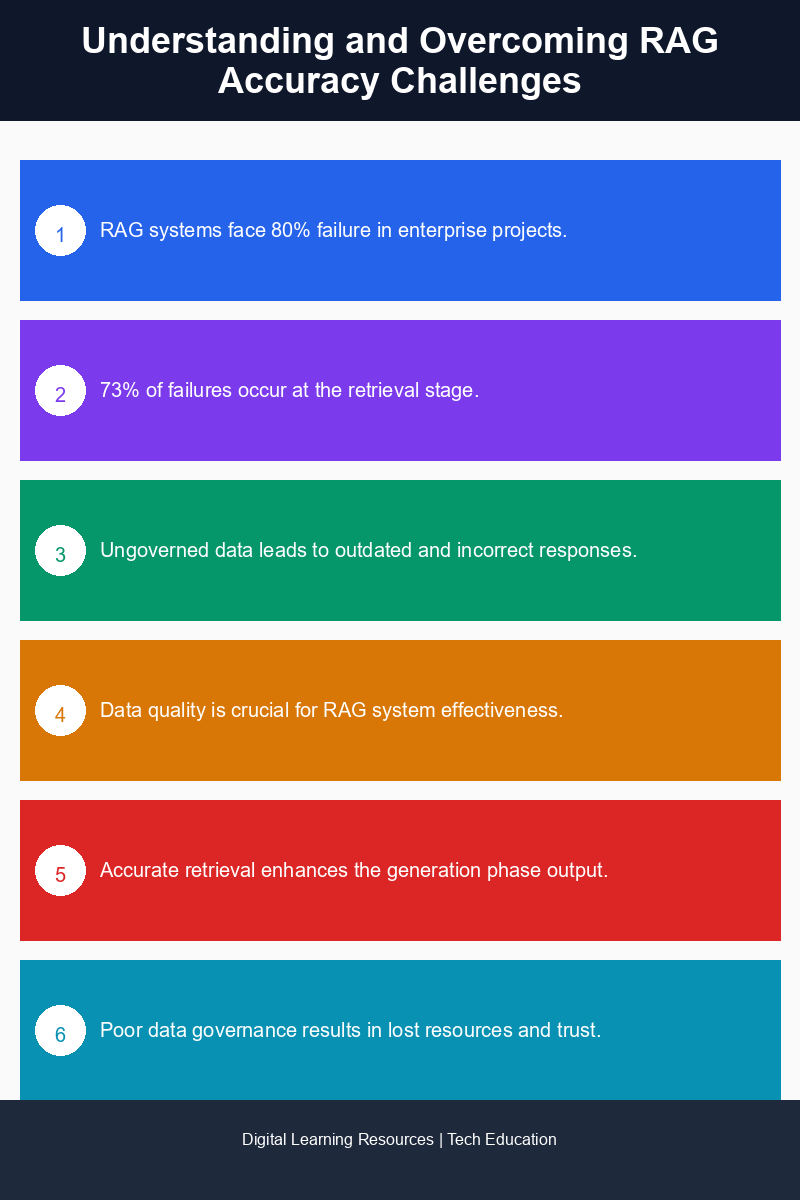
RAG systems are designed to enhance the output of large language models (LLMs) by integrating external knowledge from a database. However, a staggering 80% of enterprise RAG projects suffer from critical failures. Most of these failures—73%—occur specifically at the retrieval stage. This indicates that the foundation of RAG systems often lies on fragile data structures and retrieval processes.
The primary culprit behind these inaccuracies is ungoverned data. When the data lacks strict governance, it can become outdated or incorrect, leading to significant discrepancies between the system’s output and the expected results. For organizations relying heavily on RAG systems, this translates into a loss of time, resources, and trust in automated solutions.
Data Quality: The Foundation of RAG Accuracy
Data quality is paramount in ensuring the effectiveness of RAG systems. Ungoverned data can lead to incorrect retrieval results, which in turn affects the generation phase. RAG systems utilizing governed data can achieve a retrieval accuracy rate of 85-92%, showcasing the importance of data management.
Implementing data governance involves establishing protocols for data collection, validation, and management. This includes defining data sources, maintaining consistency, and ensuring data is current and relevant. By doing so, organizations can significantly reduce the chances of inaccuracies in their RAG systems.
Common Failure Points in Retrieval
The retrieval stage is the most vulnerable point in the RAG pipeline. A common source of failure during this phase is improper chunking of data. Chunking refers to breaking down information into manageable units for the retrieval process. However, if chunks are too large, they may encompass multiple topics, which can dilute relevance scores, leading to irrelevant results. Conversely, if chunks are too small, they might lack necessary context, compromising the meaning of the retrieved information.
📊 Key Learning Points Infographic
Visual summary of key concepts
Moreover, arbitrary splitting of data without considering sentence or semantic boundaries can create fragments that seem relevant to the user’s query but ultimately lack valuable information for the LLM. This can result in outputs that are semantically close yet contextually inappropriate.
Strategies to Improve RAG Accuracy
To enhance the accuracy of RAG systems, several strategies can be employed:
- Govern Data: Prioritize data governance practices to ensure that the information being used is accurate, up-to-date, and relevant. This includes regular audits of data sources and implementing strict validation protocols.
- Optimize Chunking: Review and adjust the chunking strategy to find the right balance. Ensure chunks maintain contextual integrity by respecting semantic boundaries. Consider using tools that facilitate intelligent chunking based on the content’s context.
- Implement Feedback Loops: Establish mechanisms for continuous feedback on the performance of the RAG system. This can help identify areas of improvement and adapt retrieval strategies accordingly.
- Monitor Retrieval Performance: Regularly analyze retrieval accuracy metrics to identify patterns of failure. This will allow for timely interventions to rectify issues before they impact the overall performance of the system.
By focusing on these strategies, organizations can significantly improve the retrieval accuracy and overall effectiveness of their RAG systems, thereby enhancing user trust and satisfaction with automated responses.
Conclusion
RAG accuracy problems stem largely from ungoverned data and failures in the retrieval process. Understanding the layers of failure—data quality, retrieval, generation, and pipeline architecture—can empower organizations to implement effective solutions. By prioritizing data governance, optimizing chunking strategies, and monitoring performance, businesses can overcome these challenges and unlock the full potential of RAG systems.
Frequently Asked Questions
What are common reasons for RAG accuracy problems?
Common reasons for RAG accuracy problems include poor data quality, inadequate training data, and insufficiently tuned retrieval mechanisms that fail to align with the specific context of queries.
How can I improve RAG accuracy in my applications?
Improving RAG accuracy can be achieved by enhancing data governance practices, optimizing the data pipeline to ensure high-quality data, and regularly fine-tuning the retrieval and generation models based on user feedback.
Why does Retrieval-Augmented Generation sometimes fail?
Retrieval-Augmented Generation can fail due to issues such as irrelevant or outdated data being retrieved, leading to incorrect or nonsensical generated outputs that do not meet user expectations.
When should I consider revising my data pipeline for RAG?
You should consider revising your data pipeline for RAG when you notice consistent inaccuracies in outputs, feedback indicating user dissatisfaction, or when integrating new data sources that could enhance performance.
Can data governance impact RAG accuracy?
Yes, data governance directly impacts RAG accuracy by ensuring that the data used for retrieval is accurate, relevant, and up-to-date, which in turn leads to more reliable and contextually appropriate generated responses.
Disclaimer: Information gathered from reputed public sources. Verify independently for specific implementations.
Ready to advance your skills? Explore our digital learning resources.
Related reading:
📑 About the author: I also build Digital Bizz Card — hosted digital business cards you can share with a QR code, no app required.