
In the rapidly evolving world of technology, understanding the hardware that powers artificial intelligence (AI) can significantly enhance your skills and career prospects. This blog post delves into the specialized AI chips, their architecture, and how you can leverage this knowledge to advance in your tech career.
Introduction: Key Takeaways
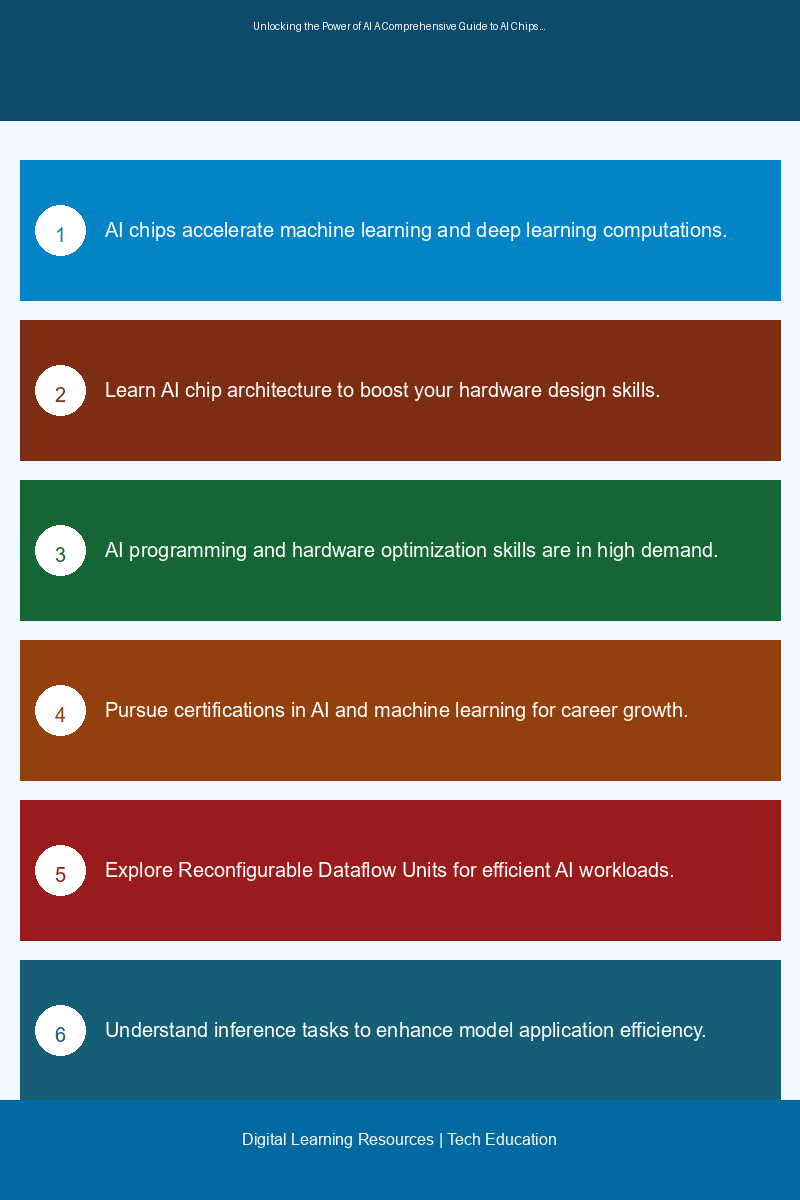
- AI chips are designed to accelerate machine learning and deep learning computations.
- Understanding the architecture of AI chips opens up educational opportunities in hardware design.
- Skills in AI programming and hardware optimization are in high demand.
- Certifications in AI and machine learning can enhance career prospects.
Technical Background and Context
AI chips are specialized hardware designed to enhance the performance of computations associated with machine learning and deep learning algorithms. While traditional Graphics Processing Units (GPUs) have been the workhorses for training neural networks, they often fall short in efficiency for inference tasks—where models are applied to make predictions.
Unlike GPUs, Reconfigurable Dataflow Units (RDUs) provide a compelling alternative, offering high-level performance with lower latency and reduced power consumption. This makes RDUs particularly well-suited for AI workloads, especially as large models like DeepSeek-V-3.1-Terminus and OpenAI’s gpt-oss 120B become common.
📚 Recommended Digital Learning Resources
Take your skills to the next level with these curated digital products:
Academic Calculators Bundle: GPA, Scientific, Fraction & More
Academic Calculators Bundle: GPA, Scientific, Fraction & More
ACT Test (American College Testing) Prep Flashcards Bundle: Vocabulary, Math, Grammar, and Science
Java Essentials: 100 Powerful Topics for Fast-Track Learning | PDF Download
Leonardo.Ai API Mastery: Python Automation Guide (PDF + Code + HTML
Leonardo.Ai API Mastery: Python Automation Guide (PDF + Code + HTML
100 Python Projects eBook: Learn Coding (PDF Download)
JavaScript for Web Development eBook | Learn to Build Interactive Websites
HSPT Vocabulary Flashcards: 1300+ Printable Study Cards + ANKI (PDF)
HSPT Vocabulary Flashcards: 1300+ Printable Study Cards + ANKI (PDF)
These models, containing billions of parameters, require specialized processing architectures. Traditional methods that load entire AI models into active memory during inference lead to inefficiencies and wasted resources. Instead, innovative approaches such as Mixture of Experts (MoE) models activate only the relevant submodules for specific tasks, significantly improving efficiency.
Practical Applications and Use Cases
The implications of these advancements in AI chip architecture are vast:
- Machine Learning Projects: Developers can leverage RDUs and MoE models to optimize their machine learning projects, improving both speed and cost-effectiveness.
- Real-Time Data Processing: Industries that rely on real-time data analysis, such as finance and healthcare, can utilize AI chips for faster decision-making.
- Smart Devices: In IoT applications, low-latency responses powered by specialized AI chips enhance user experience and operational efficiency.
- Cloud Computing: Companies can offer AI as a service, utilizing advanced AI chips to provide scalable and efficient solutions to clients.
Learning Path Recommendations
To harness the power of AI chips and bolster your career, consider the following learning paths:
- Online Courses: Platforms like Coursera, edX, and Udacity offer comprehensive courses in AI hardware, machine learning, and deep learning.
- Certifications: Pursue certifications such as TensorFlow Developer or AWS Certified Machine Learning to validate your skills and increase your employability.
- Hands-On Projects: Engage in practical projects that involve deploying AI models using RDUs and MoE architectures to gain real-world experience.
- Community Involvement: Join forums and attend workshops related to AI and hardware design to network with professionals and stay updated on industry trends.
Industry Impact and Career Implications
With the growing reliance on AI in various sectors, the demand for professionals skilled in AI chip architecture and programming is on the rise. Understanding these technologies not only equips you with the necessary skills but also positions you favorably in a competitive job market.
As more organizations seek to implement cutting-edge AI solutions, roles in AI hardware design, machine learning engineering, and data science are becoming increasingly important. The ability to bridge software and hardware knowledge will set you apart and open up diverse career opportunities.
Implementation Tips and Best Practices
When working with AI chips and models, consider these best practices:
- Optimize Your Code: Always aim to write efficient code that can leverage the underlying hardware capabilities of AI chips.
- Monitor Resource Utilization: Use monitoring tools to gauge the efficiency of your models during inference and training processes.
- Experiment with MoE Models: Implement MoE models in your projects to see firsthand the improvements in efficiency and performance.
- Stay Updated: Follow industry publications and research papers on AI chip technology to remain informed about the latest advancements.
Future Trends and Skill Requirements
The future of AI hardware is promising, with trends pointing toward even more specialized chips tailored to specific AI tasks. Understanding these trends will be crucial for professionals aiming to stay relevant in the field.
Key skills expected to be in demand include:
- Proficiency in programming languages such as Python and C++.
- Knowledge of AI frameworks like TensorFlow and PyTorch.
- Experience with hardware programming and optimization techniques.
- Understanding of dataflow architectures and parallel processing.
Conclusion: Actionable Next Steps
To capitalize on the advancements in AI chip technology and enhance your career, start by:
- Enrolling in relevant courses and gaining certifications.
- Building a portfolio of projects that highlight your understanding of AI models and hardware.
- Networking with professionals in the field to share insights and stay updated on industry trends.
- Continuously practicing and refining your skills through hands-on projects and community involvement.
By taking these steps, you can position yourself as a knowledgeable professional in the exciting and rapidly evolving landscape of AI technology.
Disclaimer: The information in this article has been gathered from various reputed sources in the public domain. While we strive for accuracy, readers are advised to verify information independently and consult with professionals for specific technical implementations.
Ready to advance your tech career? Explore our digital learning resources including programming guides, certification prep materials, and productivity tools designed by industry experts.