As the tech landscape evolves, the demand for high-performance computing continues to grow, with Graphics Processing Units (GPUs) at the forefront of this revolution. This blog post will explore the technical aspects of GPUs, their practical applications, and learning opportunities, while also highlighting industry trends and career implications for tech professionals. Whether you’re looking to enhance your skills or seeking certification materials, we’ve got you covered.
Key Takeaways
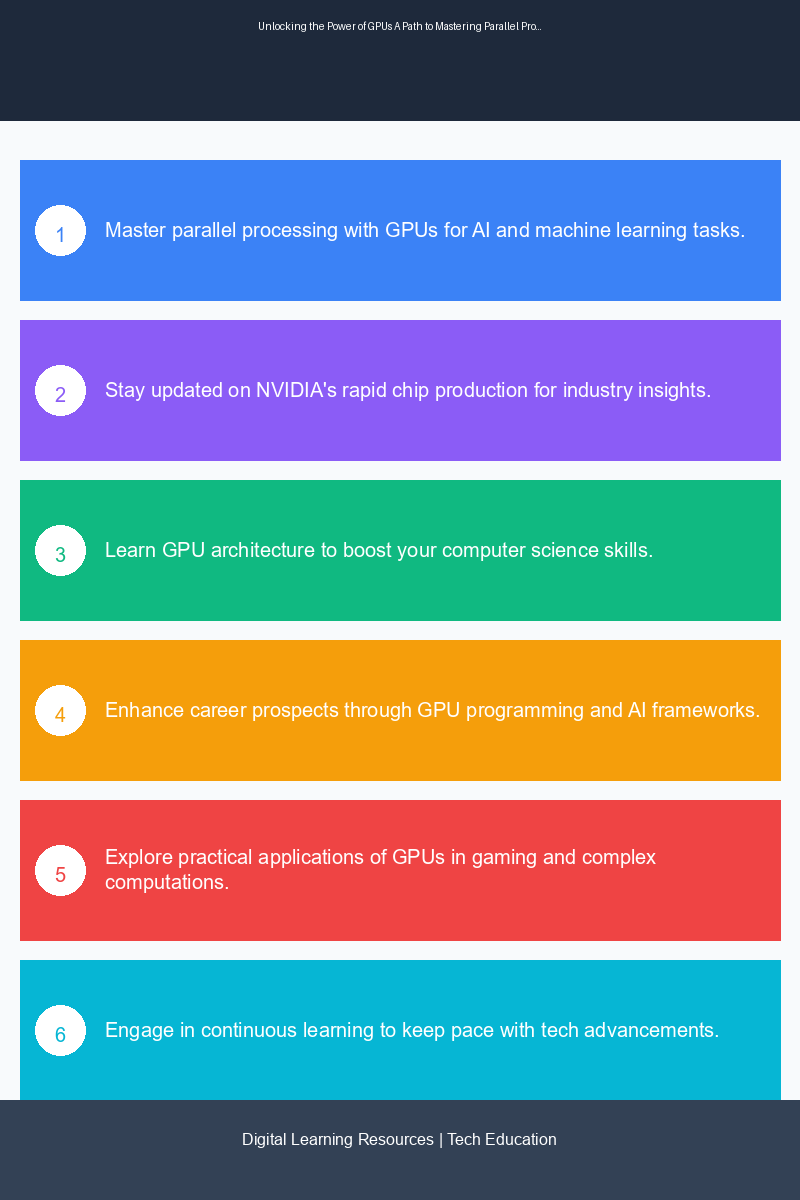
- GPUs enable parallel processing, essential for modern applications in AI and machine learning.
- NVIDIA’s rapid chip production cycle exemplifies the fast pace of technological advancement.
- Understanding GPU architecture is crucial for aspiring computer scientists and engineers.
- Professional development in GPU programming and AI frameworks can significantly enhance career prospects.
Technical Background and Context
GPUs are specialized processors designed to handle multiple operations simultaneously, making them ideal for tasks requiring high levels of parallel processing. Unlike Central Processing Units (CPUs), which perform operations in a serial manner, GPUs can execute thousands of threads concurrently. This architecture allows for significant performance improvements in applications ranging from video games to complex AI computations.
NVIDIA, a leader in GPU technology, has accelerated its chip manufacturing process, producing a new chip every six months compared to the industry average of 18 months. This rapid innovation cycle has significant implications for the tech industry, as it enables developers to access cutting-edge hardware more frequently, driving advancements in both consumer and enterprise applications.
📚 Recommended Digital Learning Resources
Take your skills to the next level with these curated digital products:
Academic Calculators Bundle: GPA, Scientific, Fraction & More
Academic Calculators Bundle: GPA, Scientific, Fraction & More
ACT Test (American College Testing) Prep Flashcards Bundle: Vocabulary, Math, Grammar, and Science
Java Essentials: 100 Powerful Topics for Fast-Track Learning | PDF Download
Leonardo.Ai API Mastery: Python Automation Guide (PDF + Code + HTML
Leonardo.Ai API Mastery: Python Automation Guide (PDF + Code + HTML
100 Python Projects eBook: Learn Coding (PDF Download)
JavaScript for Web Development eBook | Learn to Build Interactive Websites
HSPT Vocabulary Flashcards: 1300+ Printable Study Cards + ANKI (PDF)
HSPT Vocabulary Flashcards: 1300+ Printable Study Cards + ANKI (PDF)
Practical Applications and Use Cases
The versatility of NVIDIA GPUs has made them integral to various domains:
- Video Games: GPUs render high-quality graphics in real-time, providing immersive experiences for gamers.
- 3D Rendering: Professionals in design and architecture leverage GPUs for rendering complex visualizations quickly.
- Artificial Intelligence: With the rise of AI and machine learning, GPUs are essential for training and deploying models efficiently.
- Scientific Research: Supercomputers powered by thousands of GPUs are used for simulations and data analysis in fields like genomics and climate modeling.
Learning Path Recommendations
To effectively harness the power of GPUs, aspiring tech professionals should consider the following educational pathways:
- Foundational Courses: Begin with courses that cover the basics of computer architecture, focusing on the differences between CPU and GPU processing.
- Parallel Processing: Enroll in specialized courses that delve into parallel programming, such as CUDA or OpenCL, which are essential for maximizing GPU capabilities.
- Graphics Programming: Explore courses in graphics programming using APIs like OpenGL or DirectX, which are vital for game development and simulations.
- AI and Machine Learning: Participate in workshops and certifications on AI frameworks like TensorFlow or PyTorch, emphasizing their integration with GPU technology.
Industry Impact and Career Implications
The integration of GPUs into AI infrastructure has reshaped many industries. NVIDIA’s contributions to projects like OpenAI’s ChatGPT highlight the crucial role GPUs play in developing advanced AI models. As businesses leverage AI for better decision-making and automation, the demand for professionals skilled in GPU programming and AI frameworks continues to rise.
Career opportunities abound for those who specialize in these areas. Positions such as AI developer, data scientist, and graphics programmer are increasingly sought after. Moreover, certifications in GPU programming and AI can significantly enhance your resume, making you a more competitive candidate in the tech job market.
Implementation Tips and Best Practices
To effectively work with GPUs, consider the following best practices:
- Optimize Code: Write efficient, parallelized code tailored for GPU execution to maximize performance.
- Leverage Libraries: Utilize established libraries and frameworks that are optimized for GPU computing, such as cuDNN for deep learning.
- Test and Benchmark: Regularly test your GPU implementations and benchmark performance against CPU alternatives to understand the benefits and limitations.
- Stay Updated: Follow industry news and updates from NVIDIA and other GPU manufacturers to keep abreast of the latest technologies and methodologies.
Future Trends and Skill Requirements
The future of technology is increasingly intertwined with GPUs and parallel processing. As the demand for AI solutions grows, professionals will need to continuously adapt their skill sets. Key areas to focus on include:
- Deep Learning: Skills in neural network design and training will be essential as AI models become more complex.
- Real-Time Data Processing: Understanding how to process data streams in real-time using GPU capabilities will be a valuable asset.
- Chip Design Knowledge: Familiarity with semiconductor manufacturing processes will be beneficial for those interested in hardware development.
Conclusion with Actionable Next Steps
The landscape of technology is rapidly evolving, and mastering GPUs is a valuable investment in your career. To take the next steps:
- Identify relevant online courses and certification programs focused on GPU programming and AI frameworks.
- Engage with online communities and forums to network with professionals in the field and share knowledge.
- Start a personal project that incorporates GPU programming, whether in gaming, machine learning, or 3D rendering.
- Stay informed about industry trends by subscribing to tech journals and following key influencers in the GPU and AI domains.
By embracing the opportunities offered by GPU technology, you can position yourself as a leader in the ever-evolving tech industry. Explore our digital products eCommerce site for a wide range of programming guides, certification materials, and resources to kickstart your journey!
Disclaimer: The information in this article has been gathered from various reputed sources in the public domain. While we strive for accuracy, readers are advised to verify information independently and consult with professionals for specific technical implementations.
Ready to advance your tech career? Explore our digital learning resources including programming guides, certification prep materials, and productivity tools designed by industry experts.