As the landscape of AI tools continues to evolve, developers often find themselves navigating a plethora of options tailored to specific tasks. Two prominent frameworks, LangChain and LlamaIndex, stand out for their unique capabilities in automating intelligent tasks and retrieving precise information. Understanding the nuances between these tools is crucial for selecting the right one for your project’s needs.
Understanding the Unique Strengths of LangChain
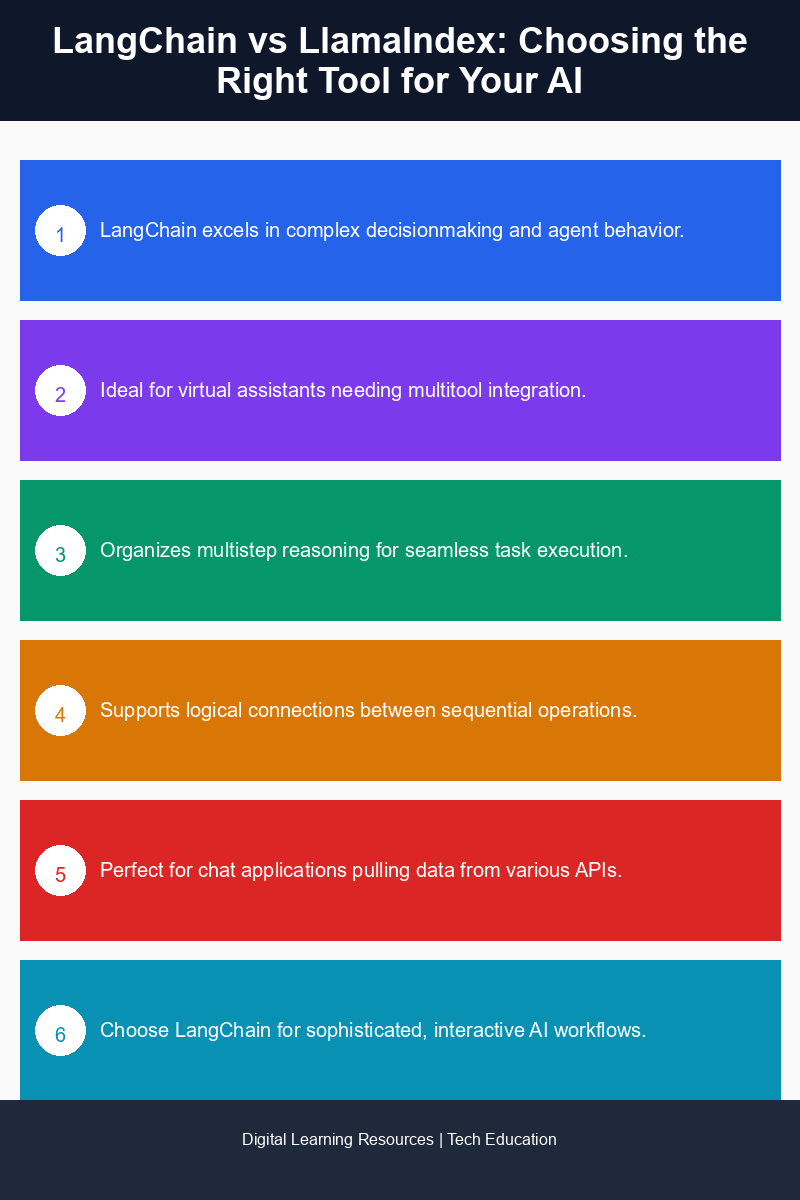
LangChain is designed primarily for scenarios that require complex decision-making and autonomous agent behavior. It excels in environments where conditional logic and tool chaining are critical to achieving sophisticated interactions. For instance, if you are building a virtual assistant that must integrate multiple tools to provide a cohesive response, LangChain’s architecture supports such workflows seamlessly.
One of LangChain’s standout features is its ability to organize multi-step reasoning. This is particularly valuable when tasks involve various stages of processing, such as collecting user input, querying databases, and generating natural language responses based on that data. With LangChain, you can define a series of operations that the AI agent must execute, ensuring that each step is logically connected to the next.
In practical terms, if you are developing a chat-based application that needs to pull information from different APIs while also processing user feedback in real-time, LangChain provides a robust framework for managing these interactions. The tool allows you to create agents that can make decisions based on real-time data, improving the overall user experience.
Leveraging LlamaIndex for Information Retrieval
LlamaIndex, on the other hand, is engineered for accuracy in handling large volumes of data, making it an excellent choice for applications focused on information retrieval. Its strength lies in parsing, indexing, and querying expansive knowledge bases, which is essential for applications that require fast and efficient access to information.
A key capability of LlamaIndex is its ability to transform raw data—such as PDFs, spreadsheets, or text files—into indexed and searchable formats. This means that if your application needs to sift through extensive documentation or databases to find specific pieces of information, LlamaIndex can streamline that process significantly. By optimizing the transformation from raw files to searchable content, it enhances the efficiency of data retrieval. That indexed content still has to live somewhere queryable — see our comparison of Pinecone, Weaviate, and Chroma for how the underlying vector database choice affects retrieval performance.
📊 Key Learning Points Infographic
Visual summary of key concepts
Moreover, LlamaIndex allows users to query data in natural language, making it accessible for non-technical users. For example, if you are building an enterprise search tool that needs to pull relevant passages from a vast repository of documents, LlamaIndex enables you to deliver contextual responses that help users quickly locate the information they need.
Choosing the Right Tool Based on Use Case
The decision between LangChain and LlamaIndex ultimately hinges on the specific objectives of your application. If your primary goal is to build intelligent automation that can interact with users in a dynamic way, LangChain is likely the better choice. Its ability to manage complex workflows and handle conditional logic makes it ideal for applications that require a high degree of interactivity.
Conversely, if your focus is on precise information retrieval and the ability to handle large datasets efficiently, LlamaIndex offers superior capabilities. Its indexing and querying features are designed to optimize the search process, making it a powerful tool for applications that prioritize data accuracy and speed.
It’s also worth noting that there may be scenarios where integrating both tools could yield the best results. For instance, a virtual assistant that leverages LangChain’s decision-making capabilities could incorporate LlamaIndex for enhanced information retrieval, providing users with both intelligent interactions and precise data access.
Real-World Applications and Examples
To better understand how these tools can be applied, consider the following examples:
- LangChain in Action: A healthcare chatbot that assists patients in scheduling appointments, checking lab results, and answering medical queries. By utilizing LangChain, the chatbot can effectively manage multiple tasks while adapting its responses based on user context.
- LlamaIndex in Action: An academic research tool designed to help scholars find relevant literature and data for their studies. Using LlamaIndex, the application can quickly index thousands of research papers, allowing users to query specific topics and receive contextually relevant results.
In conclusion, both LangChain and LlamaIndex bring valuable strengths to the table, but their effectiveness is dictated by the context in which they are applied. By carefully assessing your application’s requirements—whether they lean towards intelligent automation or precise data retrieval—you can make an informed decision that aligns with your project goals.
Disclaimer: Information gathered from reputed public sources.
Verify independently for specific implementations.
Ready to advance your skills?
Explore our digital learning resources.
📑 About the author: I also build Digital Bizz Card — hosted digital business cards you can share with a QR code, no app required.