The Cognitive Aptitude Test (CCAT) is a powerful tool designed to assess general intelligence and predict job performance more accurately than many traditional metrics. This test offers employers a reliable method to gauge a candidate’s potential in a work environment, making it a valuable addition to the hiring process. In this guide, we will explore the structure of the CCAT, its significance in the hiring landscape, and practical implications for both employers and job seekers.
What is the Cognitive Aptitude Test?
The CCAT is a standardized assessment that measures cognitive abilities relevant to job performance. It evaluates skills such as problem-solving, critical thinking, and the ability to learn new concepts quickly. The test typically consists of 50 questions that must be completed in 15 minutes, challenging candidates to think on their feet and demonstrate their mental acuity under pressure.
Unlike other assessment tools that may rely on educational background or experience, the CCAT focuses on innate cognitive abilities, providing a more objective measure of a candidate’s potential. Research has shown that the CCAT is more effective than resumes or interviews in predicting job success, as it captures a candidate’s ability to process information and adapt to new challenges.
📚 Recommended Digital Learning Resources
Take your skills to the next level:
NREMT Exam Prep Flashcards | 1000 Plus Cards | Emr Emt Aemt Paramedic | PDFs Anki HTML App | Quiz and Cheat Sheet PDF
How Does the CCAT Work?
The CCAT includes a mix of verbal, numerical, and abstract reasoning questions. Each section is designed to assess different cognitive skills:
- Verbal Reasoning: These questions evaluate a candidate’s ability to comprehend and analyze written information. Candidates may encounter tasks like identifying synonyms or completing sentences.
- Numerical Reasoning: This section assesses mathematical skills and the ability to interpret numerical data. Questions may involve basic arithmetic, interpretation of graphs, or solving word problems.
- Abstract Reasoning: This part focuses on logical thinking and the ability to recognize patterns. Candidates are asked to identify relationships between shapes or figures, which reflects their problem-solving capabilities.
The combination of these three areas allows employers to gain insights into a candidate’s overall cognitive ability, making it easier to identify individuals who can thrive in their roles. The test’s timed nature also adds an element of pressure, mirroring real-world situations where quick decision-making is crucial.
📊 Key Learning Points Infographic
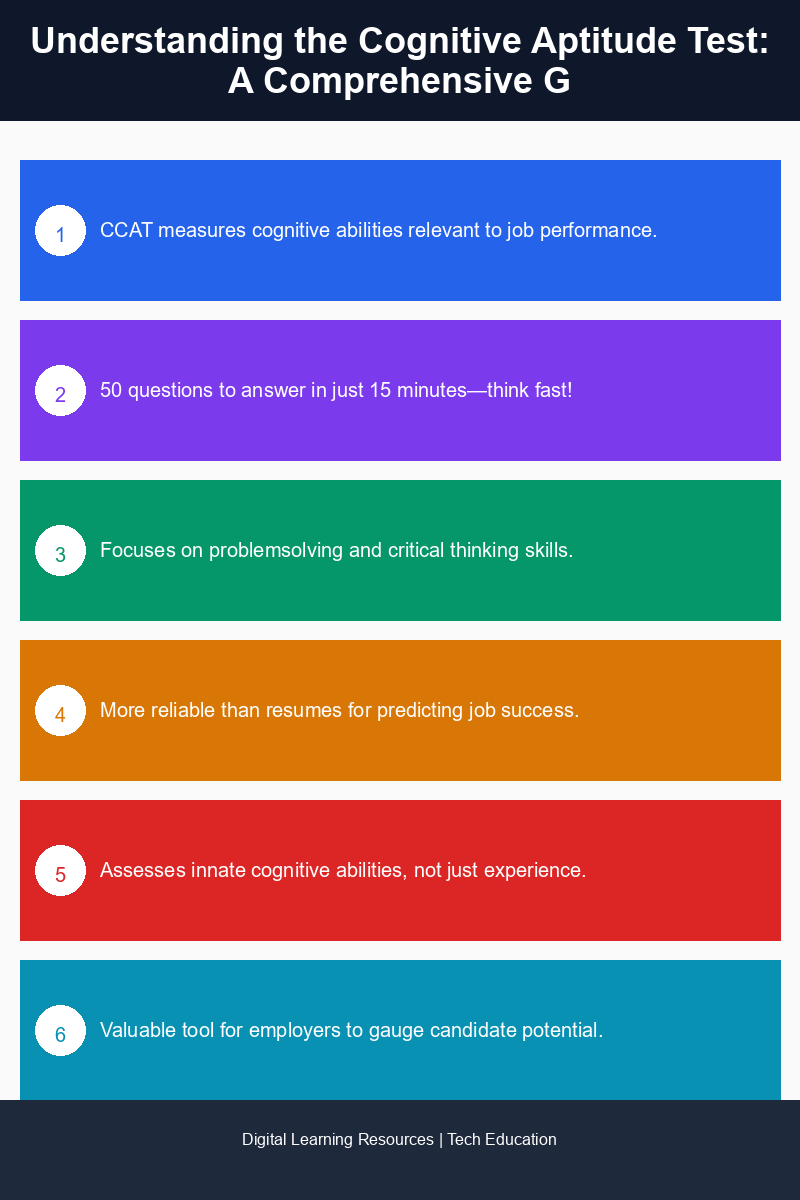
Visual summary of key concepts
Significance of the CCAT in Hiring
The CCAT’s predictive validity is one of its most compelling features. Studies have shown that cognitive aptitude tests like the CCAT can predict job performance with a higher degree of accuracy than traditional hiring methods. This is especially important in industries where critical thinking and problem-solving are essential, such as technology, finance, and healthcare.
Employers who incorporate the CCAT into their hiring processes benefit from:
- Improved hiring decisions: By relying on an objective measure of cognitive ability, employers can reduce the likelihood of biases that often affect hiring decisions based on resumes and interviews.
- Better job fit: The CCAT helps identify candidates who possess the cognitive skills necessary for specific roles, leading to higher job satisfaction and reduced turnover rates.
- Streamlined recruitment process: The CCAT allows employers to quickly assess a large pool of candidates, enabling more efficient shortlisting and reducing the time spent on interviews.
Furthermore, the CCAT’s ability to predict performance is supported by extensive research, making it a valuable asset for companies aiming to enhance their talent acquisition strategies.
Preparing for the CCAT: Tips and Resources
For candidates looking to excel on the CCAT, preparation is key. Although the test is designed to assess innate abilities, familiarizing oneself with the test format and types of questions can significantly improve performance. Here are some practical tips:
- Practice Sample Questions: Many websites offer sample CCAT questions or practice tests. Engaging with these resources can help candidates become accustomed to the question styles and time constraints.
- Focus on Weak Areas: Identify personal strengths and weaknesses in verbal, numerical, and abstract reasoning. Concentrate on improving weaker areas through targeted practice.
- Time Management: Since the CCAT is a timed test, practicing under time constraints can help candidates develop the speed necessary to complete all questions within the allocated time.
- Stay Calm and Confident: Stress management techniques can be beneficial. Taking deep breaths and maintaining a positive mindset can help candidates perform at their best.
Using structured study materials, such as flashcards for vocabulary or math problem sets, can also aid in reinforcing knowledge. Additionally, online platforms and courses specifically designed for cognitive tests can provide valuable insights and strategies for success.
Conclusion
The Cognitive Aptitude Test is an effective tool that offers a more reliable measure of a candidate’s potential to succeed in various roles. By providing insights into cognitive abilities that traditional hiring methods often overlook, the CCAT enhances the recruitment process for employers and equips candidates with the knowledge needed to prepare effectively. Understanding the structure, significance, and preparation strategies for the CCAT can lead to better hiring outcomes and increased job performance for those who pass the test.
Frequently Asked Questions
What is the Crossover Cognitive Aptitude Test?
The Criteria Cognitive Aptitude Test (CCAT) is a standardized assessment designed to evaluate a candidate’s cognitive abilities, including problem-solving skills, critical thinking, and learning capacity, which are essential for job performance.
How does the CCAT guide help in job performance assessment?
The CCAT guide provides detailed insights into the test format, sample questions, and strategies for preparation, helping candidates understand how to effectively demonstrate their cognitive skills during the evaluation.
Why is cognitive skills evaluation important for employers?
Cognitive skills evaluation is crucial for employers as it helps predict a candidate’s potential job performance, adaptability, and ability to learn new information, ultimately leading to better hiring decisions.
Can I prepare for the Criteria Cognitive Aptitude Test?
Yes, candidates can prepare for the CCAT by studying sample questions, practicing cognitive skills, and familiarizing themselves with the test format to improve their performance on the actual assessment.
Does the CCAT measure specific cognitive abilities?
Yes, the CCAT measures various cognitive abilities, including numerical reasoning, verbal reasoning, and spatial reasoning, providing a comprehensive evaluation of a candidate’s cognitive aptitude.
Disclaimer: Information gathered from reputed public sources.
Verify independently for specific implementations.
Ready to advance your skills?
Explore our digital learning resources.
📑 About the author: I also build Digital Bizz Card — hosted digital business cards you can share with a QR code, no app required.