AI-generated art frequently struggles with accurately depicting hands and fingers, leading to bizarre and distorted representations. This issue arises from several factors, including the complexity of hand anatomy, the limited focus on hands in training datasets, and the inherent limitations of AI systems in understanding three-dimensional structures.
The Challenges of Rendering Hands in AI Art
Hands and fingers present unique challenges for AI-generated art due to their small size relative to the human body and their intricate structure. Unlike other body parts that may be more prominently featured in images, hands are often peripheral, making it difficult for AI models to learn their nuances effectively. For instance, a well-posed portrait may show a person’s face in sharp focus while relegating their hands to the background, resulting in insufficient data for AI systems to analyze.
Additionally, the variability in hand positions adds further complexity. Hands can be portrayed in numerous ways—waving, flexing, or holding objects—which complicates the AI’s task of recognizing and replicating these forms accurately. This variability can lead to hands appearing misshapen or unnatural in AI-generated images, as the model attempts to interpolate between various examples it has seen during training.
📚 Recommended Digital Learning Resources
Take your skills to the next level:

Understanding the Limitations of AI Perception
One fundamental issue is that AI lacks a true understanding of what a hand is. Current AI models rely on processing two-dimensional images without any three-dimensional context, leading to misrepresentations. For example, while a human can intuitively grasp the concept of depth and spatial orientation, AI systems only analyze pixel patterns, leading them to misunderstand proportions and perspectives.
This limitation extends beyond hands. Similar inaccuracies are observed in AI-generated depictions of human teeth and ears, which can often appear overcrowded or distorted. The lack of depth perception means that AI systems can miss essential features that contribute to a realistic portrayal of these body parts.
📊 Key Learning Points Infographic
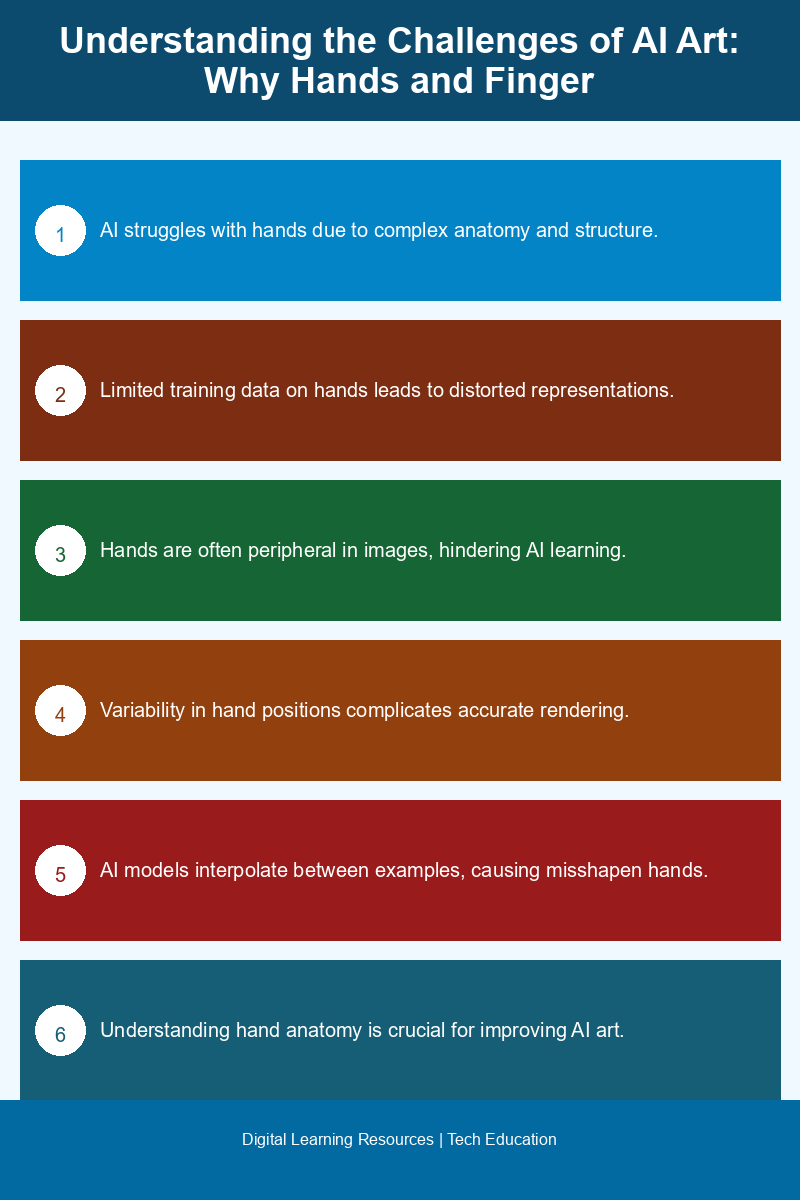
Visual summary of key concepts
Examples of AI’s Hand-Rendering Failures
Several notable examples illustrate the peculiarities of AI-generated hands. In a widely circulated AI-generated image of former President Donald Trump being arrested, the hand of a police officer appears to melt into Trump’s body, creating a surreal and unsettling effect. This phenomenon highlights the AI’s struggle to accurately render hands in a way that aligns with human anatomy.
Another example comes from a purported image of an “extreme sunburn competition,” where a competitor’s fingers appear drastically distorted, failing to represent basic anatomical structure. Such images often serve as a reminder of the artificial nature of AI-generated content, showcasing how the technology, while impressive in many respects, still grapples with fundamental challenges.
What Some Users Appreciate About AI-Generated Hands
Interestingly, some users have begun to appreciate the quirks of AI-generated hands. Rather than viewing the distortions as flaws, they see them as distinctive features that highlight the artificiality of the images. This perspective can foster a sense of creativity, prompting artists and technologists to explore the boundaries of AI art and what it means to create in a digital space.
These unique characteristics can even inspire new artistic directions. For instance, artists may choose to embrace the oddities of AI-generated hands in their work, using them as a springboard for innovation and exploration. The conversation around these quirks can encourage a deeper understanding of both the technology itself and the nature of artistic representation.
Conclusion
The challenges of generating realistic hands and fingers in AI art stem from various factors, including the complex anatomy of hands, the limitations of AI perception, and the training data available to these systems. While AI continues to evolve, the peculiarities of its outputs serve as a reminder of its current limitations. As technology advances, so too will the potential for more accurate representations, but for now, the quirks of AI-generated hands remain a fascinating aspect of this rapidly developing field.
Frequently Asked Questions
Why does AI art screw up hands and fingers?
AI art often struggles with rendering hands and fingers due to the complexity and variability of human anatomy, which can lead to inconsistencies in shape and proportion. Additionally, training data may lack sufficient examples of hands, causing the AI to generate distorted or unrealistic representations.
What are some common AI art challenges?
Common AI art challenges include difficulties with perspective, proportions, and intricate details like hands and facial features. These challenges arise from the limitations of the algorithms and the quality of the training data used.
Does AI have perception issues when rendering fingers?
Yes, AI can have perception issues when rendering fingers due to the lack of contextual understanding and the intricate nature of finger positioning and movement. This often results in awkward angles or unnatural poses in generated images.
Can AI art tools improve the rendering of hands?
Some AI art tools are incorporating advanced algorithms and more diverse training datasets to improve the rendering of hands, but challenges still remain. Continuous updates and user feedback are helping these tools evolve and produce better results over time.
When will AI art be able to accurately depict hands and fingers?
While progress is being made, accurately depicting hands and fingers in AI art is still a work in progress. As AI technology advances and more comprehensive datasets are developed, we can expect improvements in this area in the coming years.
Disclaimer: Information gathered from reputed public sources. Verify independently for specific implementations.
Ready to advance your skills? Explore our digital learning resources.
Related reading:
📑 About the author: I also build Digital Bizz Card — hosted digital business cards you can share with a QR code, no app required.