A context window in AI, particularly in Large Language Models (LLMs), defines the number of tokens a model can process in a single pass. For instance, a model with a context window of 3000 tokens can analyze and generate responses based on 3000 tokens of input at once. This capability is crucial for retaining context and producing coherent, relevant outputs. This article delves into the significance of context windows, how they function, and their impact on AI responses.
What is a Context Window?
The context window serves as the model’s working memory. It determines how much textual information the model can consider when generating responses. Tokens refer to units of text, which can be as short as one character or as long as one word, depending on the language and the specific tokenization process used. In practical terms, if an LLM has a context window of 3000 tokens, it can take into account the current query and all preceding text within that limit to generate a response.
When a query is made to an LLM, it processes the current input alongside the previous conversation history. However, if the conversation exceeds the context window limit, any text beyond that threshold is disregarded. This limitation can have significant implications for the quality and relevance of the AI’s output.
The Importance of Context Windows in NLP
In natural language processing (NLP), the context window is critical for understanding and generating human-like text. A larger context window allows the model to retain more information, leading to improved understanding and response generation. This is particularly important in scenarios where context is essential for clarity. For example, in a conversation about a complex topic, retaining previous statements is vital for producing relevant and coherent responses.
Conversely, a smaller context window can severely limit the AI’s ability to maintain context. This limitation can result in random or confusing answers, as the model may not have enough information to generate a coherent response. For instance, if a user asks a follow-up question that relies on earlier context that has been cut off due to a small context window, the model might generate a response that appears disconnected or irrelevant.
Examples of Context Window Impact
To illustrate the importance of context windows, consider a scenario involving a dialogue about a book. If a user discusses the plot of a novel and then asks a question about a character’s motivation, a model with a sufficient context window will recall previous statements about the plot and provide a nuanced answer. However, if the model’s context window is too small and it cannot retain the necessary details, it may struggle to answer accurately, leading to a disjointed conversation.
📊 Key Learning Points Infographic
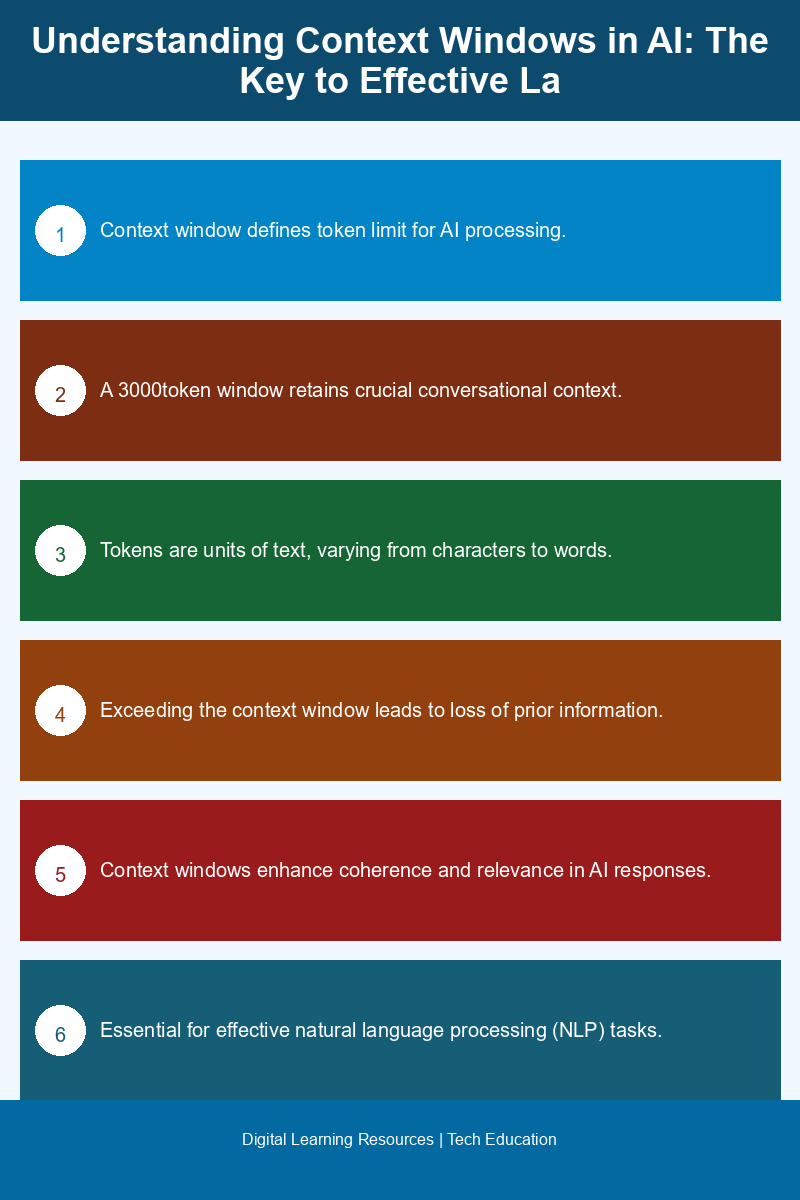
Visual summary of key concepts
Furthermore, in applications such as chatbots or virtual assistants, maintaining context over a conversation is paramount. For instance, if a user is booking a flight and mentions preferences for departure times or airlines, a larger context window allows the model to consider these preferences when making recommendations. In contrast, a limited context window may cause the model to forget important details, resulting in irrelevant suggestions or repeated questions.
Future Developments and Trends in Context Windows
As AI technology continues to evolve, the size of context windows in LLMs is also expected to increase. Researchers are constantly exploring ways to enhance model architectures, allowing for larger context windows without compromising performance. This advancement could significantly improve the capabilities of AI in various applications, from customer support to creative writing.
Moreover, the growing demand for more sophisticated AI interactions will likely drive the development of models capable of handling more complex queries and longer conversations. As context windows expand, we can anticipate improvements in the coherence and relevance of AI-generated responses, leading to more effective communication between humans and machines.
In conclusion, the context window is a fundamental aspect of LLMs, playing a crucial role in the model’s ability to process and respond to input effectively. Understanding how context windows work and their implications can help developers make informed decisions when designing AI applications, ultimately leading to better user experiences and more reliable output.
Frequently Asked Questions
What is a context window in AI?
A context window in AI refers to the amount of text or data that a language model, such as an LLM, can consider at one time when generating responses. This window determines how much relevant information the model can utilize to understand context and produce coherent outputs.
Why is the context window important in LLMs?
The context window is crucial in LLMs because it directly influences the quality and relevance of the AI responses. A larger context window allows the model to incorporate more information, leading to better understanding and generation of text that aligns with user intent.
How does the context window affect natural language processing?
The context window affects natural language processing by limiting or enhancing the model’s ability to grasp the nuances of language based on the input provided. A well-defined context window enables more accurate interpretations and responses, improving overall communication effectiveness.
Can a context window size be changed in AI models?
Yes, the context window size can be adjusted in AI models, but it often requires retraining or fine-tuning the model to optimize performance with the new configuration. Adjusting the size can help balance computational efficiency and response quality.
Does a larger context window always improve AI responses?
A larger context window does not always guarantee better AI responses; while it can provide more context, it may also introduce noise or irrelevant information if not managed properly. The effectiveness of a context window is determined by how well the model processes and prioritizes the information within it.
Disclaimer: Information gathered from reputed public sources. Verify independently for specific implementations.
Ready to advance your skills? Explore our digital learning resources.
Related reading:
📑 About the author: I also build Digital Bizz Card — hosted digital business cards you can share with a QR code, no app required.