AI Concepts Explained
Understanding Embeddings in AI: A Simple Explanation
Discover how embeddings transform text into numbers in AI, enabling machines to understand and interpret data like humans for various applications.
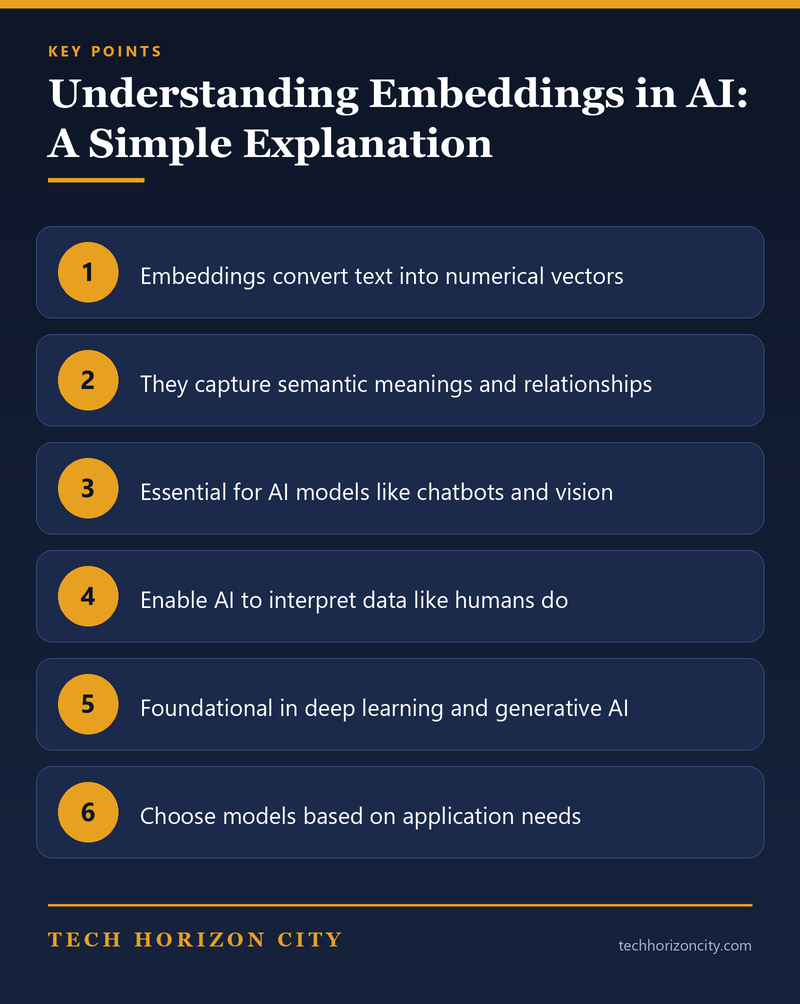
In short Embeddings in artificial intelligence (AI) refer to the numerical representations of real-world objects, enabling AI systems to interpret complex knowledge domains in ways similar to human understanding. These embeddings capture the inherent properties and relationships within data, playing a crucial role in deep learning and generative AI applications.
Contents
How Text Becomes NumbersWhere Embeddings Are UsedHow to Choose an Embedding ModelFrequently Asked QuestionsFrom computer vision models to AI chatbots and recommender systems, embeddings are a foundational component in the accurate development and deployment of AI models. This blog post delves into how text becomes numbers, where embeddings are used, and how to choose an embedding model.
How Text Becomes Numbers
In AI, the transformation of text into numbers is essential because machine learning models operate on numerical data. This transformation is achieved through a process called “embedding,” where each word or phrase in a given text is mapped to a vector in a continuous vector space. These vectors are not random; they are designed to capture semantic meanings and relationships between words. For example, in a well-trained embedding space, the vector for “king” might be close to “queen,” and “Paris” might be close to “France.” Such embeddings are typically developed through training on large text corpora, where the model learns patterns and relationships in the data.
Common techniques for generating these embeddings include Word2Vec, GloVe, and FastText. These methods involve training neural networks to predict context words from target words (or vice versa), thereby learning the numerical representations of words. The result is a dense vector, often of a lower dimensionality than the original text data, which succinctly captures the context and meaning of the words.
Where Embeddings Are Used
Embeddings are ubiquitous in AI applications, serving as the backbone for various advanced models. In computer vision, embeddings are used to represent images in a numerical format that models can process to recognize patterns and objects. For example, convolutional neural networks (CNNs) utilize embeddings to classify images by learning the spatial hierarchies of features.
In natural language processing (NLP), embeddings are crucial for tasks like sentiment analysis, translation, and text summarization. AI chatbots leverage embeddings to understand and generate human-like responses. Similarly, recommender systems use embeddings to capture the preferences of users and the attributes of items, enabling personalized recommendations. This is particularly evident in platforms like Netflix or Spotify, where user-item interactions are mapped into a shared embedding space to predict user preferences effectively.
How to Choose an Embedding Model
Choosing an appropriate embedding model depends on several factors, including the type of data, the complexity of the task, and the computational resources available. For instance, if working with text data, Word2Vec might be suitable for capturing semantic meanings in a straightforward application. However, for more nuanced understanding, BERT (Bidirectional Encoder Representations from Transformers) or GPT (Generative Pre-trained Transformer) models might be more appropriate due to their ability to consider context more deeply.
For image data, the choice might involve selecting between pre-trained models like ResNet or VGG that offer robust embeddings for image classification and object detection tasks. It’s also important to consider the scale of the dataset and the trade-off between model complexity and interpretability. Simpler models might suffice for smaller datasets or less complex tasks, whereas more complex models could be necessary for large-scale or highly nuanced applications.
Additionally, the choice of embedding model might be influenced by the need for real-time processing and the availability of computational resources. Some models require significant computation power, which might not be feasible for all applications. Therefore, balancing performance with resource availability is crucial when selecting an embedding model.
In conclusion, embeddings are a powerful tool in the AI toolkit, transforming how machines understand and interact with real-world data. By converting complex data into numerical vectors, embeddings enable AI systems to process information in a way that mimics human understanding, facilitating advancements across various domains, from language processing to visual recognition. Understanding the process of creating and choosing embeddings is essential for developing effective AI models that can operate efficiently and accurately in real-world scenarios.
Frequently Asked Questions
What are AI embeddings explained simply?
AI embeddings are a way to convert words or phrases into numerical vectors, allowing computers to understand and process human language more effectively.
How does Word2Vec work in AI embeddings?
Word2Vec works by training a neural network to predict a word based on its context, producing word embeddings that capture the semantic meaning of words in a continuous vector space.
What is the difference between GloVe and FastText embeddings?
GloVe creates embeddings by aggregating global word-word co-occurrence statistics from a corpus, while FastText considers subword information, which helps in understanding rare and misspelled words.
Why are embeddings important in converting text to numbers?
Embeddings are crucial because they translate text into numerical form, enabling machine learning models to analyze and derive insights from textual data.
Can AI embeddings improve natural language processing tasks?
Yes, AI embeddings enhance natural language processing tasks by providing rich semantic representations of words, improving the performance of tasks like sentiment analysis, translation, and information retrieval.
Ready to advance your skills? Explore our digital learning resources.
Keep reading
Details such as prices, limits and version behaviour change often. Check the provider’s own documentation before relying on them.