Retrieval-Augmented Generation (RAG) is a cutting-edge AI process that enhances the performance of large language models (LLMs) by enabling them to access and reference external knowledge bases before generating responses. This approach optimizes the output of LLMs, ensuring that the information provided is not only relevant but also accurate, thereby addressing the limitations of models trained solely on static datasets.
How RAG Works with Large Language Models
Large language models like OpenAI’s GPT-3 or Google’s BERT are trained on extensive datasets, utilizing billions of parameters to perform tasks such as answering questions, translating languages, and generating text. However, these models are limited by the data they were trained on, which can lead to outdated or incorrect information. RAG addresses this issue by integrating a retrieval mechanism into the generative process.
In a typical RAG framework, when a user poses a query, the system first retrieves relevant information from an authoritative knowledge source, such as databases, documents, or other structured data repositories. This information is then fed into the LLM, which generates a response that is informed by the retrieved data. This dual-process not only improves the quality of the output but also allows for dynamic updates to the knowledge base without retraining the entire model.
The Purpose and Benefits of RAG
The primary purpose of Retrieval-Augmented Generation is to extend the capabilities of large language models by incorporating current and relevant data into their output. This has several significant benefits:
- Enhanced Accuracy: By referencing authoritative sources, RAG improves the accuracy of the information provided by LLMs, making them more reliable for users.
- Greater Control for Organizations: Organizations can tailor the information generated by specifying which knowledge bases to use, allowing for more relevant and contextually appropriate responses.
- Increased Transparency: Users can gain insights into how the LLM generates responses, as RAG can provide information on the sources used, enhancing trust in the system.
- Cost-effective Implementation: RAG allows organizations to present accurate information with source attribution without the need for extensive retraining of models.
Implementing RAG: A Practical Approach for Developers
For developers looking to implement RAG in their applications, several key steps can be followed to ensure effective integration:
- Selecting the Knowledge Base: Choose authoritative and relevant sources that will serve as the foundation for the retrieval process. This could include databases, academic journals, or curated content repositories.
- Integrating Retrieval Systems: Utilize existing retrieval algorithms or build custom solutions to fetch relevant data based on user queries. Tools like Elasticsearch or Apache Solr can be effective in indexing and retrieving information quickly.
- Connecting with LLMs: Once relevant data is retrieved, integrate it with the LLM. This typically involves using APIs or SDKs from AI platforms like AWS, Google Cloud, or OpenAI to facilitate communication between the retrieval system and the language model.
- Testing and Optimization: Continuously test the RAG system for accuracy and relevance, fine-tuning the retrieval parameters and sources as necessary to improve output quality.
By following these steps, developers can leverage RAG to enhance the capabilities of their applications, providing users with more accurate and contextually relevant information.
📊 Key Learning Points Infographic
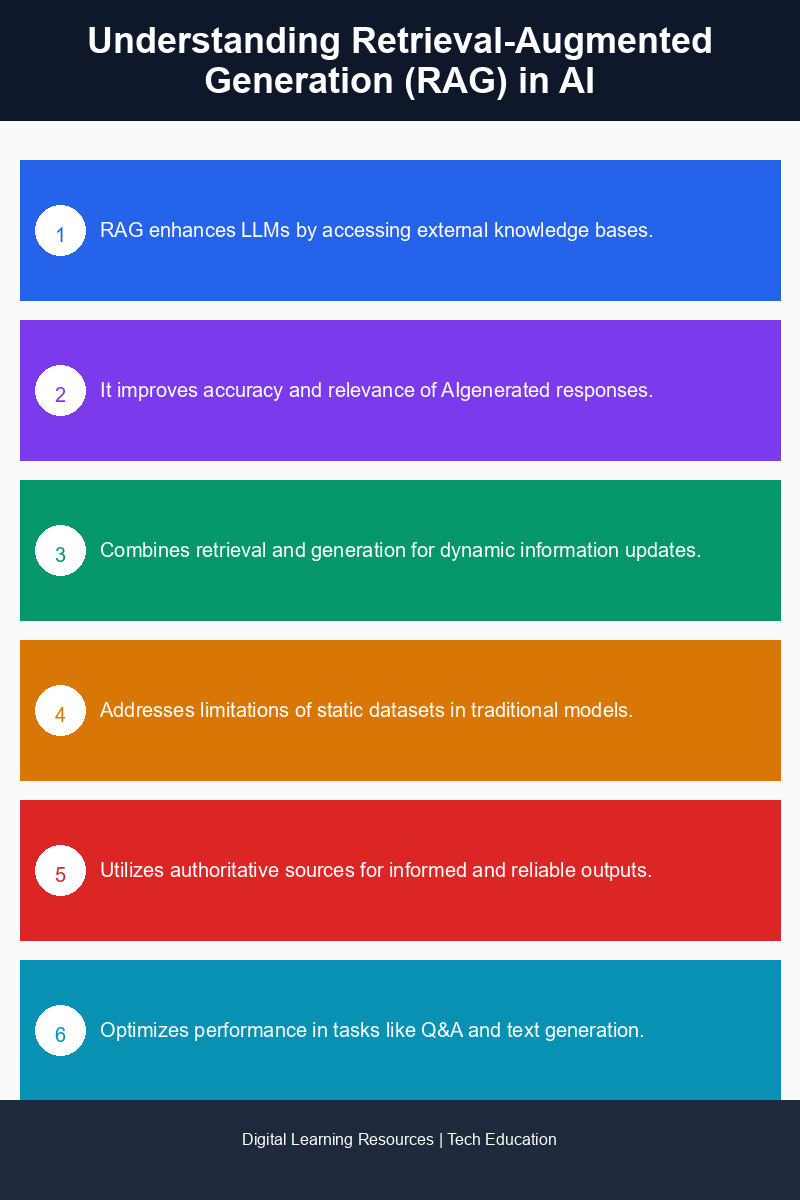
Visual summary of key concepts
Conclusion
Retrieval-Augmented Generation represents a significant advancement in the field of artificial intelligence by merging the strengths of large language models with the precision of external knowledge bases. This innovative approach not only enhances the relevance and accuracy of generated responses but also provides users and organizations with greater control and transparency. As AI continues to evolve, understanding and implementing RAG will be essential for developers aiming to create more effective and trustworthy AI solutions.
Frequently Asked Questions
What is Retrieval-Augmented Generation in AI technology?
Retrieval-Augmented Generation (RAG) is an AI framework that combines the capabilities of large language models with information retrieval systems. This approach enhances the generation of text by allowing the model to pull in relevant information from external sources, improving accuracy and context.
How does RAG improve large language models?
RAG improves large language models by integrating real-time data retrieval, enabling the model to access and incorporate up-to-date information from various databases. This results in more informed responses and reduces the likelihood of generating outdated or incorrect content.
Why is information retrieval important in AI applications?
Information retrieval is crucial in AI applications because it allows models to access a vast array of knowledge beyond their training data. This capability enhances the relevance and richness of generated content, making AI responses more reliable and contextually appropriate.
Can RAG be used for enhancing search engines?
Yes, RAG can significantly enhance search engines by providing more accurate and contextually relevant results. By leveraging retrieval techniques alongside language generation, search engines can offer users more comprehensive answers that integrate real-time data.
When should I consider using RAG in my AI projects?
Consider using RAG in your AI projects when you need to generate content that requires up-to-date information or when accuracy is critical. This approach is particularly beneficial for applications in research, customer support, and content creation where current data is essential.
Disclaimer: Information gathered from reputed public sources. Verify independently for specific implementations.
Ready to advance your skills? Explore our digital learning resources.
Related reading:
📑 About the author: I also build Digital Bizz Card — hosted digital business cards you can share with a QR code, no app required.