AI Concepts Explained
Understanding Quantization in Large Language Models: An In-Depth Guide
Discover how quantization in large language models boosts efficiency by converting data types, balancing speed with accuracy in AI applications.
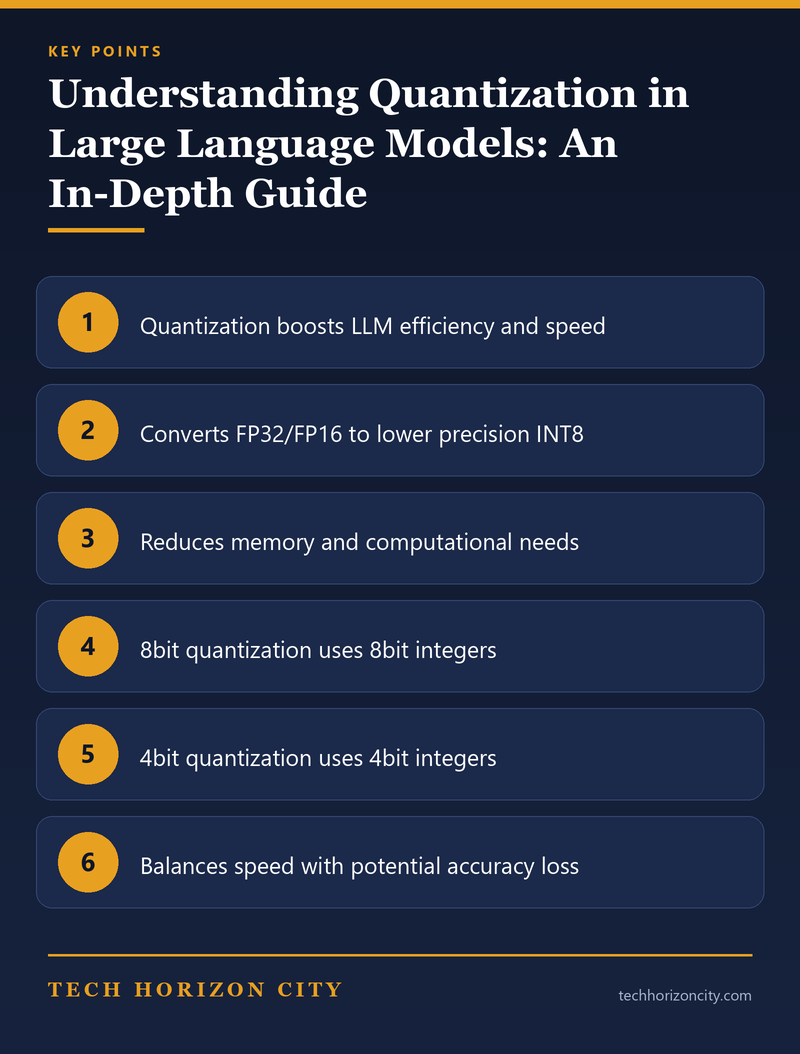
In short Quantization in large language models (LLMs) is a technique that converts high precision data types, such as FP32 (32-bit floating point) or FP16 (16-bit floating point), into lower precision formats like INT8 (8-bit integers). This conversion reduces computational requirements and increases inference speed, making LLMs more efficient to operate.
Contents
What 4-bit and 8-bit MeanQuality Versus Speed Trade-offsWhen to Use QuantizationConclusionFrequently Asked QuestionsHowever, it also introduces a trade-off between model quality and speed.
What 4-bit and 8-bit Mean
In the context of quantization, 4-bit and 8-bit refer to the precision levels of the data types used to represent model weights and activations. An 8-bit quantization uses integers that are 8 bits long, while 4-bit quantization employs integers that are only 4 bits long. This reduction in bit-width means that the model requires less memory and computational power, significantly speeding up inference times.
For instance, reducing from FP32 to INT8 can lead to a fourfold decrease in memory usage and a corresponding increase in processing speed. The trade-off here is that lower precision can result in a loss of accuracy, as the model’s representation of data is less precise. Nevertheless, for many applications, especially those requiring real-time processing, the speed benefits often outweigh the slight decrease in accuracy.
Quality Versus Speed Trade-offs
When implementing quantization in LLMs, developers face a critical decision: balancing the trade-off between model quality and computational speed. High precision data types like FP32 are associated with higher accuracy because they can represent a wider range of values more precisely. However, operating an LLM with FP32 demands substantial computational resources, which can slow down inference.
Quantization addresses this by reducing precision, thus speeding up inference and lowering resource consumption. The trade-off is that the model may lose some accuracy, which could affect performance in tasks requiring high precision, such as nuanced language understanding. For applications where speed is crucial, like real-time translations or chatbots, the benefits of quantization often outweigh the drawbacks.
When to Use Quantization
Quantization is particularly beneficial in scenarios where computational resources are limited or where fast inference is prioritized over marginal accuracy improvements. It is ideal for deploying LLMs on edge devices, such as smartphones or IoT devices, where hardware constraints make high precision processing impractical.
Moreover, quantization is useful in cloud-based applications where reducing operational costs and improving response times is necessary. In these cases, the reduction in computational load can lead to significant savings in energy and infrastructure costs.
Quantization-aware training (QAT) is another aspect to consider. This technique involves converting model weights during pre-training or fine-tuning, allowing the model to better adapt to the lower precision format. QAT can enhance performance but requires substantial computational power and a representative dataset for training. It is most beneficial when there is ample training data available, as it helps the model maintain accuracy despite the reduced precision.
Conclusion
Quantization in LLMs is a powerful technique that can significantly enhance the efficiency of models by reducing computational requirements and increasing inference speed. While it introduces a trade-off between accuracy and speed, the benefits it offers in terms of reduced resource consumption and faster processing make it a desirable approach for many applications. Understanding when and how to apply quantization, including the use of quantization-aware training, is crucial for developers looking to optimize their models for real-world use.
Frequently Asked Questions
What is quantization in LLMs?
Quantization in LLMs refers to the process of reducing the precision of the model’s weights and activations from higher bit-widths, like 32-bit, to lower ones, such as 8-bit or 4-bit, to decrease model size and improve computational efficiency.
How does 8-bit quantization affect large language models?
8-bit quantization reduces the memory footprint and increases the processing speed of large language models while maintaining a balance between model accuracy and performance.
Why use 4-bit quantization in machine learning models?
4-bit quantization is used to achieve even greater reductions in model size and computational cost, which is beneficial for deploying models on resource-constrained devices, though it may require careful tuning to preserve model accuracy.
Can quantization improve model speed without losing quality?
Yes, quantization can improve model speed by reducing computational demands, and with proper techniques, it can maintain model quality close to the original precision.
Is there a trade-off between model quality and speed in quantization?
There is often a trade-off between model quality and speed in quantization, as reducing bit-width can lead to faster computation but may also result in a slight decrease in model accuracy if not carefully managed.
Ready to advance your skills? Explore our digital learning resources.
Keep reading
Details such as prices, limits and version behaviour change often. Check the provider’s own documentation before relying on them.