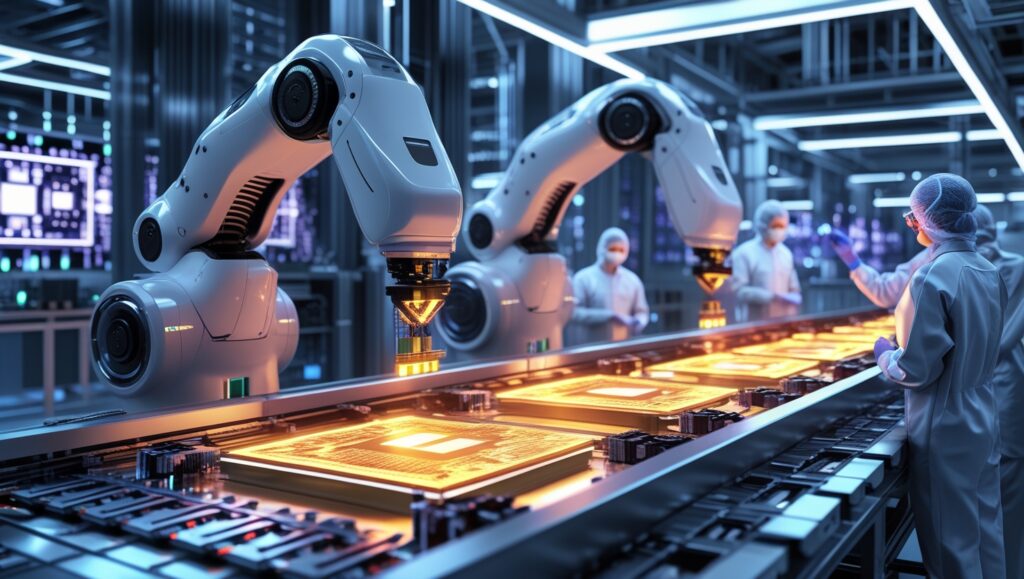
Semiconductor manufacturing sits at the intersection of extreme precision and extreme scale — a single fab runs thousands of interdependent process steps, where a small yield loss compounds into enormous cost. AI is now embedded across this pipeline: in the design tools that plan a chip, in digital twins that simulate the fab itself, and in the predictive maintenance systems keeping equipment running. Here’s how it fits together, from design through production.
Digital Twins: Simulating the Fab Before Touching It
A digital twin in this context is a comprehensive virtual model mirroring an entire fab ecosystem — equipment, processes, environmental conditions, and material flows — enabling real-time monitoring, simulation, and analysis of manufacturing operations without disrupting the physical line. The practical benefits are concrete: better predictive maintenance, improved wafer and packaged-device yield, better scheduling and throughput, and notably, faster ramp-up when bringing a new fab online, since much of the process tuning can happen in simulation first. The real difficulty is that building an accurate digital twin requires mapping the full complexity of a fab’s tools and process flows — a genuinely non-trivial modeling effort, not a plug-and-play deployment.
Predictive Maintenance
AI-driven predictive maintenance deployment has measurably improved equipment uptime — roughly 22% improvement in high-volume production as of 2026, with unplanned downtime projected to decline by nearly 35% across advanced fabs by 2028 as these systems mature. The mechanism: machine learning models trained on sensor data (vibration, temperature, throughput patterns) learn to flag equipment degradation before it causes a failure, replacing fixed maintenance schedules with condition-based ones — servicing equipment when the data indicates it needs it, not on an arbitrary calendar.
Smart Power Management
Beyond individual tool maintenance, digital twins extend to fab-wide energy monitoring, stability, and efficiency — treating power management as a system-level optimization problem rather than tuning equipment in isolation. This matters increasingly as fab energy costs and sustainability commitments both climb; the combination of machine learning, edge AI, and industrial IoT is reshaping predictive maintenance and power management workflows together rather than as separate initiatives.
Where This Connects to Chip Design
The manufacturing-side AI described above closes a loop with design-side AI tools (EDA software from vendors like Synopsys and Cadence) that already predict yield risk before a design is finalized. Wafer defect data and process variation history increasingly feed back into design tools, meaning a design decision can now be informed by real manufacturing outcomes rather than only theoretical models — design and manufacturing AI are converging into one feedback loop rather than remaining separate disciplines.
Automotive and Edge Applications
The push for AI-optimized power management is especially visible in automotive semiconductor design, where chips need to balance performance against strict power and thermal budgets — a discipline that draws directly on the same edge-AI and power-optimization techniques used fab-side, applied instead to the chip’s own operating behavior once deployed in a vehicle.
Frequently Asked Questions
How much investment does a digital twin require for a fab to benefit?
It scales with fab complexity — smaller, targeted digital twins (a single tool or process step) are far more tractable than a full fab model, and many manufacturers start narrow before expanding scope once the approach proves out.
Does predictive maintenance eliminate unplanned downtime entirely?
No — it significantly reduces it by catching degradation before failure, but it’s a reduction in frequency and severity, not a guarantee against all unplanned events.
Conclusion
AI’s role in semiconductor manufacturing now spans digital twins for fab-wide simulation, predictive maintenance that’s measurably cutting downtime, and power management treated as a system-level problem — all increasingly connected back to the design-stage AI tools that plan the chip in the first place. The fabs seeing the biggest gains are the ones treating design and manufacturing AI as one continuous feedback loop.
📑 About the author: I also build Digital Bizz Card — hosted digital business cards you can share with a QR code, no app required.