Retrieval-Augmented Generation (RAG) evaluation is a crucial process in AI development, particularly in enhancing the quality and relevance of generated responses. This evaluation technique focuses on assessing the effectiveness of retrieval systems in providing pertinent information that supports the answers generated by AI models. By implementing a structured RAG evaluation, developers can ensure that their systems not only retrieve relevant documents but also ground their responses in accurate and meaningful data. This article delves into the core aspects of RAG evaluation, its implementation process, and its significance in the development of AI systems.
What is RAG Evaluation?
RAG evaluation is the process of measuring the effectiveness of the RAG pipeline, which combines retrieval and generation in AI models. The main objective is to assess how well the system retrieves relevant documents in response to user queries and how effectively it integrates this information into its generated outputs. By capturing traces of retrieval inputs, retrieved documents, and model outputs, developers can evaluate the quality of the retrieval process and the groundedness of the model’s answers.
To implement RAG evaluation, it is essential to define a set of metrics that measure retrieval quality and answer grounding. This involves assembling a small dataset of real user queries, which can be used to establish benchmarks for evaluating performance. The metrics can include precision, recall, and F1 scores, which provide insights into how well the system is retrieving relevant documents and how accurately the generated answers reflect this information.
Implementing RAG Evaluation
Implementing RAG evaluation requires a systematic approach to capture and analyze retrieval processes. Here are the key steps involved:
- Instrumentation of the RAG Pipeline: The first step is to instrument the RAG pipeline to capture detailed traces of the retrieval inputs, the documents retrieved from the database, and the outputs generated by the AI model. This instrumentation allows developers to track the flow of information and evaluate the effectiveness of each component involved in the process.
- Dataset Assembly: Assemble a dataset containing real user queries. This dataset serves as the foundation for defining metrics that will be used to evaluate retrieval quality and answer grounding. It is crucial that this dataset reflects actual user behavior to ensure relevant evaluation metrics.
- Performance Measurement: Once the dataset is established, developers should consistently measure performance using the defined metrics. This involves analyzing the retrieval results to determine how well the system responds to user queries and how effectively it utilizes retrieved documents in generating answers.
- Conduct Offline Evaluations: Before deploying any changes to the RAG pipeline, it is essential to conduct offline evaluations. This ensures that any modifications made to the system do not negatively affect retrieval quality or answer grounding. By evaluating the system in a controlled environment, developers can identify potential issues and address them before production deployment.
- Sample Production Traffic Scoring: Developers should score sampled production traffic to identify regressions that may occur due to changes in documents, prompts, or models. This ongoing evaluation helps maintain the quality of the system and ensures that it continues to meet user expectations.
The Role of Golden Datasets in RAG Evaluation
Golden datasets play a significant role in RAG evaluation by providing a curated test set that contains known correct answers and relevant documents. These datasets serve as regression tests, allowing developers to detect quality drops before deploying changes to production systems.
By utilizing golden datasets, developers can benchmark the performance of their RAG pipeline against established standards. This benchmarking process not only confirms that the system retrieves the correct documents but also ensures that the generated answers are accurate and relevant. Maintaining a robust set of golden datasets is essential for effective RAG evaluation, as it provides a reliable reference point for ongoing assessments.
📊 Key Learning Points Infographic
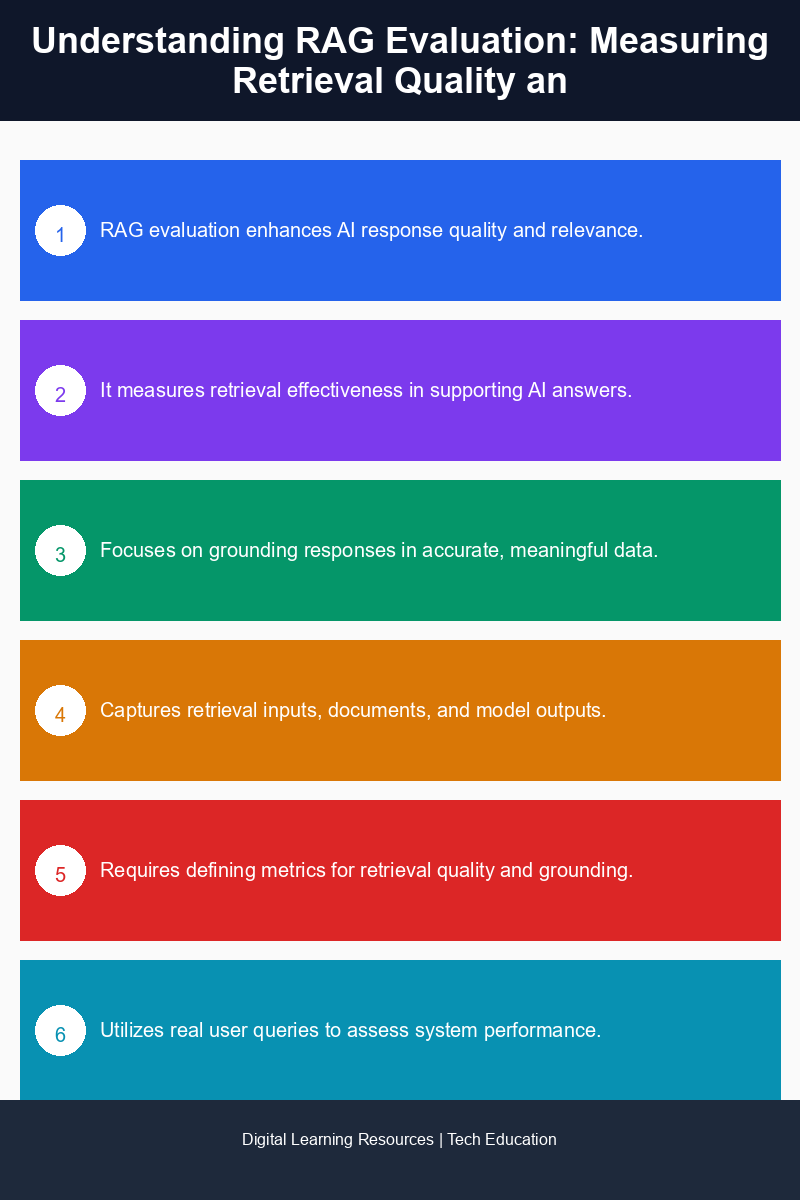
Visual summary of key concepts
Ensuring Visibility and Integration in RAG Evaluation
For effective RAG evaluation, it is crucial to ensure visibility into the retrieval process, model context usage, and scoring at each stage. This visibility allows developers to understand how different components of the RAG pipeline interact and influence the overall performance of the system.
Integrating tracing, scoring, experimentation, and monitoring into a cohesive workflow is essential for measuring retrieval and generation quality. Utilizing platforms like Braintrust can facilitate this integration, enabling developers to streamline the evaluation process. With Braintrust, teams can effectively track the evolution of signals in production, making it easier to identify areas for improvement and maintain high-quality outputs.
In summary, RAG evaluation is a vital component of developing AI systems that rely on retrieval-augmented generation. By systematically measuring retrieval quality and answer groundedness, developers can enhance the effectiveness of their models, ensuring they deliver accurate and relevant responses to user queries. Through the implementation of structured evaluation processes, the use of golden datasets, and effective integration of tools, the potential for continuous improvement in AI systems can be realized.
Frequently Asked Questions
What is RAG evaluation in AI models?
RAG evaluation, or retrieval-augmented generation evaluation, assesses how effectively AI models retrieve relevant information and generate accurate responses based on that information.
How do you measure retrieval quality in RAG evaluation?
Retrieval quality in RAG evaluation is measured using performance metrics such as precision, recall, and F1 score, which quantify how well the model retrieves relevant documents or data from a given dataset.
Why is answer groundedness important in RAG evaluation?
Answer groundedness is crucial because it ensures that the generated responses are not only relevant but also factually supported by the retrieved documents, enhancing the reliability of the AI’s output.
Can RAG evaluation improve the performance of AI models?
Yes, RAG evaluation can significantly improve the performance of AI models by identifying weaknesses in retrieval processes and guiding adjustments to enhance the accuracy and relevance of generated answers.
When should you implement RAG evaluation in AI development?
RAG evaluation should be implemented during the development and testing phases of AI models, particularly when integrating retrieval mechanisms to ensure that the generated content is both accurate and contextually relevant.
Disclaimer: Information gathered from reputed public sources. Verify independently for specific implementations.
Ready to advance your skills? Explore our digital learning resources.
Related reading:
📑 About the author: I also build Digital Bizz Card — hosted digital business cards you can share with a QR code, no app required.