When choosing embeddings for Retrieval-Augmented Generation (RAG) systems, developers face a crucial decision between utilizing OpenAI’s models and open-source alternatives. OpenAI’s large model stands out with an impressive accuracy of 80.5% in general tasks, while also achieving a remarkable 88.8% in context understanding. In contrast, the highest-performing open-source model, BGE large, only reaches an accuracy of 71.5%. This post evaluates the strengths and weaknesses of both options to guide developers in making an informed choice.
Performance Comparison: Accuracy Metrics
Performance accuracy is a fundamental factor when deciding on embeddings for RAG. The latest results indicate that OpenAI’s models outperform their open-source counterparts significantly. OpenAI’s large model has an overall accuracy of 80.5%, while its smaller model achieves 75.8%. These figures demonstrate the effectiveness of the closed-source model in various scenarios.
On the open-source side, BGE large leads with an accuracy of 71.5%, followed closely by nomic-embed-text at 71%. Although these models are free to use, their performance lags behind OpenAI’s offerings. The significant gap in accuracy means that developers may need to consider the implications of lower performance, especially in applications where precision is critical.
Context Understanding: A Key Differentiator
Context understanding is essential for embeddings used in RAG systems, as it determines how well the model interprets the nuances of language. OpenAI’s large model excels in this area, achieving an accuracy of 88.8%. This high level of context comprehension allows it to capture subtle relationships in text, making it particularly suitable for complex queries.
In comparison, open-source models generally perform with context understanding accuracy between 75% and 78%. While this is respectable, it still falls short of the benchmarks set by OpenAI. Developers looking to build applications that require sophisticated language processing should consider this difference seriously. The larger model’s additional dimensions contribute significantly to its ability to grasp intricate language contexts, which could be a game-changer for applications like chatbots, content generation, and search engines.
Cost and Resource Considerations
Cost is a vital factor when evaluating embedding options. OpenAI provides a tiered pricing structure for its models. For instance, the text-embedding-3-small model costs $0.020 per 1M tokens, while the more capable text-embedding-3-large model is priced at $0.130 per 1M tokens. Depending on the scale of the application, these costs can add up quickly, making budget considerations paramount for developers.
📊 Key Learning Points Infographic
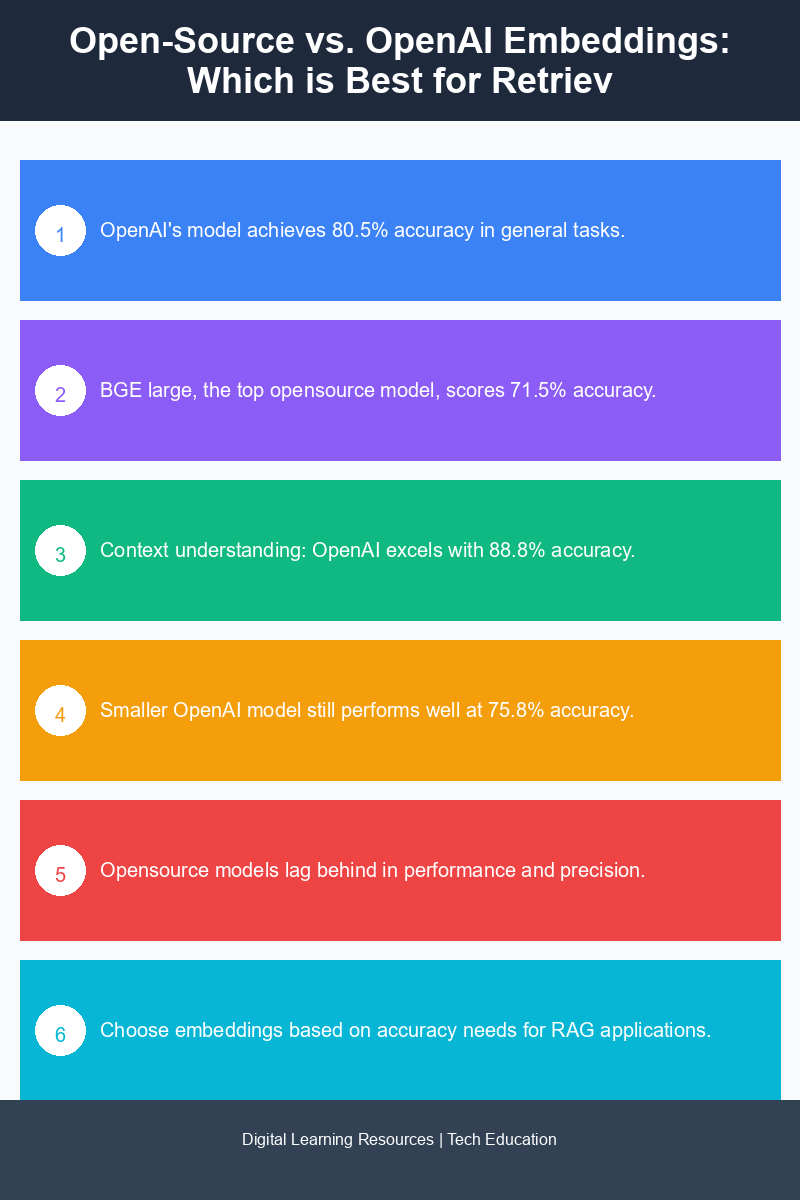
Visual summary of key concepts
On the other hand, open-source models do not come with usage fees. However, they require significant compute resources and time for training and inference. This can translate into hidden costs, as developers must invest in hardware and manage the operational overhead associated with running these models. Therefore, while open-source options seem attractive, the total cost of ownership should be carefully assessed.
Improvement Areas for Open-Source Models
Despite the advantages of cost and flexibility, open-source models still need significant improvements, particularly in context handling. To compete with OpenAI’s models, open-source options like BGE large and nomic-embed-text must enhance their ability to understand context better. Current performance metrics indicate that they fall short, which could limit their effectiveness in real-world applications.
For developers who aim to leverage open-source models, it may be worthwhile to explore techniques that can enhance context understanding. Strategies could include fine-tuning models on domain-specific data, implementing more sophisticated preprocessing techniques, or even combining multiple models to boost performance. This could potentially bridge the gap and make open-source alternatives more competitive against OpenAI’s offerings.
Conclusion
In the battle between open-source and OpenAI embeddings for Retrieval-Augmented Generation, the choice largely hinges on the specific needs of the application. OpenAI’s models offer superior accuracy and context understanding, which are critical for many advanced applications. While open-source models provide a cost-effective option, they currently lag in performance and may require additional resources to achieve comparable results. Ultimately, developers must weigh their priorities—whether it’s performance, cost, or flexibility—before making a decision that best suits their project requirements.
Frequently Asked Questions
How do OpenAI embeddings compare to open-source models for RAG systems?
OpenAI embeddings typically offer advanced context understanding and performance due to their training on large datasets, while open-source models can provide flexibility and customization but may require more tuning to achieve similar results.
What are the advantages of using open-source models in RAG systems?
Open-source models allow for greater control over the implementation, customization to specific use cases, and no licensing fees, making them a cost-effective option for many developers.
Why is context understanding important in RAG systems?
Context understanding is crucial in RAG systems because it enables the model to generate relevant and coherent responses based on the user’s input, enhancing the overall user experience and accuracy of information retrieval.
Can I use OpenAI embeddings in my RAG system?
Yes, you can integrate OpenAI embeddings into your RAG system to leverage their advanced capabilities for improved context understanding and response generation.
When should I choose open-source models over OpenAI embeddings for my project?
Choose open-source models when you need a highly customizable solution, want to avoid ongoing costs, or require specific features that are not available in OpenAI embeddings.
Disclaimer: Information gathered from reputed public sources. Verify independently for specific implementations.
Ready to advance your skills? Explore our digital learning resources.
Related reading:
📑 About the author: I also build Digital Bizz Card — hosted digital business cards you can share with a QR code, no app required.