Multi-tenant Retrieval-Augmented Generation (RAG) systems pose significant data isolation challenges, particularly when it comes to protecting sensitive customer data. Effective data isolation prevents cross-tenant data exposure, ensuring that a search result for one tenant does not inadvertently include data from another. This article delves into the intricacies of multi-tenant RAG data isolation, focusing on architectural patterns, security considerations, and the practical implications for developers looking to implement scalable solutions.
Data Isolation in Multi-Tenant RAG Systems
Data isolation in a multi-tenant RAG architecture is crucial for maintaining confidentiality and compliance. It typically employs cryptographic or logical separation methods to ensure that each tenant’s data remains secure within a shared vector retrieval system. The goal is to build a system where Tenant A’s data is completely segregated from Tenant B’s data, thereby preventing unauthorized access and potential data breaches.
To achieve this level of isolation, developers must adopt robust infrastructure-level controls. These controls enforce strict boundaries around each tenant’s data, ensuring that retrieval processes respect these boundaries during operations. Consequently, a well-architected multi-tenant RAG system becomes primarily a data security challenge rather than just an AI implementation issue.
Cross-Tenant Protection Mechanisms
Cross-tenant protection can be implemented through various mechanisms, including role-based access controls (RBAC) and advanced encryption methods. For instance, RBAC can categorize users and assign permissions based on their tenant affiliation, preventing access to data outside their scope. Encryption at rest and in transit further fortifies this protection by ensuring that even if data is intercepted, it remains unreadable without the appropriate decryption keys.
One effective strategy is to utilize a unique identifier for each tenant that is embedded within the retrieval queries. This identifier ensures that any search or data retrieval operation explicitly checks the tenant context before returning results. Failure to respect this identifier could lead to unintentional data leakage, making it imperative for developers to enforce strict validation rules within their data retrieval pipelines.
Local vs. Production Pipeline Considerations
While creating a retrieval pipeline in a local environment may seem straightforward—especially when using clean and controlled data—the transition to a production environment introduces complexities that demand careful planning. In production, the system must handle multiple enterprise customers, each with sensitive and potentially disparate data sets.
📊 Key Learning Points Infographic
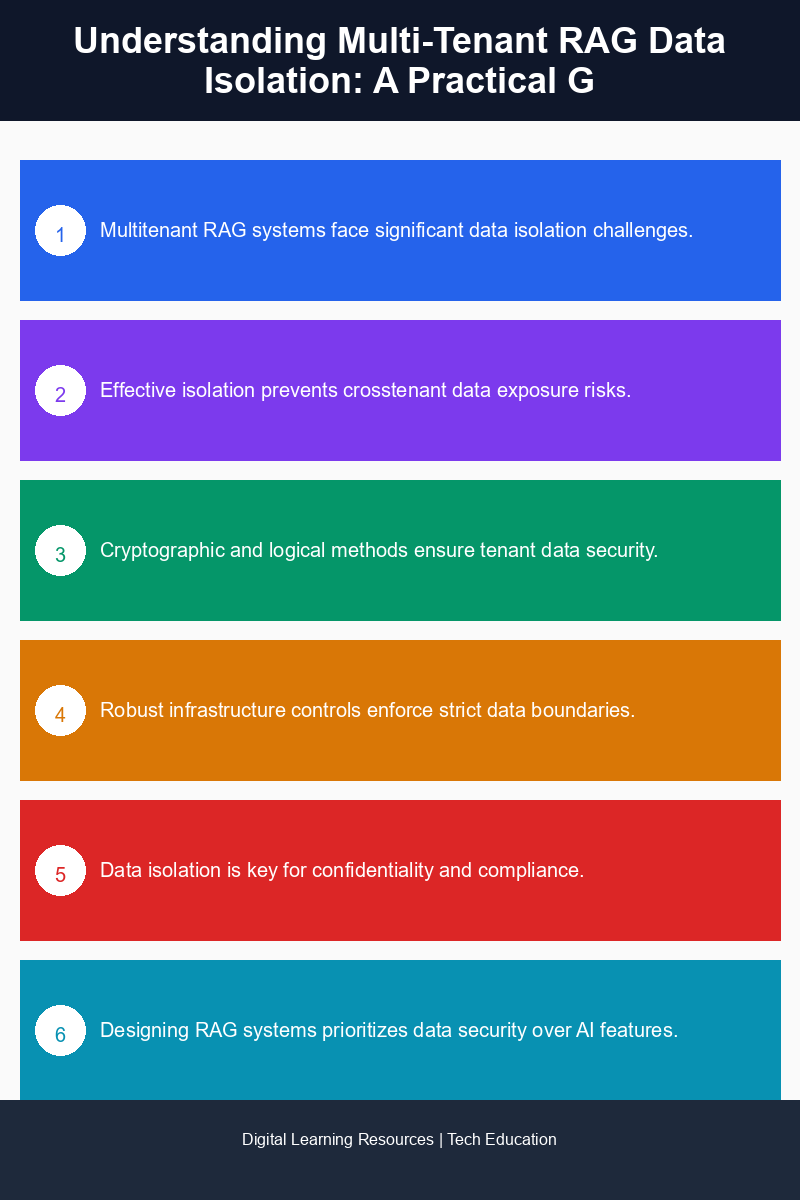
Visual summary of key concepts
Developers must consider factors such as data scaling, system performance, and compliance with data protection regulations. This often involves implementing additional layers of security and testing within the production pipeline to ensure that data isolation protocols are upheld. For example, performance testing should simulate the load of multiple tenants querying the system simultaneously to identify any potential bottlenecks or security vulnerabilities.
Architectural Patterns for Vector Database Isolation
When designing the storage layer for a multi-tenant RAG pipeline, developers typically consider two primary architectural patterns: the Silo pattern and the Pool pattern. Each of these patterns offers distinct advantages and trade-offs that impact data isolation and system performance.
Silo Pattern (Index-per-Tenant)
The Silo pattern, also known as the index-per-tenant approach, involves creating a dedicated vector database index for each customer. This means that each tenant’s data is stored in its own isolated index, providing a straightforward method for achieving data isolation. When a query is executed, the system only accesses the relevant index associated with the specific tenant, thereby inherently preventing cross-tenant data exposure.
While the Silo pattern offers clear advantages in terms of data separation and security, it can lead to scalability challenges. As the number of tenants increases, the system may need to manage a vast number of indices, which can complicate maintenance and increase storage costs. Additionally, updating algorithms or models across multiple indices can be cumbersome, necessitating more sophisticated orchestration mechanisms.
Pool Pattern
In contrast, the Pool pattern utilizes a shared vector database index that serves multiple tenants. This approach can reduce overhead by allowing common data structures and retrieval algorithms to be reused across tenants. However, achieving effective data isolation in this model requires more advanced techniques, such as tagging or attribute-based access controls, to ensure that queries only return data relevant to the requesting tenant.
The Pool pattern can enhance performance and resource efficiency, but it demands a more complex implementation of security measures to avoid data leakage. Developers must implement robust auditing and logging mechanisms to track access and ensure compliance with data protection policies.
Conclusion
Building a multi-tenant RAG application presents unique challenges centered around data isolation and security. By understanding the intricacies of cross-tenant protection mechanisms, the differences between local and production pipelines, and the architectural patterns available for vector database isolation, developers can design systems that effectively safeguard sensitive customer data. As enterprise architecture evolves, prioritizing data security within multi-tenant environments will be essential for maintaining trust and compliance in an increasingly data-driven world.
Frequently Asked Questions
What are the data isolation challenges in multi-tenant RAG environments?
Data isolation challenges in multi-tenant RAG environments include ensuring that data from different tenants is securely separated to prevent unauthorized access and data leakage, as well as managing resource allocation to avoid performance degradation.
How can cross-tenant protection be achieved in a multi-tenant architecture?
Cross-tenant protection can be achieved through robust access controls, data encryption, and regular security audits to ensure that each tenant’s data remains confidential and isolated from others.
When should encryption methods be implemented for multi-tenant RAG systems?
Encryption methods should be implemented during the initial design phase of multi-tenant RAG systems and continuously applied to protect sensitive data at rest and in transit, ensuring compliance with security standards.
Is multi-tenant RAG suitable for all types of businesses?
Multi-tenant RAG is suitable for businesses that require scalable solutions and can benefit from shared resources, but it may not be ideal for those with highly sensitive data or stringent compliance requirements.
Can data isolation be guaranteed in a multi-tenant RAG setup?
While complete data isolation cannot be absolutely guaranteed, implementing strong security measures such as encryption, strict access controls, and regular security assessments can significantly mitigate risks.
Disclaimer: Information gathered from reputed public sources. Verify independently for specific implementations.
Ready to advance your skills? Explore our digital learning resources.
Related reading:
📑 About the author: I also build Digital Bizz Card — hosted digital business cards you can share with a QR code, no app required.