As artificial intelligence continues to evolve, the demand for efficient and effective natural language processing (NLP) solutions has increased significantly. Small Language Models (SLMs) have emerged as a practical alternative to their larger counterparts, offering essential NLP capabilities without the heavy computational requirements of large language models (LLMs). This post delves into the characteristics, advantages, and applications of SLMs, highlighting their importance in resource-constrained environments.
What Are Small Language Models?
Small Language Models are AI models specifically designed to operate efficiently in environments with limited computational resources. These models typically range from 1 million to 10 billion parameters, making them significantly smaller than LLMs, which can feature hundreds of billions to trillions of parameters. Despite their reduced size, SLMs maintain core NLP functionalities such as text generation, summarization, and even basic conversational abilities.
The compact nature of SLMs allows them to be deployed on devices like smartphones, embedded systems, and low-power computers. This is particularly beneficial for applications that do not require the extensive capabilities of LLMs, allowing developers to leverage AI in scenarios where efficiency is key.
📚 Recommended Digital Learning Resources
Take your skills to the next level:
Nclex-RN Exam Prep Flashcards | 800 Cards | All 8 Content Areas | Anki Decks Normal & Cloze | 8 PDF Layouts | RN Licensing Exam
Nclex-RN Exam Prep Flashcards | 800 Cards | All 8 Content Areas | Anki Decks Normal & Cloze | 8 PDF Layouts | RN Licensing Exam
LSAT Flashcard Study System | 800 Cards | 8 Categories | Anki Decks Normal Cloze | 8 PDF Layouts Color Print
LSAT Flashcard Study System | 800 Cards | 8 Categories | Anki Decks Normal Cloze | 8 PDF Layouts Color Print
📊 Key Learning Points Infographic
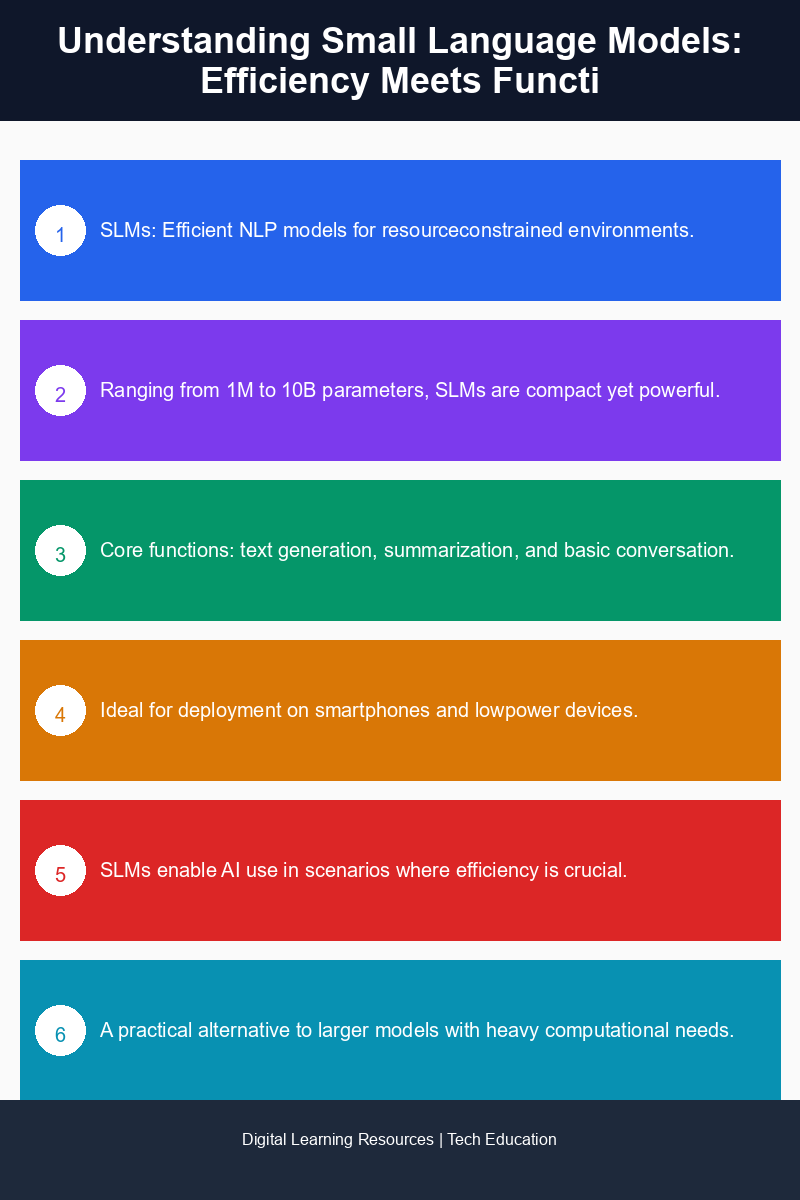
Visual summary of key concepts
GMAT Flashcard Study System | 700 Cards | 8 Categories | Anki Decks Normal Cloze | 8 PDF Layouts Color Print | Offline Interactive HTML
GMAT Flashcard Study System | 700 Cards | 8 Categories | Anki Decks Normal Cloze | 8 PDF Layouts Color Print | Offline Interactive HTML
MCAT Flashcard Study System | 820 Cards | 9 Categories | Anki Decks Normal Cloze | 8 PDF Layouts Color Print | Instant Download
MCAT Flashcard Study System | 820 Cards | 9 Categories | Anki Decks Normal Cloze | 8 PDF Layouts Color Print | Instant Download
PSAT Flashcard Study System | 600 Cards | 9 Categories | Anki Decks Normal Cloze | 8 Pdf Layouts Color Print | PSAT NMSQT Exam Prep
PSAT Flashcard Study System | 600 Cards | 9 Categories | Anki Decks Normal Cloze | 8 Pdf Layouts Color Print | PSAT NMSQT Exam Prep
Key Advantages of SLMs
One of the standout benefits of SLMs is their cost-effectiveness. By eliminating the need for high-end hardware and extensive computational resources, businesses and developers can integrate AI solutions into their products without incurring substantial costs. This accessibility opens up opportunities for smaller companies and individual developers to utilize advanced AI capabilities that were once limited to organizations with significant resources.
Moreover, SLMs offer a personalized approach to AI. Tools like Ollama provide options for fine-tuning these models, allowing developers to tailor the AI’s responses and functionalities to specific use cases. This customization ensures that the AI remains relevant and effective in addressing unique user needs while also enhancing user privacy, as SLMs can often be run locally on devices without needing to rely heavily on cloud-based computations.
Applications of Small Language Models
The versatility of SLMs makes them suitable for various applications. In mobile applications, SLMs can be used for features like chatbots, language translation, and content generation, all while maintaining a low footprint on device resources. For embedded systems, SLMs can enable voice recognition and command processing in smart home devices, wearables, and automotive applications, ensuring that users can interact with technology seamlessly.
In the realm of research, SLMs provide a practical choice for researchers looking to experiment with NLP tasks without the overhead of managing complex infrastructures. They allow for rapid prototyping and testing of ideas, fostering innovation in AI research without requiring extensive computational power.
Challenges and Considerations
While SLMs present numerous advantages, they are not without challenges. The trade-off for their efficiency is often a reduction in the depth and accuracy of the generated content compared to LLMs. This can be particularly noticeable in complex language tasks where nuanced understanding is required. Developers must carefully assess the needs of their applications to determine whether an SLM is sufficient or if the capabilities of an LLM are warranted.
Additionally, as the landscape of AI continues to evolve, so too does the need for ongoing development and support for SLMs. The community around SLMs is growing, with ongoing efforts to improve their capabilities and expand their use cases. Developers should stay updated on advancements and best practices in SLM deployment to maximize their potential.
MyFlashDecks.com
Need Custom Flashcards for Any Exam or Topic?
Get a complete flashcard study system tailored to your exact topic —
800+ cards, an interactive HTML app, 8 PDF layouts, and 2 Anki decks,
all delivered to your email within 24 hours.
HTML App
8 PDF Layouts
2 Anki Decks
Any Exam
From $4.99
In summary, Small Language Models represent a vital segment of the AI landscape, bridging the gap between advanced capabilities and resource limitations. Their efficiency, cost-effectiveness, and adaptability make them an attractive option for various applications, particularly in environments where LLMs may be impractical. As the technology continues to advance, SLMs will likely play an increasingly crucial role in shaping the future of natural language processing.
Disclaimer: Information gathered from reputed public sources.
Verify independently for specific implementations.
Ready to advance your skills?
Explore our digital learning resources.