Artificial Intelligence (AI) is rapidly evolving, and one of the most intriguing advancements is the concept of world models. Unlike traditional AI systems that focus primarily on language and sequential data, world models enable machines to simulate and understand the complexities of physical environments. This blog post explores what world models are, how they function, and their implications in the development of intelligent systems.
What are World Models?
A world model is a sophisticated deep neural network designed to represent and simulate the intricacies of the physical world. It encompasses various elements such as objects, agents, and causal relationships, allowing AI systems to predict how environments evolve over time and how specific actions will impact these environments. This predictive capability is crucial for applications that require an active understanding of dynamic scenarios, enabling machines to generate and interact with coherent virtual worlds.
The essence of world models lies in their ability to learn from the structure, motion, causality, and sensory experiences of reality. Traditional AI models, such as those used in natural language processing, often focus on predicting the next token in a sequence. In contrast, world models prioritize understanding the consequences of actions and the evolution of environments over time. This shift from token prediction to action consequence is a significant leap in creating more intelligent and capable systems.
📚 Recommended Digital Learning Resources
Take your skills to the next level:
Nclex-RN Exam Prep Flashcards | 800 Cards | All 8 Content Areas | Anki Decks Normal & Cloze | 8 PDF Layouts | RN Licensing Exam
Nclex-RN Exam Prep Flashcards | 800 Cards | All 8 Content Areas | Anki Decks Normal & Cloze | 8 PDF Layouts | RN Licensing Exam
LSAT Flashcard Study System | 800 Cards | 8 Categories | Anki Decks Normal Cloze | 8 PDF Layouts Color Print
LSAT Flashcard Study System | 800 Cards | 8 Categories | Anki Decks Normal Cloze | 8 PDF Layouts Color Print
📊 Key Learning Points Infographic
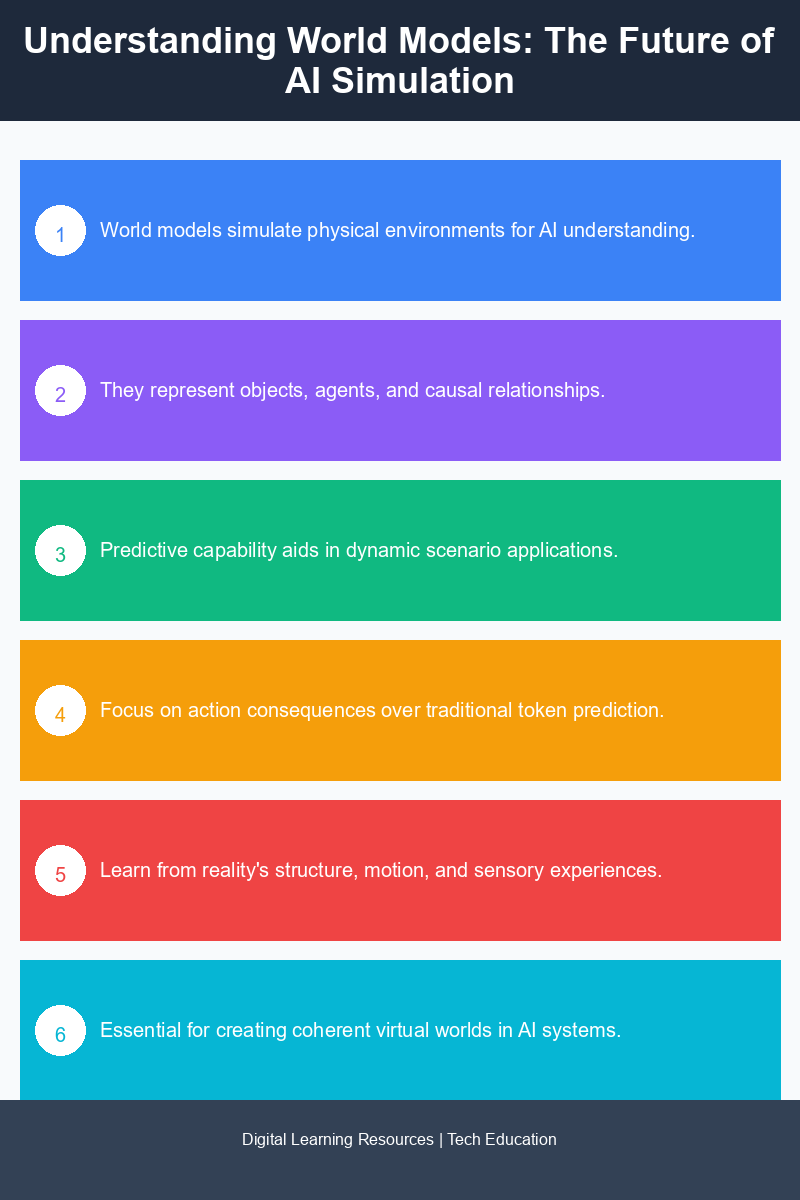
Visual summary of key concepts
GMAT Flashcard Study System | 700 Cards | 8 Categories | Anki Decks Normal Cloze | 8 PDF Layouts Color Print | Offline Interactive HTML
GMAT Flashcard Study System | 700 Cards | 8 Categories | Anki Decks Normal Cloze | 8 PDF Layouts Color Print | Offline Interactive HTML
MCAT Flashcard Study System | 820 Cards | 9 Categories | Anki Decks Normal Cloze | 8 PDF Layouts Color Print | Instant Download
MCAT Flashcard Study System | 820 Cards | 9 Categories | Anki Decks Normal Cloze | 8 PDF Layouts Color Print | Instant Download
PSAT Flashcard Study System | 600 Cards | 9 Categories | Anki Decks Normal Cloze | 8 Pdf Layouts Color Print | PSAT NMSQT Exam Prep
PSAT Flashcard Study System | 600 Cards | 9 Categories | Anki Decks Normal Cloze | 8 Pdf Layouts Color Print | PSAT NMSQT Exam Prep
How Do World Models Work?
World models operate by constructing rich representations of their environments through observation and interaction. This process includes understanding physical dynamics and recognizing how various entities within a space interact with one another. For instance, a world model can simulate a room where objects move and interact based on specific rules, such as gravity or friction.
The process typically involves the following steps:
- Data Collection: The AI system gathers data from the environment, including visual inputs, sensory feedback, and physical interactions.
- Model Training: Using supervised or reinforcement learning techniques, the AI is trained on this data to recognize patterns and causal relationships within the environment.
- Simulation: Once trained, the world model can simulate various scenarios, predicting how changes in the environment or actions taken by agents will lead to different outcomes.
For example, if an AI is placed in a simulated kitchen, it can learn how to interact with objects, such as turning on a stove or opening a refrigerator, by understanding the underlying mechanics of these actions and their consequences. This ability to simulate actions allows for safer and more efficient decision-making in real-world applications, such as robotics or autonomous vehicles.
Applications and Implications of World Models
The implications of world models extend across various domains, from robotics to gaming and beyond. In robotics, world models enable machines to navigate and interact with dynamic environments more effectively. For instance, a robot equipped with a world model can simulate various paths in a warehouse to optimize its delivery route, taking into account obstacles and other moving agents.
In the gaming industry, developers are beginning to leverage world models to create more immersive experiences. By allowing AI characters to understand and predict player actions, games can become more responsive and engaging, providing players with challenges that adapt to their strategies.
Moreover, world models can enhance AI performance in areas like healthcare, where understanding the dynamics of patient interactions and treatment responses can lead to better outcomes. By simulating various treatment pathways, AI can help healthcare professionals make informed decisions based on predicted results.
Challenges and Future Directions
Despite their potential, world models face several challenges. One significant hurdle is the need for vast amounts of observational data to train these models effectively. Most aspects of reality are not documented in written form, making it imperative for systems to learn from direct interactions with the environment. This requirement can complicate the training process and limit the applicability of world models in certain scenarios.
Future developments in world models may focus on improving the efficiency of data collection and enhancing the algorithms used for training. Techniques such as transfer learning, where knowledge gained in one context is applied to another, could play a pivotal role in overcoming these challenges. Additionally, integrating world models with other AI paradigms, such as reinforcement learning, could lead to more sophisticated systems that understand and adapt to complex environments.
MyFlashDecks.com
Need Custom Flashcards for Any Exam or Topic?
Get a complete flashcard study system tailored to your exact topic —
800+ cards, an interactive HTML app, 8 PDF layouts, and 2 Anki decks,
all delivered to your email within 24 hours.
HTML App
8 PDF Layouts
2 Anki Decks
Any Exam
From $4.99
World models represent a significant advancement in AI, bridging the gap between traditional models and the need for a deeper understanding of the physical world. As these systems evolve, they have the potential to transform how we interact with technology and the environments around us.
Disclaimer: Information gathered from reputed public sources.
Verify independently for specific implementations.
Ready to advance your skills?
Explore our digital learning resources.