As quantum computing technology advances, traditional cryptography faces unprecedented threats. Current encryption methods, such as RSA and Elliptic Curve Cryptography (ECC), rely on problems that quantum computers can solve efficiently. This vulnerability highlights the urgent need for robust alternatives: enter post-quantum cryptography (PQC). This article breaks down what PQC is, why it matters, and the diverse mathematical approaches it employs to protect our digital information.
What is Post-Quantum Cryptography?
Post-quantum cryptography refers to a set of cryptographic algorithms that are designed to be secure against the potential threats posed by quantum computers. Unlike classical algorithms, which depend on problems like integer factorization and discrete logarithms, PQC leverages mathematical structures that remain complex even for quantum systems. This shift is not just technical; it represents a fundamental evolution in how we think about securing digital trust.
Vulnerabilities of Traditional Cryptography
The current standards for encryption, including RSA and ECC, are at risk of being broken by quantum algorithms such as Shor’s algorithm. Shor’s algorithm can efficiently factor large integers and compute discrete logarithms, rendering traditional public-key systems vulnerable. As quantum computing technology continues to develop, the timeline for potential attacks on current cryptographic systems shortens, raising critical concerns for developers, organizations, and individuals who rely on secure communications.
📚 Recommended Digital Learning Resources
Take your skills to the next level:
Nclex-RN Exam Prep Flashcards | 800 Cards | All 8 Content Areas | Anki Decks Normal & Cloze | 8 PDF Layouts | RN Licensing Exam
Nclex-RN Exam Prep Flashcards | 800 Cards | All 8 Content Areas | Anki Decks Normal & Cloze | 8 PDF Layouts | RN Licensing Exam
LSAT Flashcard Study System | 800 Cards | 8 Categories | Anki Decks Normal Cloze | 8 PDF Layouts Color Print
LSAT Flashcard Study System | 800 Cards | 8 Categories | Anki Decks Normal Cloze | 8 PDF Layouts Color Print
📊 Key Learning Points Infographic
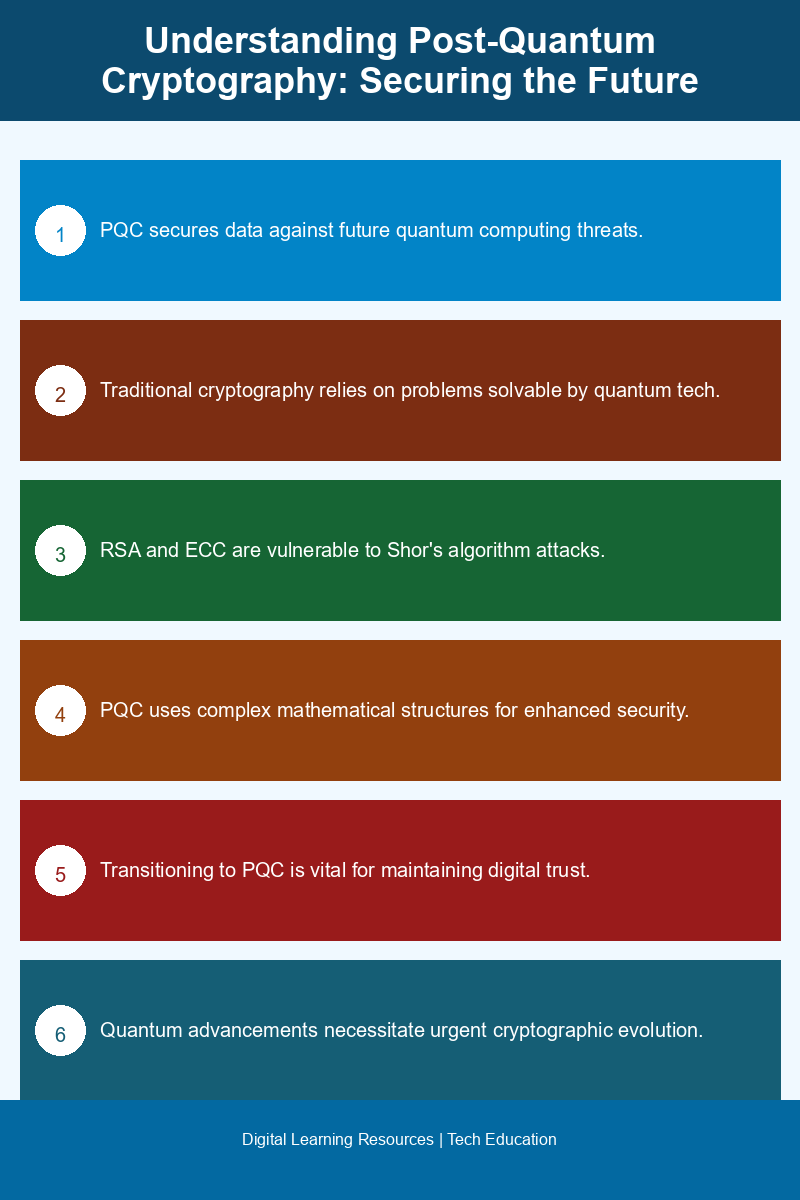
Visual summary of key concepts
GMAT Flashcard Study System | 700 Cards | 8 Categories | Anki Decks Normal Cloze | 8 PDF Layouts Color Print | Offline Interactive HTML
GMAT Flashcard Study System | 700 Cards | 8 Categories | Anki Decks Normal Cloze | 8 PDF Layouts Color Print | Offline Interactive HTML
MCAT Flashcard Study System | 820 Cards | 9 Categories | Anki Decks Normal Cloze | 8 PDF Layouts Color Print | Instant Download
MCAT Flashcard Study System | 820 Cards | 9 Categories | Anki Decks Normal Cloze | 8 PDF Layouts Color Print | Instant Download
PSAT Flashcard Study System | 600 Cards | 9 Categories | Anki Decks Normal Cloze | 8 Pdf Layouts Color Print | PSAT NMSQT Exam Prep
PSAT Flashcard Study System | 600 Cards | 9 Categories | Anki Decks Normal Cloze | 8 Pdf Layouts Color Print | PSAT NMSQT Exam Prep
Mathematical Foundations of Post-Quantum Cryptography
PQC employs alternative mathematical challenges that remain hard for quantum computers, categorized mainly into five families:
- Lattice-based cryptography: This approach relies on the hardness of lattice problems, which are believed to be resistant to quantum attacks. Algorithms like NTRU and Kyber fall into this category.
- Hash-based signatures: Utilizing secure hash functions, these signatures are based on the difficulty of finding collisions in hash functions. Examples include the Merkle signature scheme.
- Multivariate equations: These algorithms leverage the complexity of solving systems of multivariate polynomial equations. The Rainbow signature scheme is a notable example.
- Code-based cryptography: This family relies on error-correcting codes and has been around for decades, with algorithms like McEliece providing practical implementations.
- Isogeny-based cryptography: Utilizing the mathematics of elliptic curves, this approach focuses on the hardness of finding isogenies between them, as seen in the Supersingular Isogeny Key Encapsulation (SIKE).
Each of these families has distinct attributes, making them suitable for different applications and security requirements. For instance, lattice-based cryptography is often favored for its efficiency and scalability, while code-based systems have a long-standing history of practical use.
Building a Secure Algorithm Ecosystem
The development of PQC represents a broader ecosystem of algorithms based on new mathematical problems that resist both classical and quantum attacks. Organizations like the National Institute of Standards and Technology (NIST) have been working on standardizing these algorithms to ensure they’re ready for deployment across various platforms. In 2022, NIST announced the first set of post-quantum cryptographic standards, including four candidates for public-key encryption and key establishment, and three for digital signatures.
This ecosystem is critical for developers as it provides a roadmap for transitioning from vulnerable encryption methods to quantum-resistant solutions. Implementing these new algorithms will require updates in software libraries, protocols, and application frameworks, making it essential for developers to stay informed about these advancements.
Moreover, as organizations begin to adopt PQC, it will be crucial to assess the performance implications. Some algorithms may be slower than their classical counterparts, necessitating optimizations and adaptations in real-world applications.
MyFlashDecks.com
Need Custom Flashcards for Any Exam or Topic?
Get a complete flashcard study system tailored to your exact topic —
800+ cards, an interactive HTML app, 8 PDF layouts, and 2 Anki decks,
all delivered to your email within 24 hours.
HTML App
8 PDF Layouts
2 Anki Decks
Any Exam
From $4.99
Conclusion
Post-quantum cryptography is not just a theoretical concept; it is a necessary evolution in the landscape of digital security. As quantum computing continues to advance, the need for cryptographic methods that can withstand these new capabilities becomes increasingly urgent. Understanding the different mathematical foundations of PQC and their implications for current encryption practices is essential for anyone involved in technology and security. By preparing for a future with quantum computers, we can ensure that our digital communications remain secure and trustworthy.
Disclaimer: Information gathered from reputed public sources.
Verify independently for specific implementations.
Ready to advance your skills?
Explore our digital learning resources.